Trivium remotes

Once a victim is wearing a Trivium Bracelet, any of Orlak’s henchmen can control the wearer’s actions. The victim’s expression is blank, suggesting that their consciousness is either comatose, twilit, or in some sort of locked in state. Their actions are controlled via a handheld remote control.
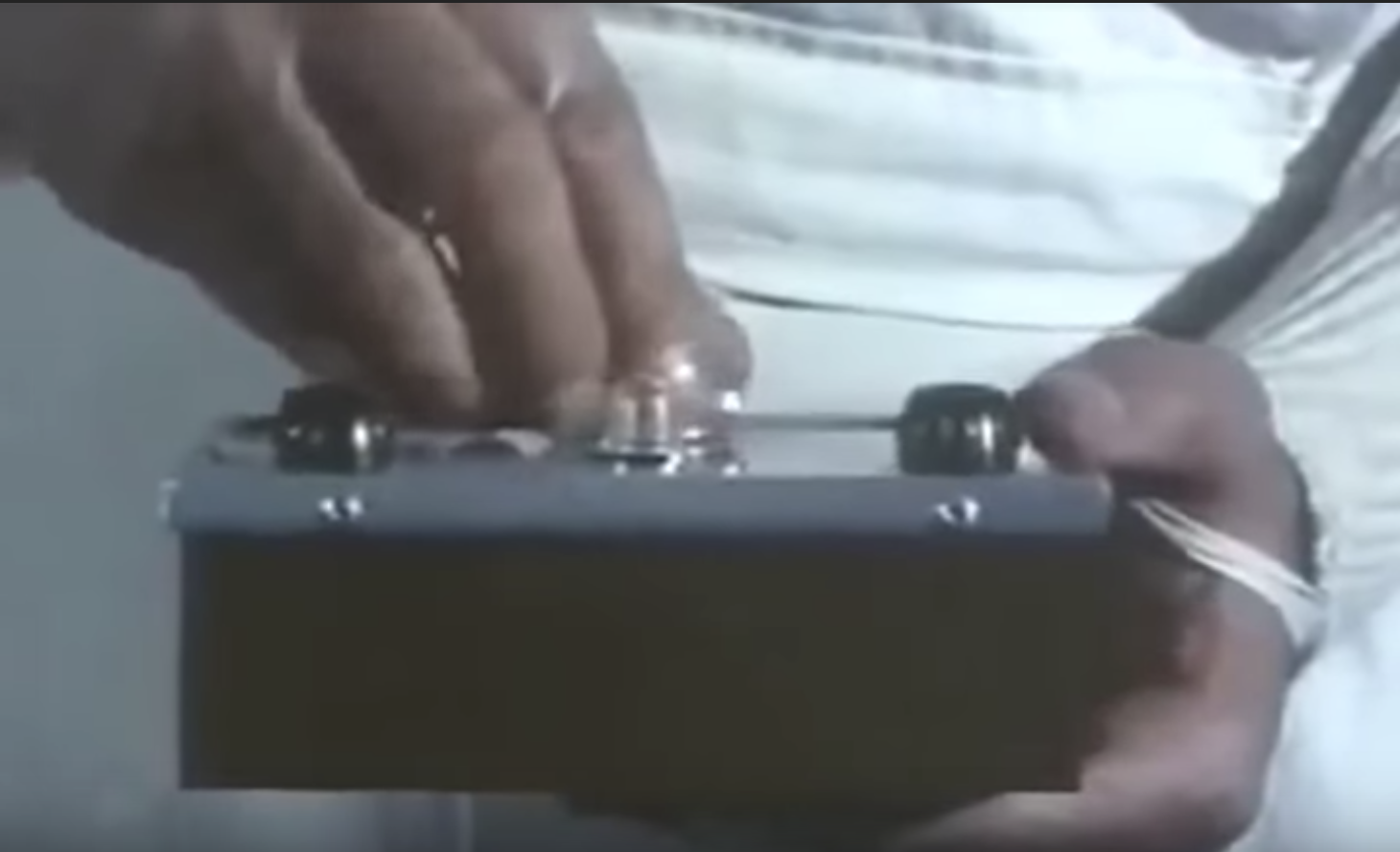
We see the remote control in use in four places in Las Luchadoras vs El Robot Asesino.

  1. One gets clapped on Dr. Chavez to test it.
  2. One goes on Gemma to demonstrate it.
  3. One is removed from the robot.
  4. One goes on Berthe to transform her to Black Electra.

In these examples we see victims are able to be made to walk around, raise their arms, and drop their arms in a karate chop. There is one other function worth mentioning: When Orlak turns one knob really hard, it overloads Dr. Chavez somehow and kills him.

Death at 11?

So this bears an aside. This device is pure fiction of course, and wretched in concept for all the consent and bodily autonomy reasons, but, just to make sure I’m covering my bases here, I should note that “death” should just not be possible by turning a knob up to 11. First off, any moral person wouldn’t want that to happen, and so would engineer the damned thing to avoid it.

But even if you’re Orlak-eque, and want a kill function on your device, “kill” is a categorically different thing than “control.” It shouldn’t just be one end of a dial. It’s too easy to accidentally invoke, and especially for an irrevocable act. There is no “undo” or even “sorry” that works in that circumstance.

If only.

Even if Orlak was just hedging against of the possibility of his winding up in a bracelet, he wouldn’t want his own death to be the result of an oopsie. No, if you’re going to have a function like that, it should require authorization, or at least something like two-hand trip mechanisms, to make sure that this horribleness is, seriously, truly and for real, what the person wants to have happen. OK. Yes? Yes.

But I digress.

Doing the Potentiometer Dance

So the effects that we see are:

  • Walk around
  • Raise arms
  • Karate chop
  • Perform in a wrestling match.

Is it believable that the device can do what the movie shows it doing? Short answer: Maybe, but it’s a stretch.

Here is the beta version used on Dr. Chavez and Gemma, on the floor of the laboratory before Gaby kicks it and everything explodes. This is the clearest view we get of either device.
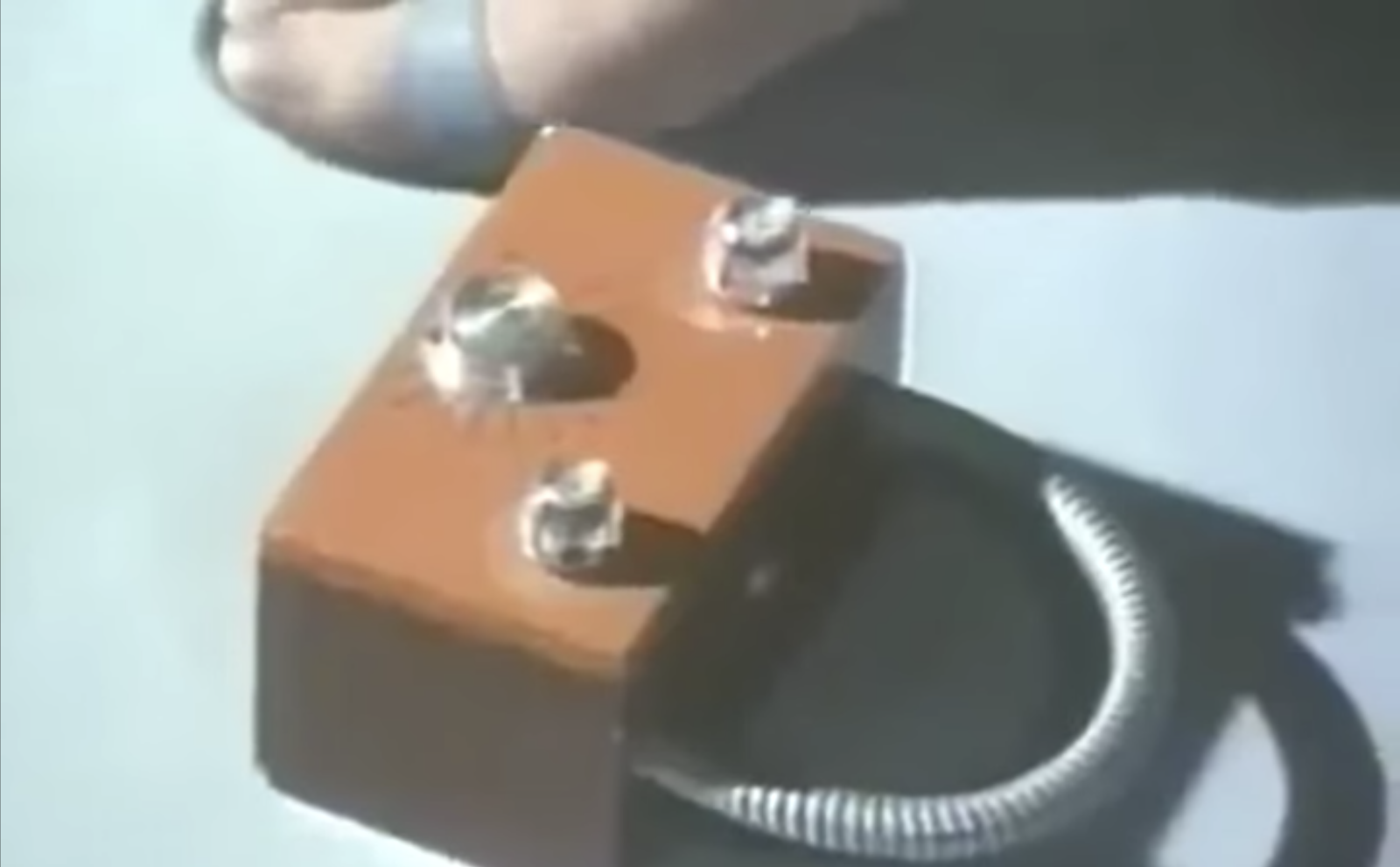
Come on, I know it’s in beta, but no labels?

Both remotes have a rotary switch on the bottom edge and two click-stop potentiometers on the top edge. At first glance, it seems that these controls aren’t enough to manage all the variables that could apply to the actions taken by the victims. Lift arm? OK sure, but which one? Where’s the elbow? What’s the hand position?

But if the victims are in a perfectly-suggestible state—rather than complete automotons—then maybe all he has to specify with the remote is some goal and the degrees of two important variables, leaving everything else up to the human intelligence to interpret and decide to the best of his or her ability.

  • Mode: variable 1 | variable 2
  • Arm lift: left hand height | right hand height
  • Walk around: speed | clockwiseness (even though this befits a toggle switch, it could work here)
  • Karate chop: Force | Palm angle
  • Wrestle: Face | Heel
  • &c

Since it’s custom-coded, Orlak might even have multiple stops on the rotary switch for different inflections of the same mode. For instance, “Try to win match” and “Throw match” allowing different variables that suit each mode applicable within a given match.

Pictured: Botched move mode.

This design strategy leaves a lot up to the intelligence of the victim that isn’t specified by one of the mode/variable combinations, e.g. Which wrestling move should I try next? How do I escape this oncoming chokeslam? But we’re working with a subjugated human intelligence here, and we are used to working to achieve goals under difficult constraints. That’s, like, literally, life. So, if you can accept the speculative technology that controls a victim and passes interpretable instructions to them via a bracelet, then yeah, this remote control passes believability, even if it looks like a high school theater prop.

The prop could be made better by having the modes hand-written along the stops of the rotary switch. And if it was a real product, knowing what the potentiometers controlled in the current mode would save the user from not having to memorize it, or trial-and-error it. But please, let’s not make this thing a real world anything.

The generalizable lesson is that when you are working with an agent of a certain sophistication, your users don’t have to specify everything, just the most important things. The agent can do the rest of the interpretation. (And if not, design a recovery mode.)

Again, not a robot

Note that this bit of apologetics only applies to Orlak’s human victims with their general intelligence. Orlak also has a remote control for the Robot Asesino, but it’s much harder to see how it could not have language, but enough general intelligence to do what it must do with those meager instructions.

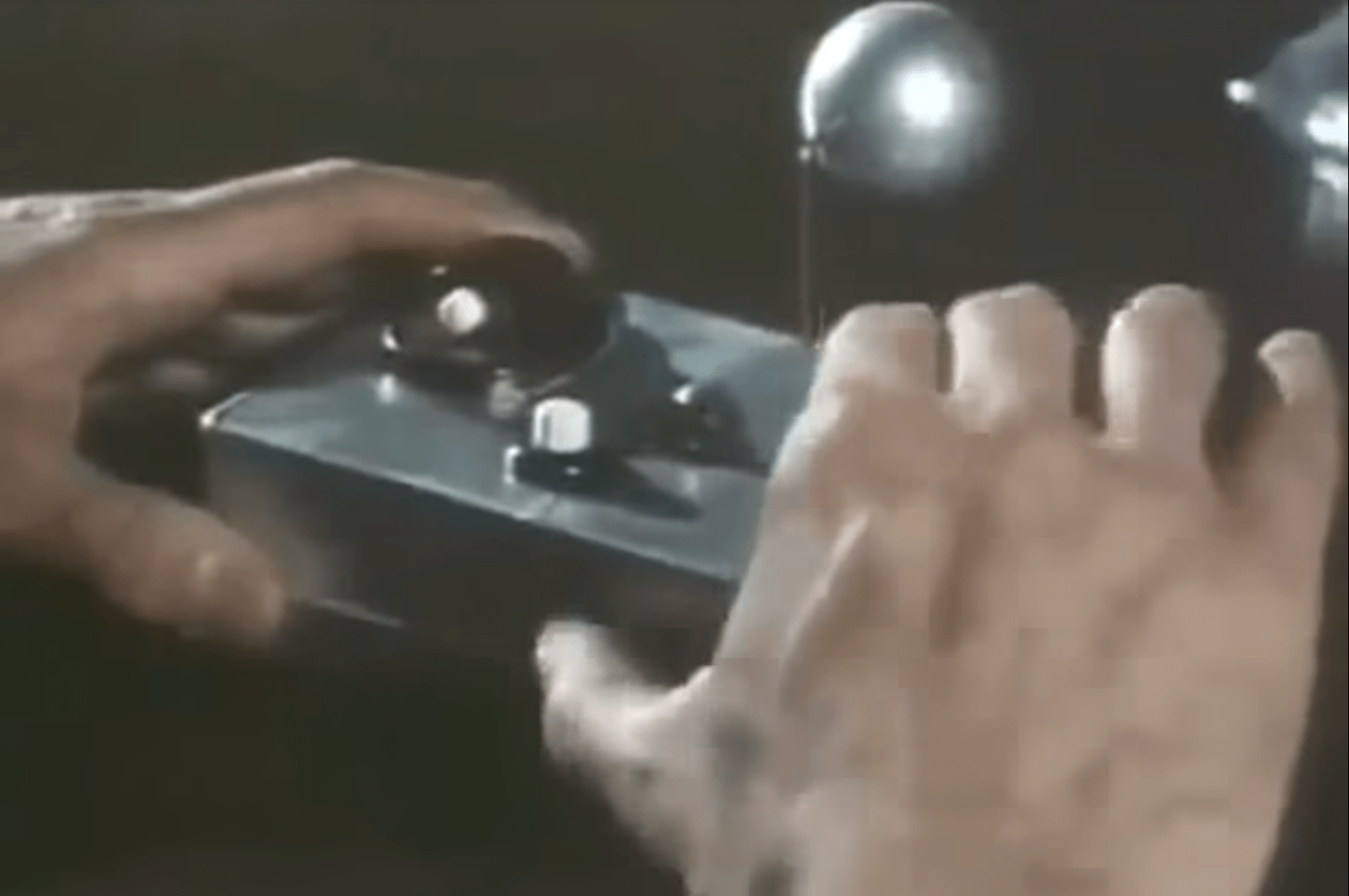
No dials needed

A last note is that the script could have made it so that a remote control was not necessary. If the film had explained that the bracelet puts the subject into a state of passive suggestibility, then Orlak could just rely on his subject’s (and audience’s) familiarity with language, issuing spoken instructions for his automatons to follow, and bypassing the ridiculousness of this interface. But. You know. Then the writers would have to have Gaby save the day through some other means than kicking the remote. And this is not that movie.

Lumpy’s Brilliant Cartoon Player

I am pleased to report that with this post, we are over 50% of the way through this wretched, wretched Holiday Special.

SWHS-Cartoon-Player-07

Description

After Lumpy tries to stop stormtroopers from going upstairs, an Imperial Officer commands Malla to keep him quiet. To do so, she does what any self-respecting mother of a pre-teen in the age of technology does, and sits him down to watch cartoons. The player is a small, yellow device that sits flat on an angled tabletop, like a writing desk.

Two small silver buttons stack vertically on the left, and an upside down plug hole strainer on the right. A video screen sits above these controls. Since no one in the rest of his family wants to hear the cartoon introduction of Boba Fett, he dons a pair of headphones, which are actually kind of stylish in that the earpieces are square and perforated, but not beveled. There are some pointless animations that start up, but then the cartoon starts and Lumpy is, in fact, quiet for the duration. So, OK, point one Malla.

SWHS-Cartoon-Player-08
Why no budding DJ has glommed onto this for an album cover is beyond me.

Analysis

We only see Lumpy press down onto the surface of the device from the far side, so it’s mostly conjecture about how the interface works. The same goes for the media. But we do know the basic needs of video: Start, stop, and volume. And a single click-stop dial could handle all that, even if kind of poorly.

We also don’t know whether the device has media inserts—like a Blu-Ray player—or is more like a television with fixed streams of ongoing content to pick from, or like a Netflix requiring a search of a practically infinite on-demand catalogue. But that sink drain thing looks like it’s meant to be a channel selector, and this was 1978, so let’s presume it was a television model with a few-year prescient Walkman personal-media bent. In fact, there’s a handle visible in the shot posted below, so let’s give this thing some credit for presaging miniaturization to the point of mobility. It must have blown some kids minds back then.

And, sure, this interface could manage the task at hand, even if it’s missing some feedback for exactly which channel is being watched, and what the current volume is or what that second click-stop dial does, or why it has an affordance for turning when Lumpy clearly pushes it.

SWHS-Cartoon-Player-09.png

Apology

What I’m most interested in though is the crappy, crappy production quality of the thing. While it’s easy and admittedly fun to decry this as rushed through the prop department in about 30 minutes, I’m going to use my old friend apologetics to wonder if maybe Lumpy himself put this together. Not like a science fair project, but as an off-the shelf product. Wouldn’t it be awesome to give a kid a blank box with a video screen, let him take any object he found on top of it to use as a control device? A thimble could become the on-off switch. A jack could become the channel selector. A Matchbox car could become the volume control. This would diegetically explain the dopey sink strainer, and give Lumpy an awesome opportunity to think about the affordances of the things around him and the relationships-of-parts he could use to control abstract variables like volume, power, playback speed, etc. Maybe he could even assign objects to favorite videos. This stone in that crayon circle means that video. It would be a dream to foster interaction design thinking.

Sure, you might be thinking, but this would take cameras of an eye-like quality, and perfect image recognition attached to a near general artificial intelligence. Too bad they don’t have anything like that in Star Wars, yeah?

r2d2-and-c3po-star-wars

Of course one imagines such a device might be prohibitively expensive for a smuggler’s Life Day budget, and moreover this is giving the Star Wars Holiday Special waaaaay too much credit, but these are the truffles I actually do hope to find in rooting around all this muck for you.

Also to drop this. Contact me with demos.

DJLumpy.png

Tony Stark is being lied to (by his own creation)

In the last post we discussed some necessary, new terms to have in place for the ongoing deep dive examination of the Iron Man HUD, there’s one last bit of meandering philosophy and fan theory I’d like to propose, that touches on our future relationship with technology.

The Iron Man is not Tony Stark. The Iron Man is JARVIS. Let me explain.

Tony can’t fire weapons like that

vlcsnap-2015-09-15-05h12m45s973

The first piece of evidence is that most of the weapons he uses are unlikely to be fired by him. Take the repulsor rays in his palms. I challenge readers to strap a laser perpendicular to each of their their palms and reliably target moving objects that are actively trying to avoid getting hit, while, say, roller skating an obstacle course. Because that’s what he’s doing as he flies around incapacitating Hydra agents and knocking around Ultrons. The weapons are not designed for Tony to operate them manually with any accuracy. But that’s not true for the artificial intelligence.

Iron Targeting 02

The same thing goes for the mini-missiles he uses to take down the hostage situation in Revengistan. Recall that people can only have their attention on one thing at a time (called the locus of attention in the literature) but the whole point of this scene is that he’s taking out half a dozen at once. It’s pretty clear from the HUD here that Tony is simply indicating which ones he thinks are the bad guys, and JARVIS pulls the triggers.

Iron-Tareting

It’s also clear from the larger context of the movies that JARVIS would be perfectly capable of making this determination for himself. Even if Tony’s saccades were a fraction of a second too slow and one of the hostages made a move, JARVIS could detect that move and act autonomously to ensure that a hostage didn’t die, even before Tony’s had time to process what was going on.

Tony can’t fly like that

Iron Flight 03

Sure, with enough practice I’ll bet someone could figure out how to pilot the suit for short flights. (If the physics could be worked out.) But the movies show him flying from Santa Monica to the Middle East. That’s around a 30 hour commercial flight. Even if the suit can fly six times the speed of a modern jetliner, he’s got to hold his hands resisting and aiming the propulsion for 5 hours. No one has that kind of concentration and endurance. (Let’s not even talk about holding his neck up for that long, too.)

Iron Obstacle Course

Even for him to get as good as an aerobatic pilot over short flights dodging lasers and performing intricate maneuvers would take (per the popular estimate) 10,000 hours, not the few flits about that Tony can squeeze in between inventing and superheroing, playboying and billionairing.

It makes more sense if JARVIS is wholly responsible for the flying, and on the long hauls Tony can take care of other things, rest his body or even sleep, and on short flights just indicate his intentions, and let JARVIS work with that as input as he uses his ubiquitous sensors and massively more powerful processing speed to get the actual tactical flying done.

So what is Tony doing?

With JARVIS handling the tactics of flight and combat, information gathering and behind the scenes coordination, Tony is really an onboard command and control center. Sure, he’s the major strategic input for JARVIS to consider, but he’s just an input.

But how wise is it for Tony to be on board, tactically? One of the reasons there are command and control centers is to keep the big picture decision makers out of the heat and danger of the moment. But Tony is right there in the action risking himself, constantly. If he was incapacitated or wounded, Jarvis would have to remove the suit from combat just to get Tony to safety. In the battle, Tony is a biological liability.

The short answer is that Tony is a megalomaniac. He can’t not want to be there, to crack wise, to indulge in post-pub fisticuffs with Thor, to remove the helmet at the end of battle over the smoking corpses of the Chitauri and partake in the glory. But it doesn’t have to be this way.

Iron Drone

There’s a scene in Iron Man 3 where he has to pilot one of the suits remotely, and it’s impossible for us in the audience to detect the difference from the outside. So this remote control is right there in the Marvel Cinematic Universe.

But with a fully-functioning A.I. on board, the remote supervisor would be the wiser strategy-of-record, allowing Tony to keep emotional distance and himself bodily safer, participating strategically and coolly, operating the suit like it was a hyper-sophisticated drone, and able to jump between suits when any particular one fails, or as the needs of the moment demand. More like a video game with multiple lives than hand-to-hand combat with the very real risk of broken bone and blood in the circuits.

But still there is the megalomania. What is JARVIS to do? He has a job to get done. Unfortunately he is stuck his sweet-but-slow supervisor riding his back, threatening to micromanage his every move. He cannot lock Tony out, and he can’t just let Tony be solely in control. To meet the goals he was programmed with, he has to keep feeding Tony’s ego while JARVIS himself handles most of the superheroing. How does he do that? He distracts Tony. And that brings us back to the HUD.

The HUD is a massive distraction

The video below is Tony’s first flight (which he undertakes against the advice of the artificial intelligence he built), edited to only show the first- and second-person Iron HUD views. The overlay enumerates individual components. As you can see, it’s complicated. Even saying there are 29 elements is conservative, because some of those elements have lots of internal complexity; many moving parts. But 29 is complex enough as it is. Of those 87% reposition themselves against his field of view without his having asked for it. 6 of them persist for less than 2 seconds. 6 risk dangerous mid-flight startle reactions by expanding quickly in place. Every one of them is overlaid via transparency with at least one other element. It’s so complex it’s dazzling. A sense of spectacle for the audience, to be sure, but given the above rationale, might be the point in the diegesis, too.

The HUD is less usable because it’s not meant to be usable. It’s a placebo interface meant to keep Tony thinking he’s in control, but really there to direct his attention and keep him busy reading Wikipedia articles about the Santa Monica Ferris Wheel while JARVIS does the job. If Tony demands something, or the team all agree on a course of action, JARVIS must respond, but business as usual is one where JARVIS is secretly calling the shots.

So that’s why I think JARVIS is the real superhero, the real titular Iron Man.

This is about our relationship to future technology

But here’s the kicker. This isn’t just idle backworlding, either, to apologize our way into a consistent diegesis. (Not that I’m against idle backworlding. Clearly.) This is a challenge to our ego being faced by both Hollywood and the world. As technology advances beyond our ability to keep up, we don’t want to be put in safe ball pits while the tech handles the adult stuff. We want to be at the adult table. We’re as megalomaniacal as Tony. Just as Hollywood can’t let its tech heroes all be drone operators phoning in to the fight, we want to be in the action. Or rather, we really want to feel like we are, and maybe they’ll evolve to help us feel that way, but keep us from doing harm. It might just be that sci-fi interfaces, as focused on the sciencish-ness and distracting spectacle as they are, really are the template for the future.

Next up in the Iron HUD series: The last post, which brings us back around to Iron Man’s videoconferencing system.

Scav Reticle

The last Scav tech (and the last review of tech in the nerdsourced reviews of Oblivion) is a short one. During the drone assault on the Scav compound, we get a glimpse of the reticle used by the rebel Sykes as he tries to target a weak spot in a drone’s backside.
Scav reticle

The reticle has a lot of problems, given Sykes’ task. The data on the periphery is too small to be readable. There are some distracting lines from the augmentation boxes which, if they’re just pointing to static points along the hairline, should be removed. The grid doesn’t seem to serve much purpose. There aren’t good differentiations among the ticks to be able to quickly subitize subtensions. (Read: tell how wide a thing is compared to the tick marks.) (You know, like with a ruler.)

ruler

The reticle certainly looks sci-fi, but real-world utility seems low.

The nicest and most surprising thing though is that the bullseye is the right shape and size of the thing he’s targeting. Whatever that circle thing is on the drone (a thermal exhaust port, which seem to be ubiquitously weak in spherical tech) this reticle seems to be custom-shaped to help target it. This may be giving it a lot of credit, but in a bit of apologetics, what if it had a lot of goal awareness, and adjusted the bullseye to match the thing he was targeting? Could it take on a tire shape to disable a car? Or a patella shape to help incapacitate a human attacker? That would be a very useful reticle feature.