Dust Storm Alert

WallE-DustStorm04

While preparing for his night cycle, Wall-E is standing at the back of his transport/home. On the back drop door of the transport, he is cleaning out his collection cooler. In the middle of this ritual, an alert sounds from his external speakers. Concerned by the sound, Wall-E looks up to see a dust storm approaching. After seeing this, he hurries to finish cleaning his cooler and seal the door of the transport.

A Well Practiced Design

The Dust Storm Alert appears to override Wall-E’s main window into the world: his eyes. This is done to warn him of a very serious event that could damage him or permanently shut him down. What is interesting is that he doesn’t appear to register a visual response first. Instead, we first hear the audio alert, then Wall-E’s eye-view shows the visual alert afterward.

Given the order of the two parts of the alert, the audible part was considered the most important piece of information by Wall-E’s designers. It comes first, is unidirectional as well as loud enough for everyone to hear, and is followed by more explicit information.

WallE-DustStorm01

Equal Opportunity Alerts

By having the audible alert first, all Wall-E units, other robots, and people in the area would be alerted of a major event. Then, the Wall-E units would be given the additional information like range and direction that they need to act. Either because of training or pre-programmed instructions, Wall-E’s vision does not actually tell him what the alert is for, or what action he should take to be safe. This could also be similar to tornado sirens, where each individual is expected to know where they are and what the safest nearby location is.

For humans interacting alongside Wall-E units each person should have their own heads-up display, likely similar to a Google-glass device. When a Wall-E unit gets a dust storm alert, the human could then receive a sympathetic alert and guidance to the nearest safe area. Combined with regular training and storm drills, people in the wastelands of Earth would then know exactly what to do.

Why Not Network It?

Whether by luck or proper programming, the alert is triggered with just enough time for Wall-E to get back to his shelter before the worst of the storm hits. Given that the alert didn’t trigger until Wall-E was able to see the dust cloud for himself, this feels like very short notice. Too short notice. A good improvement to the system would be a connection up to a weather satellite in orbit, or a weather broadcast in the city. This would allow him to be pre-warned and take shelter well before any of the storm hits, protecting him and his solar collectors.

Other than this, the alert system is effective. It warns Wall-E of the approaching storm in time to act, and it also warns everyone in the local vicinity of the same issue. While the alert doesn’t inform everyone of what is happening, at least one actor (Wall-E) knows what it means and knows how to react. As with any storm warning system, having a connection that can provide forecasts of potentially dangerous weather would be a huge plus.

The SandPhone

LogansRun037

Not everyone is comfortable giving over to the flimsy promise of Carrousel [sic]. Some citizens run, and Sandmen find and terminate these cultural heretics.

Sandmen carry a device with them that has many different uses. It goes unnamed in the movie, so let’s just call it the SandPhone. It is a thick black rectangle about 20cm at its long edge, about the size of a very large cell phone. Near the earpiece on one broad side is a small screen for displaying text and images. Below that is a white line. The lower half of this face is metallic grill that covers a microphone. On the left edge is a momentary button that allows talking. Just above this is a small red button. When not in use, the device is holstered on the sandman’s belt.

The SandPhone lets the Sandman receive information through a display that can show both image and text. The Sandman sends back information and requests by voice in a CB radio metaphor.

Notifications

The first time we see the device is when Logan and Francis are attending Carrousel. Somehow, on his belt it catches his attention. With the crowd too loud for sound, and no evidence it’s light, my bet’s on haptics. Realizing he’s got a message, he picks it up, presses the edge button and the screen displays two lines of text:

RUNNER: GREAT HALL
ENTRANCE WEST.

He then puts the device to his face as we would a cell phone and shouts, “Affirmative!” as loud as he can.

LogansRun038

Perp wayfinding

Running with the device outside the Great Hall, Logan uses the SandPhone as a detector. By holding it flat out in front of him he hears a rhythmic pulse. Turning it this way and that, he listens for the change in pitch. It rises when he is pointing towards the targeted runner.

Bio identification

LogansRun046
LogansRun050

When he and Francis have terminated the runner, he snaps the device off his belt, and pressing the edge button, he reports back to dispatch, “Runner terminated, 0.31. Ready for cleanup.” Then by placing the device near the head of the dead runner, the device displays on the screen the last photographic image of him on file. Since the face on the SandPhone screen does not match the face he sees before him, Logan lifts the device to his face and, holding the edge button, requests an identity check of dispatch. Instantly he pulls the device away from his face to show the text:

IDENT. AFFIRM
NEW YOU #483
FACE CHANGE.

LogansRun182

Send backup

Much later in the film we see Logan alert dispatch to the location of the underground hideout by reaching down to the holstered device and pressing the white line button on its face. Its screen pulses green, and his position is highlight on the runner board (see below) at dispatch. Minutes later the location is raided by Sandmen.

Analysis

The first thing to note is that this is pretty close to a modern smart phone. He receives images and text messages, can talk to dispatch, and it has a biometric capability for identifying citizens. It’s tempting to paint this as visionary, but keep in mind that the first mobile phone was demonstrated in 1973, three years earlier, so it’s likely that the film makers were riffing off of the demo technology they’d heard about or maybe even seen in person.

We evaluate an interface’s design by how well it helps its user achieves his goals. (Even if those goals are anethma. That’s how we judge an interface.) In this case, the SandPhone helps Logan get the information he needs, when he needs it, across multiple channels. It doesn’t distract him with other functions. It’s context aware and doesn’t apparently have battery issues.

There are improvements of course.

We should make sure his hands are free by making the information available as an augmented reality display instead of a handheld device. This would also give him the information privately rather than display it for anyone (notably members of the resistance) to see it. Wayfinding would be more sensible as an overlay to his vision through this device.

Some surface tweaks might also be made, such as giving him a means of text input so he wouldn’t have to shout above the roar of Carrousel. Some silent means of input would help for when he needs to provide silent input as well. First I thought optical inputs might be ideal, given the augmented reality, but we don’t want his eyes distracted like that, even for the duration of glances. Instead some other gestural input—perhaps a face twitch or subvocal input—that lets him keep the rest of his body tense and ready for action.

Citizen biometrics should be a background fact, given the penopticon of Dome City. The information would come to him when he gets his assignement. But turn those same biometrics around on Logan, and his body could request reinforcements before he even thought to do so manually. When his heart rate elevates and galvanic skin response lowers, dispatch would know something was up, and route backup immediately.

A strategic interaction designer would even ask why he has to chase runners at all, when predictive algorithms could guess which citizens were likely to run and take action to forestall their rebellion. But then we’re into Minority Report, and this needs to stay Logan’s Run.

Lifeclock: The central conceit

LogansRun004

The central technological conceit of the movie is the lifeclock, a rosette crystal that is implanted in each citizen’s left palm at birth. This clock changes color in stages over the course of the individual’s lifetime.

Though the information in the movie is somewhat contradictory as to the actual stages, the DVD has an easter egg that explains the stages as follows.

White white Birth to 8 years
Yellow yellow 9 to 15 years
Green green 16 to 23 years
Red red 24 years to 10 days before Lastday (30 years)
Blinking Red red_blink from 10 days before Lastday to Lastday
Black black End of Lastday (Carousel/death)

LOGANS_RUN_blinking_520

Lifeclocks derive their signal and possibly power from a local-area broadcast in the city. When Logan and Jessica leave the city their lifeclocks turn clear.

The signal of the lifeclock is so central to life that most citizens dress exclusively in colors that match their lifeclock color. Only certain professions, such as Sandmen and the New You doctor, are seen to wear clothing that lacks clear reference to a lifeclock color, even though the individuals in these professions have lifeclocks and are still subject to carousel at Lastday. We can presume, though are not shown explicitly, that certain rights and responsibilities are conferred on citizens in different stages, such as legal age of sexual consent and access to intoxicants, so the clothing acts as a social signal of status.

LogansRun018

As an interface the lifeclock is largely passive, and can be discussed for its usability in two main ways.

Color

The first is the color. Are the stages easily discernable by people? The main problem would be between the red and green stages since the forms of red-green color blindness affects around 4% of the population. To accommodate for this, reds are made more discernable with a brighter glow than the green. As a wavelength, red carries the farthest, and blinking is of course a highly visible and attention-getting signal, which makes it difficult for an individual to socially hide that his or her time for carousel has come.

LogansRun228

Black is a questionable signal since this indicates actual violation of the law but does not draw any attention to itself. Casual observation of a relaxed hand with a black lifeclock might even be mistaken for a colored lifeclock in shadow, but as the citizenry has complete faith in the system and a number of countermeasures in place to ensure that everyone either attends carousel or is terminated, perhaps this is not a concern.

But if we’re just going on human signal processing, the red should be reserved for LastWeek, and a blinking red for after LastDay. That leaves a color gap between 24 and 30. I’d make this phase blue, since it looks so clearly different from red. The new colors would be as follows.

White white Birth to 8 years
Yellow yellow 9 to 15 years
Green green 16 to 23 years
Blue blue 24 years to 10 days before Lastday (30 years)
Red red from 10 days before Lastday to Lastday
Blinking Red red_blink End of Lastday (Carousel/death)

Location on the body

The second question is the location of the lifeclock. Where should it be placed? It is a social signal, and as such needs to be visible. The parts of the body that are most often seen uncovered in the film are the hand, the neck, and the head. The neck and head are problematic since these are not visible to the citizen himself, useful for reinforcing compliance with the system. This leaves the hand.

LogansRun_placement

Given the hand, the palm seems an odd choice since in a relaxed position or when the hand is in use, the palm is often hidden from view of other people. The colored clothing seen in the film show that a citizen’s life stage is not really considered a private matter, so a location on the back of the hand would have made more sense. To keep it in view of its owner, a location on the fleshy pad between the thumb and the forefinger would have made a better, if less cinematic, choice.

Zorg bomb

TheFifthElement-ZorgBomb-001

When Zorg believes he has recovered the sacred stones, he affixes a bomb to the door of Plavalaguna’s suite. The bomb is a little larger than a credit card, with a slot at the top for a key card to be dropped in. The front of the bomb houses all the buttons and lights. The bottom and top edges are rounded back.

The interface for the bomb is quite simple. Zorg presses three large, transparent buttons along the top in order from left to right to activate the bomb. These buttons glow bright red during the countdown. Below these buttons, four red LEDs blink in succession counting off quarter seconds. At the bottom of the display a 4-character, 7-segment timer counts down from the time set: 20 minutes. The device audibly ticks off each second as it passes.

timebomb

Activation

An (adhesive? magnetic?) backing lets Zorg simply place the bomb on the wall to affix it there. Zorg presses the three large buttons in order from left to right to activate it and start the countdown.

Activation analysis

The bomber is after simple activation, but also wants very much to avoid accidental activation. Pressing the buttons in order might happen accidentally, for example from a tire or foot rolling across it. Better would be to have the activation code something much less likely to happen accidentally, like 1-3-2 or 2-3-1.

There’s also a question of whether a bomber would put giant glowing lights, reflective yellow tape, or an audible tick on the bomb (LEDs, if you didn’t know, don’t come with a ticking sound built in.) Each of these draws attention to the bomb, giving helpless victims time to evacuate, alert the authorities, or inform any explosive ordnance disposal personnel that happen to be wandering by. Yes, Zorg wants the bomb to explode, but only after a certain time, so he can get away. He should affix the bomb in some hidden place and design it with a less attention-getting display to suit his fiendish goals.

TheFifthElement-ZorgBomb-003

Deactivation

Once Zorg realizes that the box he stole was empty, he returns to the Fhloston Paradise liner to look for the stones. His first task is to deactivate the bomb. To do this he pulls out a keycard, and gingerly holds it above the bomb. His caution and nervousness implies that it has a jostle-sensitive anti-handling sensors, and that if he bumped it, it would go off. Fortunately for him, he manages to slip the card in without jostling the bomb, and sure enough, it stops with five seconds to go.

TheFifthElement-ZorgBomb-006

Deactivation analysis

The keycard is a mostly-smart deactivation strategy. As we can see, Zorg is quite nervous during the deactivation, and in such high-stress times, it’s better to rely on an object than a stressed villain’s memory for something like a password. The card is thin like a credit card and can fit in a wallet, so it’s easy to carry around. There’s a risk that the card could be misplaced, but the importance of the key will ensure that Zorg will keep track of it. There’s a risk it could be ruined and become useless, but we can presume Zorg made it with tough, ruggedized materials.

The problem with the shape is one of orientation. There are four ways a card can be oriented to a slot, and looking at the card, there is no clear indication of the correct one. The copper circuitry printed on both sides is asymmetrical, so it’s at least possible to tell the current orientation. Perhaps this is the “password” that the system requires, and the random stranger picking it up only has a one in four chance of getting it right.

Fortunately for Zorg, he remembers the correct orientation, and is able to stop the bomb.

TheFifthElement-ZorgBomb-007

Or, this bomb, anyway.

Resistance Chutes

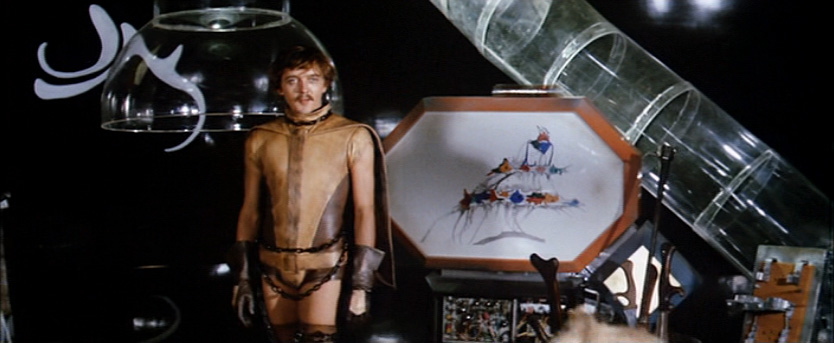
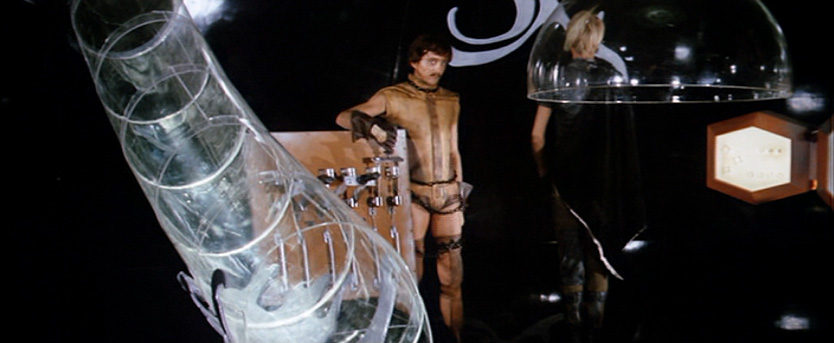
Barbarella-079

In order to conduct its subversions, the Resistance has a set of secret pneumatic chutes throughout SoGo. To monitor them, they have a map of the city with the chutes drawn as lines and places within the city illuminated with small lights.

The purpose of the lights is a bit vague, since just before Barbarella leaves Resistance Headquarters, Dildano glances at the map to see a red dot flashing at the very top. Gesturing at the light he remarks, “The time is right. The Queen is in her Chamber of Dreams.” But we know from the end of the film that the Queen’s Dream Chamber is on the lowest level of the city, close to Mathmos. (It would seem the Resistance has some severe information gathering issues.) So is each location able to change color to represent prominent individuals? What if two prominent people are in the same place? How does Dildano indicate which prominent person he wishes to track? We never see these controls, and per the axiom of providing inputs near outputs, we would want them to be somewhere around here.

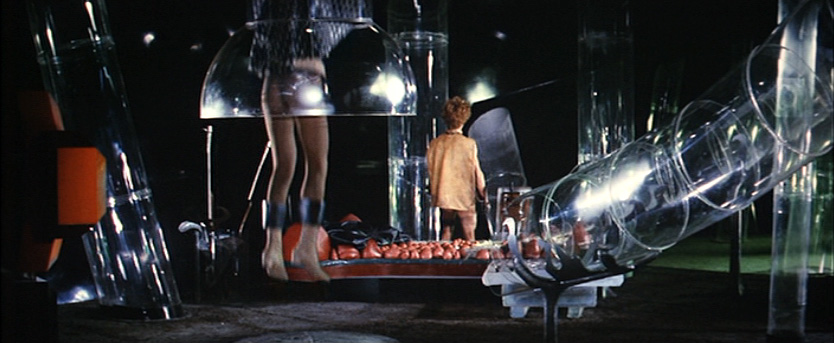
We do get to see one interface in action, though. The chutes themselves are controlled by a set of rather rickety knife switches with large handles. A Resistance member throws one of the switches to initiate suction in a particular tube. (Fans of Futurama should note some similarities to the public transportation system in New New York.)

Barbarella-081

One the switch is thrown, a traveler extends his or her arms upwards, and then the tube handles the rest. The exits is ungraceful, tumbling travelers onto the floor in conspicuous places somewhere in SoGo.

Barbarella-096

Barbarella’s energy box

Barbarella-037

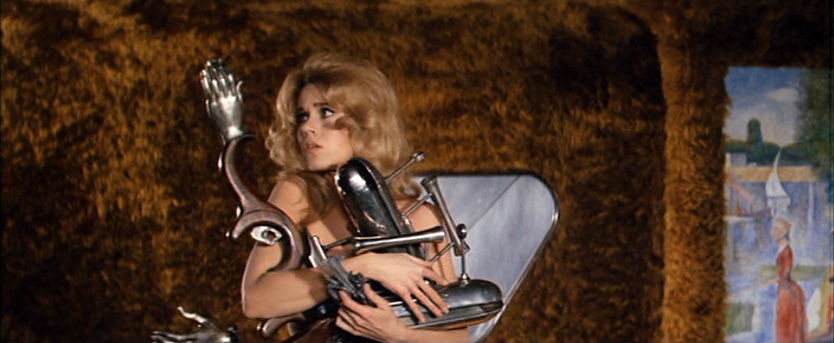
In addition to the portable brainwave detector, Dianthus also provides Barbarella with a number of weapons from the Museum of Conflict for her mission. All of these weapons are powered by a single energy box.

We only see it in use after she fires a single shot from the smallest of the weapons. She tries a second shot, but when it doesn’’t work, she glances at a device on the cuff of her boot. The device is designed in a taijitu, a yin-yang set of lights: one red, one white. They are blinking in an alternating pattern, and after viewing it she tells Pygar, ““My energy box is completely dead.””

Energy-Box

Though having a visual signal is quite useful to understand the state of an invisible resource like power, the signal would be much more useful if it showed the amount of energy remaining, and gave warnings before the power was completely out. Failing all that, it would be more useful if she just put the device on the glove of her shooting hand so it was in her field of view at all times.

And though Barbarella’s culture doesn’t understand war, even a peaceful person can quickly come to realize the risk in making your available resources—like power for your weapons—wholly visible to your enemies.

Portable brainwave detector

Barbarella-032

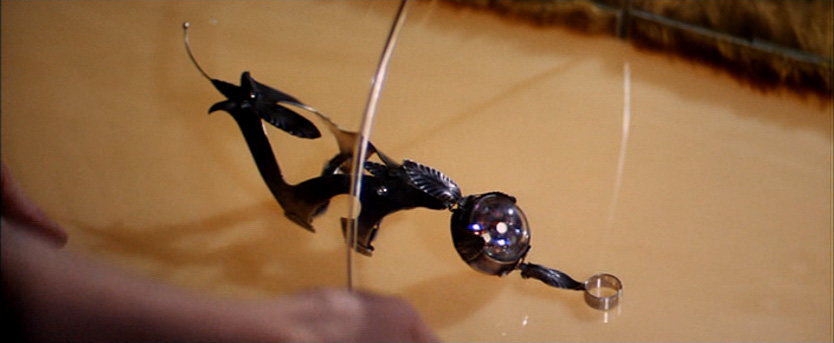
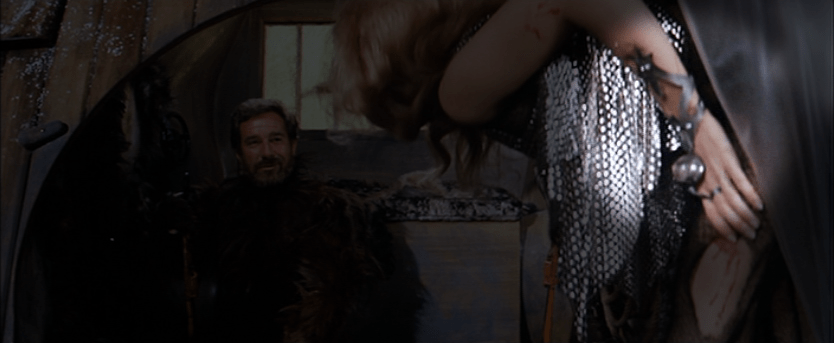
Through the atom transmitter Dianthus bestows several gifts on Barbarella to help her with her mission. The first of these is the “portable brainwave detector…to test for Durand-Durand’s presence.” To operate it, Barbarella must press “a contact,” (Dianthus is offscreen when he indicates the contact, but later we see her operating the leaf-like button near the wrist) and if Durand-Durand is around, the ball of lights will glow and an alarm will sound.

vlcsnap-00002

The device is wearable, wrapping around Barbarella’s forearm, and held in place by a ring. This aspect of the design is good, since it means the device is ever-present for operation, and the design of it makes it lovely enough to be overlooked as a fashion accessory. In fact many characters see her wearing it and make no mention.

PBD_worn

Manual activation is less than ideal, though, since this might tip off the suspect. This is especially true with the blinking, glowing ball of light and audio feedback. And, in fact, this is what happens later in the film when Durand-Durand trips over the device. The blinking light and audio catch his attention, betray the device for what it is, and blow Barbarella’’s cover in the process.

Portable Brainwave Device

The best feedback would be invisible, like a haptic vibration through the cuff to her skin. Ideally, the device would be constantly on, to detect the subject passively, the moment he came into range. But presuming battery life is the issue, the activation cue should be something much more subtle, like Barbarella’s touching the back of the ring with the thumb of the same hand. Such a gesture would match the existing design of the object, be discreet to an observer, and yet still discrete enough to prevent accidental activation.

Destination threshold

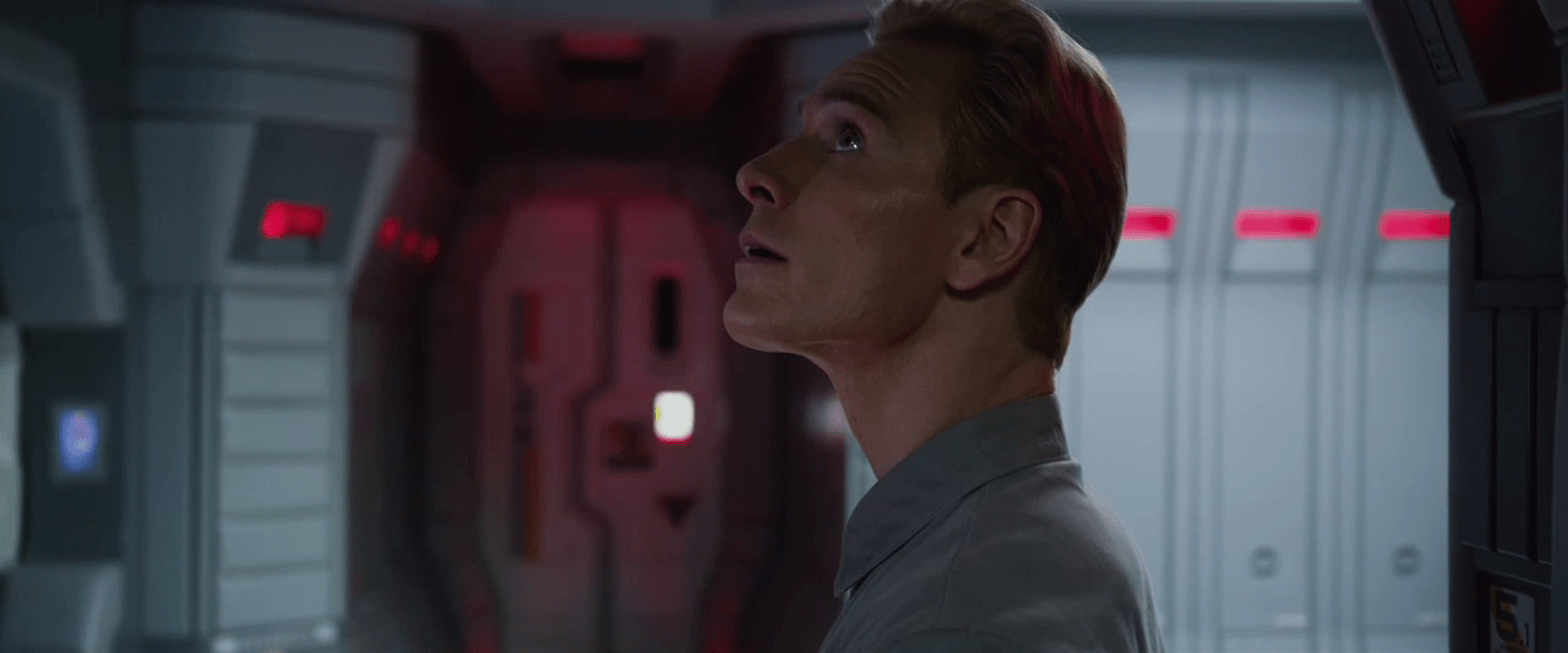
As David is walking through a ship’s hallway, a great clanging sounds from deep in the ship, as the colored lights high in the walls change suddenly from a purple to a flashing red, and a slight but urgent beeping begins. He glances at a billiards table in an adjacent room, sees the balls and cue sliding, and understands that it wasn’t just him: gravity has definitely changed.

Prometheus-020

There are questions about what’s going on with the ship that the gravity changed so fast, but our interest must be in the interfaces.

Why did David not expect this? If they’re heading to a planet and the route is known, David should know well in advance. The ship should have told him, especially if the event is going to be one that could potentially topple him. Presuming the ship has sensors to monitor all of this, it should not have come as a surprise.

The warning itself seems mostly well designed, using multiple modes of signal and clear warning signs:

  • Change in color from a soft to intense color (They even look like eyes squinting and concentrating in the thumbnails.)
  • A shift to red, commonly used for warning or crisis
  • Blinking red is a hugely attention-getting visual signal
  • Beeping is a auditory signal that is also a common warning signal, and hard to ignore

After David sees these signals, he walks to wall panel and presses a few offscreen buttons which beep back at him and silence the beeping, replacing it with overhead pulses of light that race up and down the hallway. Over the sound system a male voice announces “Attention. Destination threshold.”

Prometheus-Destination_Threshold

Why should David have to go find out what the crisis is at the wall interface? If he had been unable to get to the wall interface, how would he know what happened? Or if it required split-second action, why require of him to waste his time getting there and pressing buttons? In a crisis, the system should let you know what the crisis is quickly and intrusively if it’s a dire crisis in need of remedy. The audio announcement should have happened automatically.

Racinglights

The overhead lights are almost a nice replacement for beeping. It still says, “alert” without the grating annoyance that audio can sometimes be. (There’s still a soft “click” with each shifting light, just not as bad.) But if he’s able to silence the audio at this wall panel, why wasn’t he able to silence the race lights as well? And why do they “race” up and down the hallway rather than just blink? The racing provides an inappropriate sense of motion. Given that this signal is for when the crew is in an unusual and potentially dangerous situation, it would be better to avoid the unhelpful motion cue by simply blinking, or to use the sense of direction they provide to signal to David where he ought to be. A simple option would be to have the hallway lights race continuously in the direction of the bridge, leading the crew to where they would be most effective. Even better is if the ship has locational awareness of individual crew members, then you can cut all overhead illumination by 20% and pulse a light a few feet away in the desired direction between 80 and 100 percent, while darkening the hallway in the opposite direction. Then, as David walks towards the blinking light, the ship can lead him, even around corners, to get him where he needs to be. In a real crisis, this would be an easy and intuitive way to lead people where they’re need to be. It would of course need simple overrides in case the crew knew something about the situation that the ship did not.

After walking through the racing-light hallways, he turns just past the door and into the bridge, where we can see the legend “DESTINATION THRESHOLD” across the pilots HUD. He turns on a light, licks a finger, and presses another button to activate all of the interfaces on the bridge. He walks to the pilot’s panel, presses a button to open the forward viewscreen, observing LV223 with wide-eyed wonder.

This entire sequence seems strange from an interface perspective. We’re going to presume that licking his fingers was just a character tic and not required by the system. But in addition to the fact, raised above, that David seems somewhat surprised by it all, that he should have to open doors and manually turn on lights and interfaces during a crisis seems pointless. It’s either not a crisis and these signals should diminish, or it is a crisis and more of this technology should be automated.

Robbie the Robot

Dr. Morbius creates Robbie after having his intellectual capacity doubled by the Krell machines. The robot is a man-sized, highly capable domestic servant receiving orders aurally, and responding as needed with a synthesized voice of his own.

Robbie exits the cockpit of his vehicle.

Robbie invites the men inside.

Robbie first appears steering a special vehicle to pick up the officers. It is specially built for him, accommodating his inability to sit down. From this position, he can wirelessly maneuver the vehicle, and even turn his head around to address passengers.

Robbie fires Adams’’ sidearm.

Despite his having only two wide, flat fingers on each hand, he is able to grasp and manipulate objects as a human would. To demonstrate this, Morbius has him aim and fire Commander Adams’’ weapon at a nearby tree. How he pulled the trigger is something of an unanswered question since his hands are hidden from view as he fires, but he does so all the same. This makes him quite useful as an interface, since he is able to use any of the devices already in the environment. Additionally, should he become unavailable, humans can carry on in his absence.

Alta thanks Robbie for offering to make her a new dress.

Given that he must interact with humans, who have social needs, his stature helps ingratiate him. In one scene Alta wishes to express her gratitude for his promise of a new dress, and she gives him a hug. Though he does not hug back, she still smiles through and after the expression. Had he been less anthropometric, she would have had to express her thanks in some other way that was less pleasant to her.

Robbie warms the coffee for Alta and Farman.

In addition to being physically suited for human interaction, he is quite socially aware and able to anticipate basic human needs. In one scene, as Lt. Farman walks with Alta towards a cold pot of coffee, without having been asked, Robbie reaches down to press a button that warms the coffee by the time the two of them arrive. He also knows to leave immediately afterwards to give the two some privacy.

Despite these human-like qualities, some of his inhuman qualities make him useful, too. He is shown to be incredibly strong. He is tireless. He can synthesize any material he “tastes.”

With eyes behind his head, Robbie shoos a pesky monkey.

He even has “eyes in the back of his head,” or a 360-degree field of vision for surveillance of his surroundings. In one charming scene he combines this observation with small nonlethal lasers to shoo away a pesky monkey trying to steal fruit behind his back.

Morbius shows Robbie’’s “sub-electronic dilemma” when asked to harm a human.

Addressing safety concerns, Robbie is built to obey Asimov’’s first law of robotics. After having his creator instruct him to point a weapon at Adams, and “aim right between the eyes and fire,” Robbie’’s servos begin to click and whir noisily. His dome glows a pinkish-red as blue sparks leap across it. Morbius explains, ““He’’s helpless. Locked in a sub-electronic dilemma between my direct orders and his basic inhibitions against harming rational beings.”” When the command is canceled, the sparks stop immediately and the red fades over a few seconds.

This failsafe seems quite serious, as Dr. Morbius explains that if he were to allow the state to continue, that Robbie would “blow every circuit in his body.” Since the fault of such a state is with the one issuing the command and not Robbie, it seems a strange design. It would be like having your email server shut down because someone is trying to send an email infected with a virus. It would make much more sense for Robbie to simply disregard the instruction and politely explain why.

Tool of liberation

Maria’’s heroism in saving the children of the Lower City from flooding is aided by what may be only positive depiction of a technology in the film.

Maria summons the children with the gong in the town square.

To summon the children so that she can direct them to safety, she climbs a structure in the center of the town square. There she struggles with a very difficult-to-budge lever, but when she finally does so, it sets a loud gong to ringing. In keeping with the film’’s theme, this brings people together so they can be saved.