Loki’s glaive: Mojo Radiator

Loki’s wants to take down the Avengers and the S.H.I.E.L.D. helicarrier, to disable the two greatest threats to his invading forces. To accomplish this, he lets himself get captured and the glaive taken away from him, knowing Banner would study it, fall prey to one of its terrible effects, become the ragemonster, and wreck the place.

That effect goes unnamed in the film so I’ll call it the bad mojo radiator. The longer people hang around it, the more discord it sows. In fact just before Loki’s thralls enact a daring rescue of him, we see all of the Avengers fighting in the lab, for no other reason than they stand in the glaive’s presence.

Avengers-glaive-mojo-02

The infighting ends suddenly when Banner unintentionally takes the glaive in hand as he attempts to silence the group. Because the threat of Hulk + glaive is enough to make other fights seem secondary.

Avengers-glaive-mojo-03

We never see Loki triggering this ability of the glaive. Is it just a default, going on at all times? That seems problematic if you needed allies around you to behave, or even take disguise and hide amidst people for any length of time. So maybe that’s not the most useful design.

What if this bad mojo was actually triggered, just passively? What if it starts quietly humming its Song of Discord when it is separated from its appointed wielder for some length of time? This would be an excellent anti-theft device, and even one that would make it hard to keep it hidden long.

Avengers-glaive-mojo-01
[sic]

How might we use this sort of strategy beyond the world-conquering semi-mystical, fictional sort? This strategy is one step beyond the authenticated-users-only constraints of smart weapons, adding a layer of deterrence from possession. Imagine if a gun pulled from its authorized user shocked the holder or occasionally sprayed malodor? Or a car that turned its volume increasingly louder after it was reported stolen? You can be sure the thieves wouldn’t keep it for long.

Drone Programmer

A close-up of a hand wearing a glove holding a futuristic device with a screen displaying a holographic globe and various data interfaces.

One notable hybrid interface device, with both physical and digital aspects, is the Drone Programmer. It is used to encode key tasks or functions into the drone. Note that it is seen only briefly—so we’re going off very little information. It facilitates a crucial low-level reprogramming of Drone 172.

This device is a handheld item, grasped on the left, approximately 3 times as wide as it is tall. Several physical buttons are present, but are unused in the film: aside from grasping, all interaction is done through use of a small touchscreen with enough sensitivity to capture fingertip taps on very small elements.

Jack uses the Programmer while the drone is disabled. When he pulls the cord out of the drone, the drone restarts and immediately begins to try and move/understand its surroundings.

A person stands facing a large, futuristic robotic head with multiple cameras and sensors, while two armed figures are positioned nearby in a dimly lit environment.
When Drone 172 is released from the Programmer cable, it is in a docile and inert state…
A person standing in front of a large, futuristic robotic machine with glowing lights and mechanical arms, set in a dimly lit environment.
…but it quickly becomes aware, its failsafes shut down and its onboard programming taking over.

From this we understand that drones are controlled via internal software; this is the only time we see them programmed or their behavior otherwise influenced by a human. This reprogramming requires an external device wired into the drone in direct physical proximity, which suggests an otherwise high level of autonomy for each drone.

(Narrative implications) Following Orders

The Drone Programmer, and the way it interacts with Drone 172, suggests useful information about the Drones’ default states—namely, that their default state is autonomous, aggressive, and proactive, depending upon their orders and programming.

Drone 172 does not attack at this stage, and we have seen through Jack’s eyes on the screen that this is due to an overriding primary objective, implanted directly into the Drone’s firmware / low level programming: Rendezvous with the Tet.

Low Level Controller: Handle With Care

A gloved hand holding a futuristic device with a digital screen displaying various readings and graphs.

Its suggestion of a provisional or failsafe role is reinforced by warning text above the display, (legible at high resolution,) reflective of its power: “Electric Hazard Do Not Touch Terminals on Both Lines at Same Time: Lead Ends May Be Energized…

Between this and the sparks ignited when the cable is detached from the Drone, one gets the sense of a device somewhere between a terminal and a jumper cable. Potent, hazardous, direct.

A close-up image of a hand holding a wire while interacting with the interior of a mechanical object.
A close-up of a male astronaut in a futuristic suit, focused on a mechanical device above him, set in a dimly lit environment with sparks and steam.

Jack is clearly at ease with the Programmer and its usage from repair sessions at home and in the field. This ease suggests either that his training (or memory replacement) is thorough, or that such low level work is needed frequently enough to be quite familiar.

The latter explanation, along with the Programmer’s nature as a physical device requiring direct proximity, would reinforce the interpretation that Tet places a remarkable amount of trust in instances of the human Maintenance team, and that the equipment in question is nearly symbiotic with the Team(s) in its need for frequent recovery.

Thus through this one seemingly incidental device, and its low level role in the chain of command, we can deduce that the combination of Drones and Team(s) is much more effective than either could be individually. Jack was reprogrammed by his time spent in curious wandering, crossed with the opportunity presented by the book quotation mentioned as a trigger. In the case of Jack, the book and its couplet is the low-level reprogramming device, shocking in its directness.

Dialogue within the film reinforces the analogy directly: We learn during this sequence that the first invasion phase entailed many instances of a short-lived (non-learning) Jack as soldier. We also learn that phase two is this symbiotic maintenance arrangement between human and machine. When it is suggested that Drone 172 is the weapon, Jack corrects that it is he himself—its user and maintainer—who is the weapon. Without his role as user and maintainer, the machine would ultimately be a neutralized mechanical husk.

Lessons:

  1. Low level interfaces suggest fundamental programming and activity.
    (NOTE: Compare to interfaces such as the Nostromo Self Destruct pulls in Alien, etc.)
  2. Use of low level interfaces suggests familiarity and/or “grace under pressure”, as well as systemic trust in the user.
  3. Low level interfaces suggest a deep symbiosis between the user and the machine, to the point of interdependence.
    (NOTE: Compare to failsafe systems and manual overrides in aeronautics and (a few realistic moments in) space films such as Sunshine. In an alternate universe, I have the time to cover/analyse Sunshine to uncover this very dynamic…)
  4. Bonus Lesson (Oblivion-centric): By analogy, in highly technological or post-apocalyptic settings, books are, for humans, a low level interface, forcing the user to slow down and absorb sometimes startling, unexpected, or course-changing information.

A Deadly Pattern

The Drones’ primary task is to patrol the surface for threats, then eliminate those threats. The drones are always on guard, responding swiftly and violently against anything they do perceive as a threat.

An explosion in a dimly lit library with debris scattered around and a hovering robotic device amidst the chaos.

During his day-to-day maintenance, Jack often encounters active drones. Initially, the drones always regard him as a threat, and offer him a brief window of time speak his name and tech number (for example, “Jack, Tech 49”) to authenticate. The drone then compares this speech against some database, shown on their HUD as a zoomed-in image of Jack’s mouth and a vocal frequency.

vlcsnap-2015-02-03-22h07m47s249

Occasionally, we see that Jack’s identification doesn’t immediately work. In those cases, he’s given a second chance by the drone to confirm his identity.

A man with a glowing headband appears concerned, reaching out with his hand, in a dimly lit environment.

Although never shown, it is almost certain that failing to properly identify himself would get Jack immediately killed. We never see any backup mechanism, and when Jack’s response doesn’t immediately work, we see him get very worried. He knows what happens when the drone detects a threat.

Zero Error Tolerance

This pattern is deadly because it offers very little tolerance for error. The Drone does show some desire to give Jack a second chance on his vocal pattern, but it is unclear how many total chances he gets.

On a website, if I enter my password wrong too many times it will lock me out. With this system, the wrong password too many times will get Jack killed.

There are many situations where Jack may not be able to immediately respond:

  • Falling off his bike and knocking himself out
  • Focus on repairing a drone, when a second drone swoops in to check the situation out
  • Severe shock after breaking a limb
  • etc…

As we see in the crashed shuttle scene, the Drones have no hesitation in killing unconscious targets. This means that Jack has a strong chance of being killed by his Drone protector in some of the situations where he needs help the most.

A futuristic robotic sphere with the number 166 displayed on its surface, emitting flames and smoke from its underside.

A more effective method could be a passive recognition system. We already know that the drone can remotely detect Jack’s biosignature, and that the Tet has full access to the Drone’s HUD feed.

The Drone then could be automatically set to not attack Jack unless the Tet gives a very specific override. Or, alternatively, the Drone could be hard-wired to never attack Jack at all (though this would complicate the movie’s plot). In any situation where it looks like the Drone might attack anyways, the remote software Vika uses could act as a secondary switch, providing a backup confirmation message.

That said, we must acknowledge that this system excels at is keeping Jack nervous and afraid of active drones.  While they help him, he knows that they can turn on him at any moment.  This serves the TET by keeping Jack cowed, obedient, and always looking over his shoulder.

Ethical Ramifications

The Drones are built as autonomous sentries, able to protect extraordinarily expensive infrastructure against attack. They need to be able to eliminate that threat, quickly and efficiently. Current militaries are facing the exact same issues. Even though they have pledged (for now) to not build autonomous kill systems, modern military planners may find value in having a robot perform a drudging, dangerous task like patrolling remote infrastructure.

The question asked best in Oblivion is “What should constitute a threat?

A desolate landscape with wreckage and flames, suggesting a recent disaster or battle scene.

Drones fire mercilessly on unarmed civilians and armed enemy militia, but do not attack armed friendly soldiers (Jack). This already implies some level of advanced threat analysis, even if we abhor the choices the Drone makes.

The Future

Military Planners will need to answer the same question: How does the algorithm determine a threat? With human labor becoming more and more expensive both monetarily and emotionally, the push for autonomous drone systems will become even stronger for future conflicts.

There is still enough time to research and test potential concepts before we have to make a decision on autonomous drones.

Interaction Design Lessons:

  1. Don’t threaten civilians and non-combatants.
  2. Give clear feedback of limits and consequences if a deadly pattern is about to be activated.
  3. Give users a second chance.

Escape pod weapons cache

I wish that the last Starship Troopers interface wasn’t this one, but so it goes.

After piloting the escape pod through the atmosphere using the meager interfaces she has to work with, it careens off of a hill to pierce the thin wall of a mountainside and landing Ibanez and Barcalow squarely in the dangerous depths of bug burrows.

After checking on Ibanez, Barcalow exits the pod and struts around to the back of it, where he pulls open a panel to access the weapons within.

So equipped, the pair are able to defend themselves at least a few moments before being overwhelmed by superior bug numbers.

StarshipTroopers-podweapons-07

So. OK. This.

I want to ask why, in the first place, they would get out of a vehicle that can survive space, re-entry, breaking through a frakking mountainside, and crash landing without so much as a scratch. If they’d stayed there, would the bugs have been able to get at them? Couldn’t staying inside of it given them at least a fighting chance until Rico got there? The glass didn’t break when slammed at terminal velocity into stone. I think it can handle bug pincers. But I digress. that’s a question of character logic, not interfaces, so let me put that aside.

Instead, let me ask about the design rationale of putting the weapons in an exterior compartment. Wouldn’t it make more sense to put them inside the pod? If they’d landed with hostiles present outside the vehicle, what was the plan, ask them to hold on while you grabbed something from the trunk?

Additionally, it appears that there are no security features. Barcalow just opens it. Silly seeming, of course, but that’s how it should work, i.e., for the right person it just opens up. So in the spirit of apologetics—and giving it way more credit than it’s earned across this film—let’s presume that the pod has some passive authentication mechanism that biometrically checks him at a distance and unlocks the panel so that he doesn’t even have to think about it, especially in this crisis scenario.

That’s an apologetics gift from me to you, Starship Troopers, since I still have a soft spot in my heart for you.

Multipass

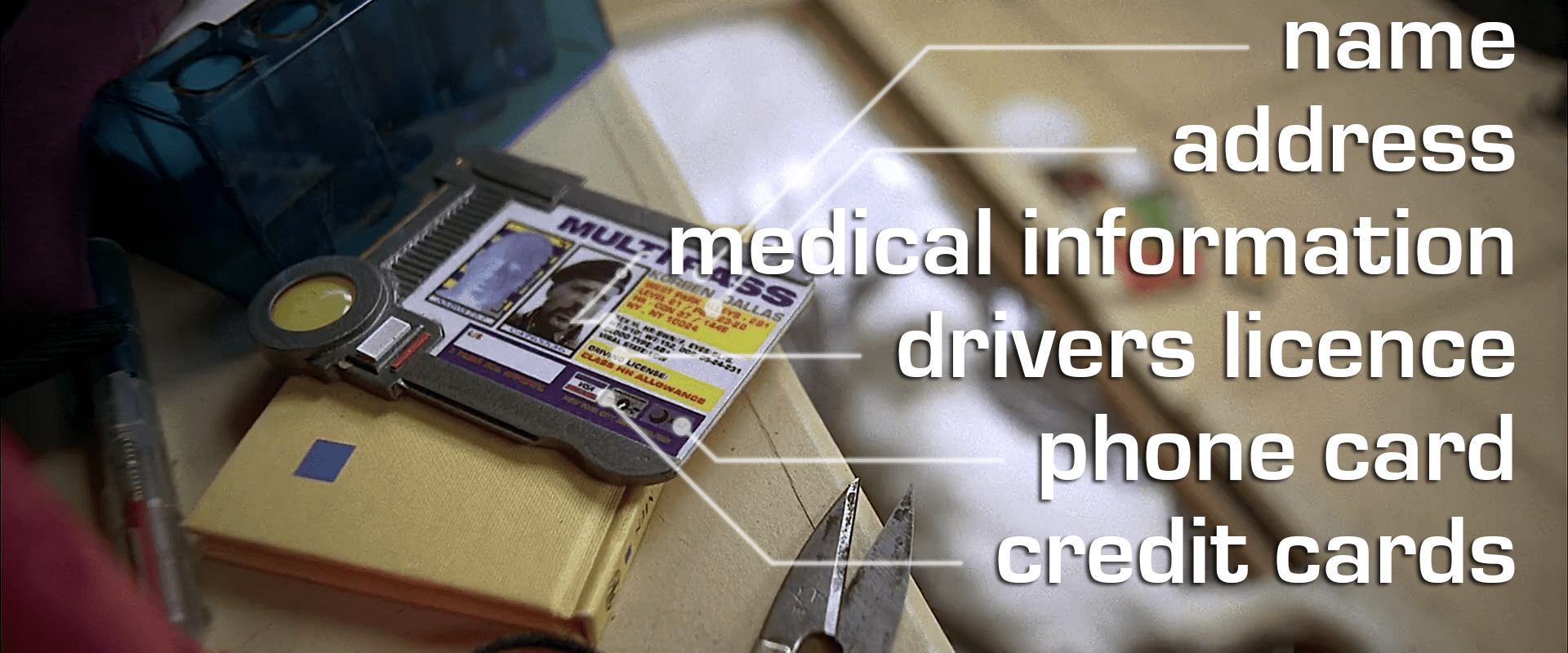
TheFifthElement-multipass

The multipass is the all-purpose card of 2263. It’s a driver’s license, work authorization record, proof of identity, emergency medical information, phone card, plus all your credit cards in one. There is a white rectangle and yellowish, rounded-bevel shape on the lower left, each of which may be a button, but that we don’t see in use.

Often just showing it is enough for a human’s satisfaction, but sometimes it must be read by a machine. To do this, the holder inserts it into a slot, where the machine verifies its authenticity and registers the user locally. In Korben’s taxi, he has to leave it in as he operates the vehicle. At the Fhloston Paradise check-in booth, travelers dip it in and out of the reader.

TheFifthElement-multipass-014TheFifthElement-multipass-008

TheFifthElement-multipass-009

The act of inserting the card to authenticate may seem a bit old-fashioned in the days of RFID and read-at-a-distance technology, but it’s also nice to see that whatever agency was able to get the various corporations and government agencies to cooperate has also got privacy in mind. If it needs to be dipped to be read, maybe it can’t be read at a distance. That means the holder has more control over when and how it’s accessed.

As far as convenience, hot damn. It’s practically a wallet in and of itself. But there are security concerns to having all of this in one place. There are many cards that work like this in the world. Bus passes, skeeball tickets, gift cards. They’re generally low-cost. If you steal or forge Korben Dallas’ multipass, though, do you suddenly have his charge accounts, his taxi, and his phone card all at once? Seems high-cost, especially since the one forgery we see in the movie actually works.

This returns us, as so many things do, to multifactor authentication. This security philosophy requires that the user presents three factors: something they have, something they are, and something they know. The multipass covers only the first two.

  • The multipass itself is the thing they have.
  • The picture is something they are, i.e., what they look like.
  • It could be improved by requiring something they know, like a PIN or a password.

We don’t know what kind of power Cornelius’ order wielded in the world, but since it wasn’t enough to sway the president or purchase tickets to Paradise, let’s presume it wouldn’t have been enough to uncover Korben’s password, and in that case, the PIN would have foiled the attempted forgery.

TheFifthElement-multipass-002

Escape Pod

Prometheus-313

When Vickers realizes Janek is really mutinying and going to ram the alien ship with the Prometheus, she has only 40 seconds to flee to an escape pod. She races to the escape room and slams her hand on a waist-high box mounted on the wall next to one of the pods. The clear, protective door over the pod lifts. She hurriedly dons her environment suit and throws herself into one of the coffin-shaped alcoves. She reaches to her right and on a pad we can’t see, she presses five buttons in sequence, shouting, “Come on!” The pod is sealed and shot away from the ship to land on the planet below.

Prometheus_EscapePod-0003

The transparent cover gives a clear view into the pod. That’s great, since if there were multiple people trying to escape, it would be easier to target an empty one. The the shape inside is unmistakeable. That’s great because at a glance even an untrained passenger could figure out what this is. The bright orange stripes are appropriately intense and attention-getting as well.

Viewers might have questions about the placement of the back-lit button panels inside the pod, seeing as how they’re in a very awkward place for Vickers to see and operate. I presume she has some other interface facing her, and the panels we see in the scene are for operating when the pod is resting on the planet’s surface and its lid opened. From that position, these buttons make more sense.

I think that’s where the greatness ends. The main consideration for an escape pod is that it is used in dire emergencies. Fractions of a second might mean the difference between safety and disintegration, and so though the cinematic tension in the scene is built up by these designed-in delays, an ideal system shouldn’t work the same way. How could it be improved? There are three delays, and each of them could be improved or removed.

Delay 1: Opening a pod

Why should she have to open the pod with a button or handprint reader or whatever that thing is? The pods should be open at all times.

Prometheus_EscapePod-0004

If pods had to be sealed for some biological or mechanical reason, then a pod should open up for her immediately when she enters the room. Simple motion detectors are all that is needed.

If she has to authorize for some dystopian, only-certain-people-can-be-saved corporate reason, then a voice print could work, allowing her to shout in the hallway as she runs for the pod.

Prometheus_EscapePod-0002

Some passive recognition would be even better since it wouldn’t cost her even the time of shouting: Face-recognition or fast retinal scan through cameras mounted in the room or the pod. Run a quick laser line across her face and she’s authorized.

Delay 2: Suiting Up

Can she put on the environment suit in the pod? Yes, the pod is cramped, but that’s the biggest delay she experiences. Increase the size of the pod slightly to allow for that kind of maneuvering, and then she can just grab the suit as she’s running by and put it on in the pod’s relative safety.

Prometheus_EscapePod-0001

Even cooler would be if the pod was the environment suit: All she would have to do is throw herself in the pod, activate it, and the minute she landed on LV223, the capsule transformed, Autobot-style, into an exosuit, giving her more protection and more enhancement for survival on an alien planet. Plus, you can imagine the awesomeness of letting Vickers fight the zombified Weyland Ripley-style.

Delay 3: Activation

This is one delay that I’m pretty sure can’t be either automatic or passive. The cost of making a mistake is too dire. Accidentally pressed a button? Sorry, you’re now being shot away from the mother ship faster than it can travel. Still, why does she have to hit a series of buttons here? Is it a (shudder) password, as a corporate cost-control measure? Yes, that spells dystopia, but it should be faster and more intuitive, and we’ve already authorized her, above.

Fortunately this doesn’t need much rethinking. Since we’ve already seen a great interaction used for an emergency procedure, i.e. the 5-finger touch-twist used for emergency decontamination on the MedPod, I’d suggest using that. Crew would only have to be trained once.

Prometheus-270

The total interaction, then, should be that Vickers:

  1. Runs to the escape room
  2. Is identified passively (and notified of it by voice)
  3. Grabs a suit (this is optional if you go with the awesome exosuit idea)
  4. Throws herself into an open pod
  5. Performs a simple gesture on a touch pad
  6. Is shot away from the soon-to-explode ship

Bam! You have saved massive amounts of time, a crewmember removed from the immediate danger, and you have the setup for an awesome ending where Vickers in her exosuit can just punch the falling alien spaceship out of the the way rather than running from it like a moron.