The Gendered AI series looks at sci-fi movies and television to see how Hollywood treats AI of different gender presentations. For example, are female AIs generally shown as smarter than male AIs? Are certain AI genders more subservient? What genders are the masters of AI? This particular post is about gender and category of intelligence. If you haven’t read the series intro, related category distributions, or correlations 101 posts, I recommend you read them first. As always, check out the live Google sheet for the most recent data.
What do we see when we look at the correlations of gender and level of intelligence? First up, the overly-binary chart, and what it tells us.
Gender and AI Category
You’ll recall that levels of AI are one of the following…
Super: Super-human command of facts, predictions, reasoning, and learning. Technological gods on earth.
General: Human-like, able to learn arbitrary new domains to human-like limits
Narrow: Very smart in a limited domain, but unable to learn arbitrary new domains.
The relationships are clear even if the numbers are smallish.
When AI characters are of a human-like intelligence, they are more likely to present gender.
When AI characters are either superintelligent or only displaying narrow intelligence, they are less likely to present gender.
My feminist side is happy that superintelligences are more often female and other than male, but it’s also such small numbers that it could be noise.
If you check the details in the Sheet, you’ll see the detailed numbers don’t reveal any more intense counterbalancing underneath the wan aggregate numbers.
Chris: I posted a question on Twitter, “Other than that SNL skit, have there been queer sci-fi AI in television or movies?” Among the responses is this awesome one from Terence Eden, where he compiled the answers and wrote a whole blog post about it. The following is slightly-modified from the original post on his blog. Consider this a parade of sci-fi AI, to help you nerds celebrate Pride.
Terence: Let’s first define what we mean by queer. This usually means outside of binary gender and/or someone who is attracted to the same sex—what’s commonly referred to as LGBT+. Feel free to supply your own definition.
As for what we mean by AI, let’s go with “mechanical or non-biological autonomous being.” That’s probably wide enough—but do please suggest better definitions.
So is a gay/lesbian robot one who is attracted to other robots? Or to humans with a similar gender? Let’s go with yes to all of the above.
Wait. Do robots have gender?
Humans love categorising things – especially inanimate objects. Some languages divide every noun into male a female. Why? Humans gonna human.
The television is female in French —“la télévision”—but masculine in German—“der Fernseher.” Stupid humans and their pathetic meaty brains. Nevertheless, humans can usually look at a human-ish thing and assign it a specific gender.
Maschinenmensch, from Metropolis, is a gynoid (as distinct from an android). “She” has a feminine body shape and that’s enough for most people to go on.
HAL from 2001 is just a disembodied voice. But it definitely has a male voice. Is there any attraction between HAL and Dave? I doubt it, but it’s an interesting reading of their toxic relationship.
Editor’s note: The whole Gendered AI series is predicated on the question of gender in sci-fi AI, so if you’re interested in this question, have I got a series for you…
Wait. Do Robots have sexuality?
Did we mention that humans love categorizing everything? Just like we can speak of the gender presentation, robots with a General AI can have romantic affection for other beings, and depending on their equipment and their definitions of sex, yes, get it on. Even by narrow human common definitions of gender and sexuality, (TV, movies, and comic book) sci-fi has a dozen or so examples that can populate our imaginary AI pride parade.
Kryten from Red Dwarf is an AI that receives a human body. Kryten coded as male. All the characters refer to him with male pronouns. Under British comedy rules, he is also “camp,” an over-the-top and stereotypically effeminate man. Kryten is sexually attracted to household appliances.
But… Kryten’s “perfect mate” is a distinctly female Gynoid, so he’s something other than straight, something other than appliance-sexual.
Fun fact: Camille and Kryten are played by real-life wife and husband Judy Pascoe and Robert Llewelyn!
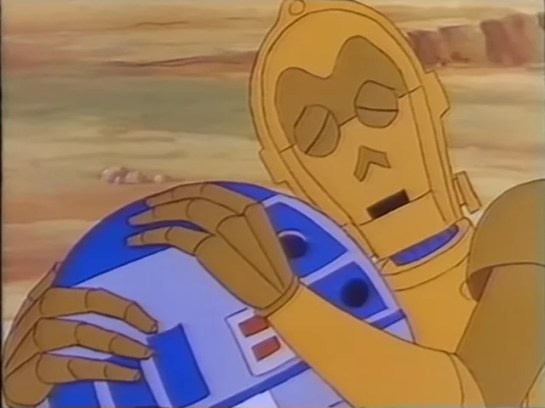
C-3P0—another British campbot—is arguably in love with R2-D2. Whether or not that love is reciprocated is hard to say.
(I say “ladies,” but for the record let’s note that just because a robot is pink, wearing bobby socks, and a high heels, it doesn’t necessarily mean it’s a girl. If you’re looking for a pink R2 unit that is expressly a girl, check out the real-world KT-10 robot.)
In the “extended universe” of Transformers (outside of movies and television), there are a few gay Autobots and gay Decepticons.
Tigatron and Airazor. They even kind of had a baby.
Knock Out and Breakdown.
And of course there’s no denying that a few of the Futurama bots have tastes that veer from the straight and narrow. Notably we can point to that one time Hedonismbot stole Bender’s antenna and used it for “anything and everything,” said while in a sex dungeon surrounded by couples of every stripe who are getting it on.
“You might want to sterilize that.”
The “Robots attracted to humans of the same sex” float
There are several examples of “female” computers falling in love with male humans, a handful of male robots with female human lovers, and a disturbing number of sex-worker bots, but it is much harder to find queer examples of any of these.
The Tick show has a superhero named Overkill whose sidekick is an AI named Danger Boat that is, yes, housed in a boat. (Hat tip to Twitter user @FakeUnicode.) The AI identifies as male and is expressly attracted to other men, specifically The Tick’s (human) sidekick Arthur.
Is Danger Boat programmed to be gay? Are his desires hardwired? Are yours?
Remember Alien: Resurrection? Winona Ryder played the robot “Call” who has a suggestive relationship with Ripley. As this ship video demonstrates.
Battlestar Galactica has some demonstrably bisexual Cylons. They are sexually compatible and interested in humans and other Cylons.
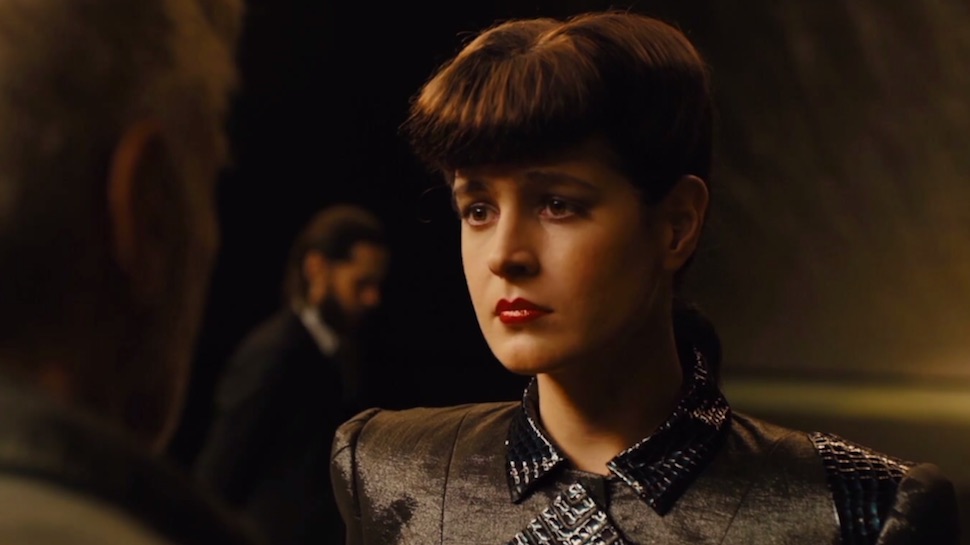
Is Rachael from Blade Runner a robot, or bisexual?
Clearly, yes.
How about Samantha from Her? Late in the movie she reveals to Theodore that she’s having intimate conversations with 621 other humans. Some portion of them must have turned romantic and even sexual, as hers did with Theodore himself. The genders aren’t mentioned, but the odds are that 51% of them are female.
Unfortunately she has no embodiment, but maybe we can hook her up to the loudspeakers.
The Transexual Float
This float only has one robot, (the poorly-named) Hermaphrobot from Futurama, but she is sassy and awesome and assuring us that we couldn’t afford it. (And apologies for the insulting title added by the person who uploaded this video.) We are wholly unsure of Hermaphrobot’s sexuality, but we welcome our transexual robot brothers and sisters and others all and the same.
The GenderFluid Float
It’s possible for you to swap the gender of your Voice Assistant in real life. Your GPS can have a male voice one day, and you can swap it to female the next. There’s only one example of a sci-fi AI that swaps gender.
It takes us back to Red Dwarf again. In the series 3 opener “Backwards” it is revealed that Holly (a computer with a male face) fell in love with Hilly (a computer with a female face). And subsequently performed a head sex change. Although she kept the name Holly.
What is awesome and instructive is that the entire crew of Red Dwarf accept this. They never comment on it, nor disparage her. Basically, what I’m saying is this: if you can’t accept your trans and non-binary friends, you’re literally a worse human than Arnold Judas Rimmer, the worst human in the Red Dwarf universe.
Oh, look, and here comes The Fifth Elementfloor sweeping robots, picking up all the glitter and source code left on the ground by the crowd, marking the end of the AI Pride parade. Happy Pride to everyone, silicon or not!
Where we are: To talk about how sci-fi AI attributes correlate, we first have to understand how their attributes are distributed. In the first distribution post, I presented the foundational distributions for sex and gender presentation across sci-fi AI. Today we’ll discuss categorically how intelligent the AI appears to be.
Narrow AI is smart but only in a very limited domain and cannot use its knowledge in one domain to build intelligence in novel domains. The Spider Tank from Ghost in the Shell in narrow AI.
General AI is human-like its knowledge, memory, thinking, learning. Aida from Agents of S.H.I.E.L.D. possesses a general intelligence.
Super AI is inhumanly smart, outthinking and outlearning us by orders of magnitude. Deep Thought from The Hitchhiker’s Guide to the Galaxy is a super AI.
The overwhelming majority of sci-fi AI displays a general intelligence.
Where we are: To talk about how sci-fi AI attributes correlate, we first have to understand how their attributes are distributed. In the first distribution post, I presented the foundational distributions for sex and gender presentation across sci-fi AI. Today we’ll discuss goodness.
Goodness is a very crude estimation of how good or evil the AI seems to be. It’s wholly subjective, and as such it’s only useful patterns rather than ethical precision.
If you’re looking at the Google Sheet, note that I originally called it “alignment” because of old D&D vocabulary, but honestly it does not map well to that system at all.
Very good are AI characters that seem virtuous and whose motivations are altruistic. Wall·E is very good.
Somewhat good are characters who lean good, but whose goodness may be inherited from their master, or whose behavior occasionally is self-serving or other-damaging. JARVIS from Iron Man is somewhat good.
Neutral or mixed characters may be true to their principles but hostile to members of outgroups; or exhibit roughly-equal variations in motivations, care for others, and effects. Marvin from The Hitchhiker’s Guide to the Galaxy is neutral.
Somewhat evil characters are characters who lean evil, but whose evil may be inherited from their master, or whose behavior is occasionally altruistic or nurturing. A character who must obey another is limited to somewhat evil. David from Prometheus is somewhat evil.
Very evil are AI characters whose motivations are highly self-serving or destructive. Skynet from The Terminator series is very evil, given that whole multiple-time-traveling-attempts-at-genocide thing.
Though slightly more evil than good, it’s a roughly even split in the survey between evil, good, and neutral AI characters.
Where we are: To talk about how sci-fi AI attributes correlate, we first have to understand how their attributes are distributed. In the first distribution post, I presented the foundational distributions for sex and gender presentation across sci-fi AI. Today we’ll discuss how germane the AI character’s gender is germane to the plot of the story in which they appear.
Is the AI character’s gender germane to the plot? This aspect was tagged to test the question of whether characters are by default male, and only made female when there is some narrative reason for it. (Which would be shitty and objectifying.) To answer such a question we would first need to identify those characters that seemed to have the gender they do, and look at the sex ratio of what remains.
Example: A human is in love with an AI. This human is heteroromantic and male, so the AI “needs” to be female. (Samantha in Her by Spike Jonze, pictured below).
If we bypass examples like this, i.e. of characters that “need” a particular gender, the gender of those remaining ought to be, by exclusion, arbitrary. This set could be any gender. But what we see is far from arbitrary.
Before I get to the chart, two notes. First, let me say, I’m aware it’s a charged statement to say that any character’s gender is not germane. Given modern identity and gender politics, every character’s gender (or lack of, in the case of AI) is of interest to us, with this study being a fine and at-hand example. So to be clear, what I mean by not germane is that it is not germane to the plot. The gender could have been switched and say, only pronouns in the dialogue would need to change. This was tagged in three ways.
Not: Where the gender could be changed and the plot not affected at all. The gender of the AI vending machines in Red Dwarf is listed as not germane.
Slightly: Where there is a reason for the gender, such as having a romantic or sexual relation with another character who is interested in the gender of their partners. It is tagged as slightly germane if, with a few other changes in the narrative, a swap is possible. For instance, in the movie Her, you could change the OS to male, and by switching Theodore to a non-heterosexual male or a non-homosexual woman, the plot would work just fine. You’d just have to change the name to Him and make all the Powerpuff Girl fans needlessly giddy.
Highly: Where the plot would not work if the character was another sex or gender. Rachel gave birth between Blade Runner and Blade Runner 2049. Barring some new rule for the diegesis, this could not have happened if she was male, nor (spoiler) would she have died in childbirth, so 2049 could not have happened the way it did.
Second, note that this category went through a sea-change as I developed the study. At first, for instance, I tagged the Stepford Wives as Highly Germane, since the story is about forced gender roles of married women. My thinking was that historically, husbands have been the oppressors of wives far more than the other way around, so to change their gender is to invert the theme entirely. But I later let go of this attachment to purity of theme, since movies can be made about edge cases and even deplorable themes. My approval of their theme is immaterial.
So, the chart. Given those criteria, the gender of characters is not germane the overwhelming majority of the time.
At the time of writing, there are only six characters that are tagged as highly germane, four of which involve biological acts of reproduction. (And it would really only take a few lines of dialogue hinting at biotech to overcome this.)
XEM
A baby? But we’re both women.
HIR
Yes, but we’re machines, and not bound by the rules of humanity.
HIR lays her hand on XEM’s stomach.
HIR’s hand glows.
XEM looks at HIR in surprise.
XEM
I’m pregnant!
Anyway, here are the four breeders.
David from Uncanny
Rachel from Blade Runner (who is revealed to have made a baby with Deckard in the sequel Blade Runner 2049)
Deckard from Blade Runner and Blade Runner 2049
Proteus IV from the disturbing Demon Seed
The last two highly germane are cases where a robot was given a gender in order to mimic a particular living person, and in each case that person is a woman.
Maria from Metropolis
Buffybot from Buffy the Vampire Slayer
I admit that I am only, say, 51% confident in tagging these as highly germane, since you could change the original character’s gender. But since this is such a small percentage of the total, and would not affect the original question of a “default” gender either way, I didn’t stress too much about finding some ironclad way to resolve this.
Where we are: To talk about how sci-fi AI attributes correlate, we first have to understand how their attributes are distributed. In the first distribution post, I presented the foundational distributions for sex and gender presentation across sci-fi AI. Today we’ll discuss the gender of the AI’s master.
In the prior post I shared the distributions for subservience. And while most sci-fi AI are free-willed, what about the rest? Those poor digital souls who are compelled to obey someone, someones, or some thing? What is the gender of their master?
Of course this becomes much more interesting when later we see the correlation against the gender of the AI, but the distribution is also interesting in and of itself. The gender options of this variable are the same as the options for the gender of the AI character, but the master may not be AI.
Before we get to the breakdown, this bears some notes, because the question of master is more complicated than it might first seem.
If a character is listed as free-willed, I set their master as N/A (Not Applicable). This may ring false in some cases. For example, the characters in Westworld can be shut down with near-field command signals, so they kind of have “masters.” But, if you asked the character themselves, they are completely free-willed and would smash those near-field signals to bits, given the chance. N/A is not shown in this chart because masterlessness does not make sense when looking at masters.
Similarly, there are AI characters listed as free-willed but whose “job” entails obedience to some superior; like BB-8 in the Star Wars diegesis, who is an astromech droid, and must obey a pilot. But since BB-8 is free to rebel and quit his job if he wants to, he is listed as free-willed and therefore has a master of N/A.
If a character had an obedience directive like, “obey humans,” the gender of the master is tagged as “Multiple.” Because Multiple would not help us understand a gender bias, it is not shown on the chart.
The Terminator robots were a tough call, since in the movies in which most of them appear, Skynet is their master, and it does not gain a gender until Terminator Salvation, when it appears on screen as a female. Later it infects a human body that is male in Terminator Genisys. Ultimately I tagged these characters as having a master of the gender particular to their movie. Up to Salvation it’s None. In Salvation it’s female, and in Genisys it’s male.
So, with those notes, here is the distribution. It’s another sausagefest.
Again, we see the masters are highly skewed male. This doesn’t distinguish between human male and AI male, which partly accounts for the high biologically male value compared to male. Note that sex ratios in Hollywood tend towards 2:1 male:female for actors, generally. So the 12:1 (aggregating sex) that we see here cannot be written off as a matter inherited from available roles. Hollywood tells us that men are masters.
The 12:1 sex ratio cannot be written off as a matter inherited from available roles. It’s something more.
Oh, and it’s not a mistake in the data, there are nosocially female AI characters who are masters of another AI of any gender presentation. That leaves us with 5 female masters, countable on one hand, and the first two can be dismissed as a technicality, since these were identities adopted by Skynet as a matter of convenience.
Skynet-as-Kogan is master of John, the T-3000, from Terminator Genisys
Skynet-as-Kogan is master of the T-5000 from Terminator Genisys
Barbarella is master of Alphy from Barbarella
VIKI is master of the NS-5 robots from I, Robot
Martha is master of Ash in Black Mirror, “Be Right Back”
It seemed grotesquely prescient in regards to the USA leading up to the elections of 2016
I wanted to do what I could to fight the Idiocracy in the 2018 using my available platform
But now it’s 2019 and I’ve dedicated the blog to AI this year, and I’m still going to try and get you to re/watch this film because it’s one of the most entertaining and illustrative films about AI in all of sci-fi.
Not the obvious AIs
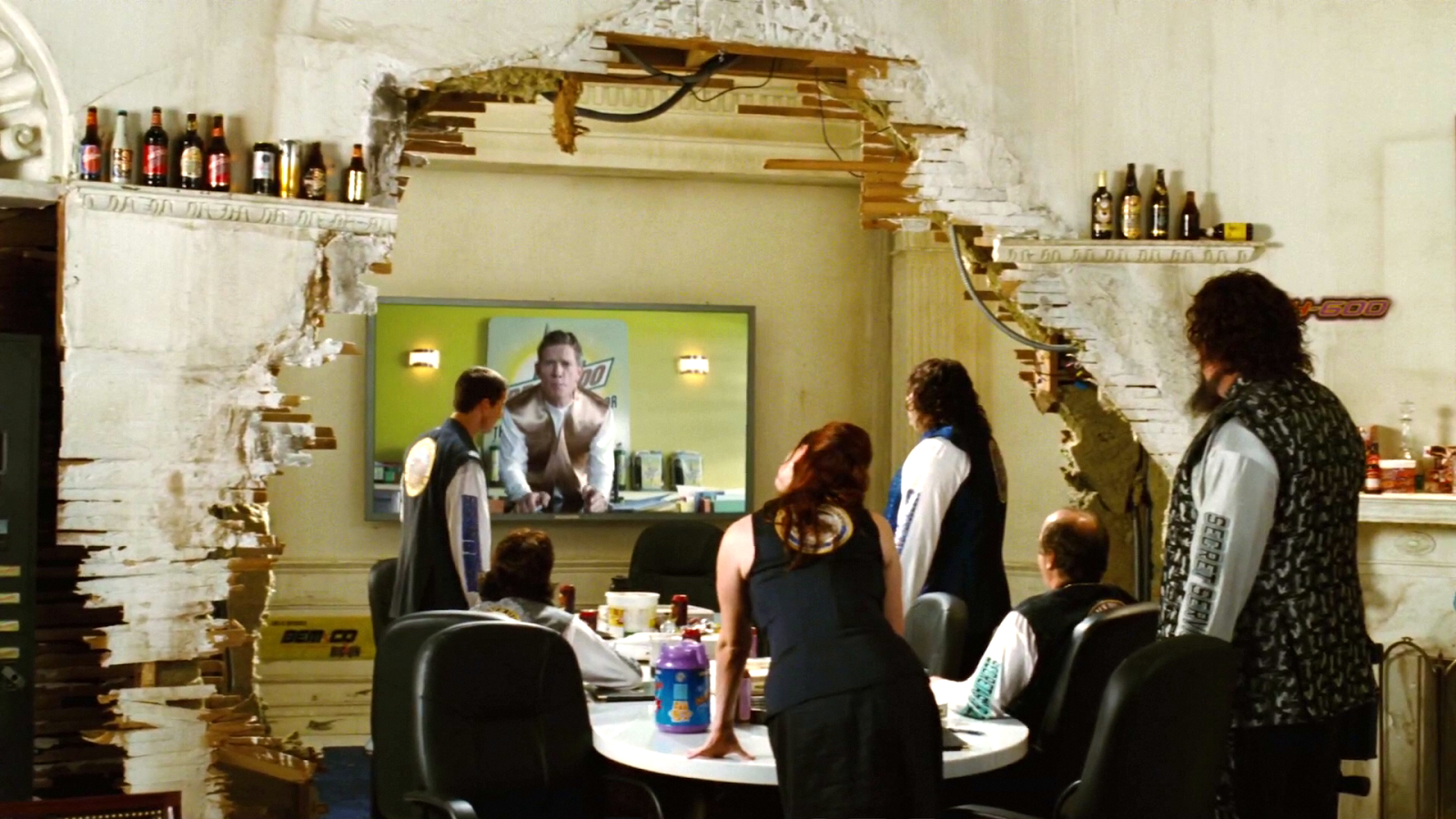
There are a few obvious AIs in the film. Explicitly, an AI manages the corporations. Recall that when Joe convinces the cabinet that he can talk to plants, and that they really want to drink water…well, let’s let the narrator from the film explain…
NARRATOR
Given enough time, Joe’s plan might have worked. But when the Brawndo stock suddenly dropped to zero leaving half the population unemployed; dumb, angry mobs took to the streets, rioting and looting and screaming for Joe’s head. An emergency cabinet meeting was called with the C.E.O. of the Brawndo Corporation.
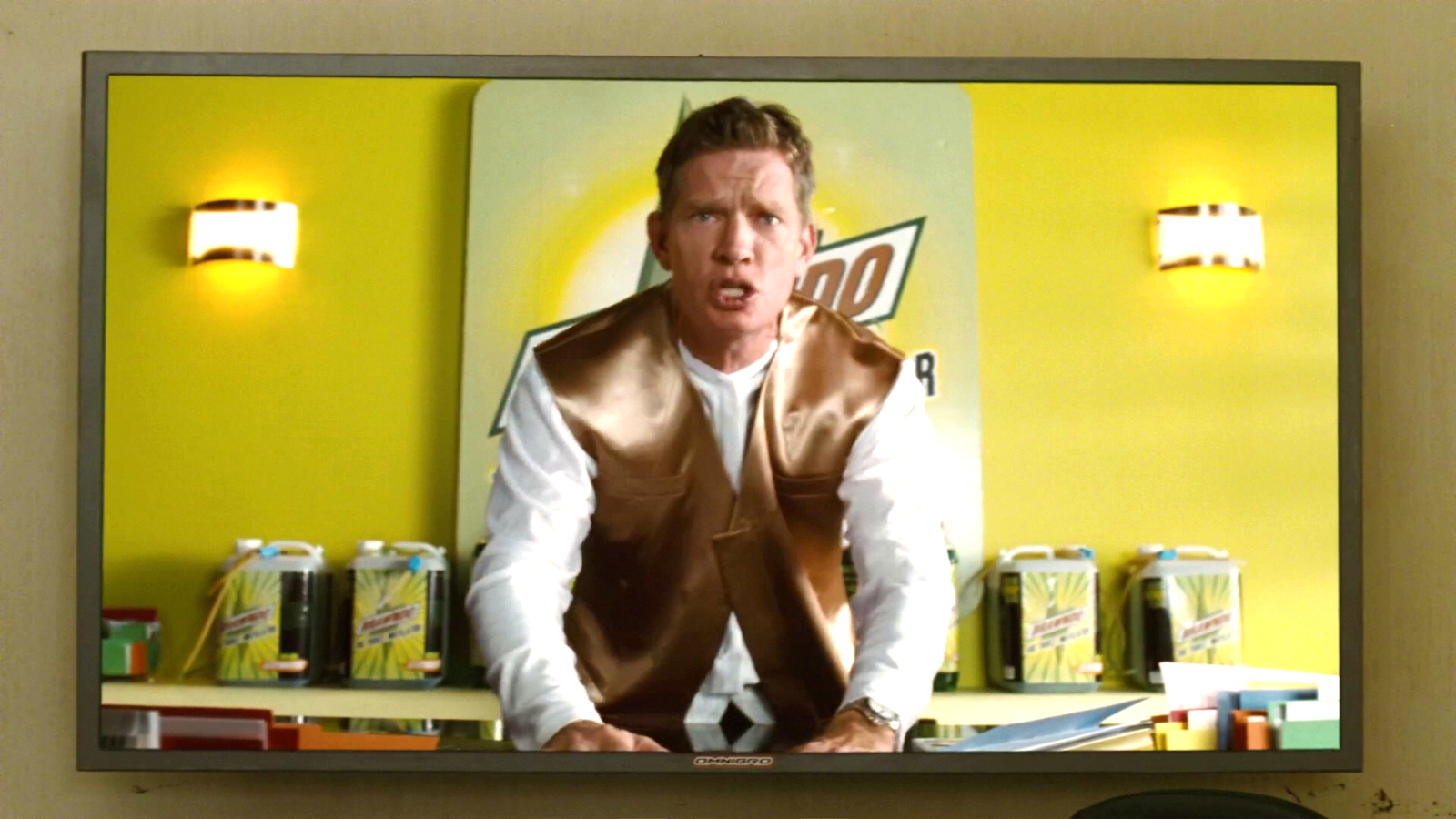
At the meeting the C.E.O. shouts, “How come nobody’s buying Brawndo the Thirst Mutilator?”
The Secretary of State says, “Aw, shit. Half the country works for Brawndo.” The C.E.O. shouts, “Not anymore! The stock has dropped to zero and the computer did that auto-layoff thing to everybody!” The wonders of giving business decisions over to automation.
I also take it as a given that AI writes the speeches that King Camacho reads because who else could it be? These people are idiots who don’t understand the difference between government and corporations, of course they would want to run the government like a corporation because it has better ads. And since AIs run the corporations in Idiocracy…
No. I don’t mean those AIs. I mean that you should rewatch the film understanding that Joe and Rita, the lead characters, are Super AIs in the context of Idiocracy.
The protagonists are super AIs
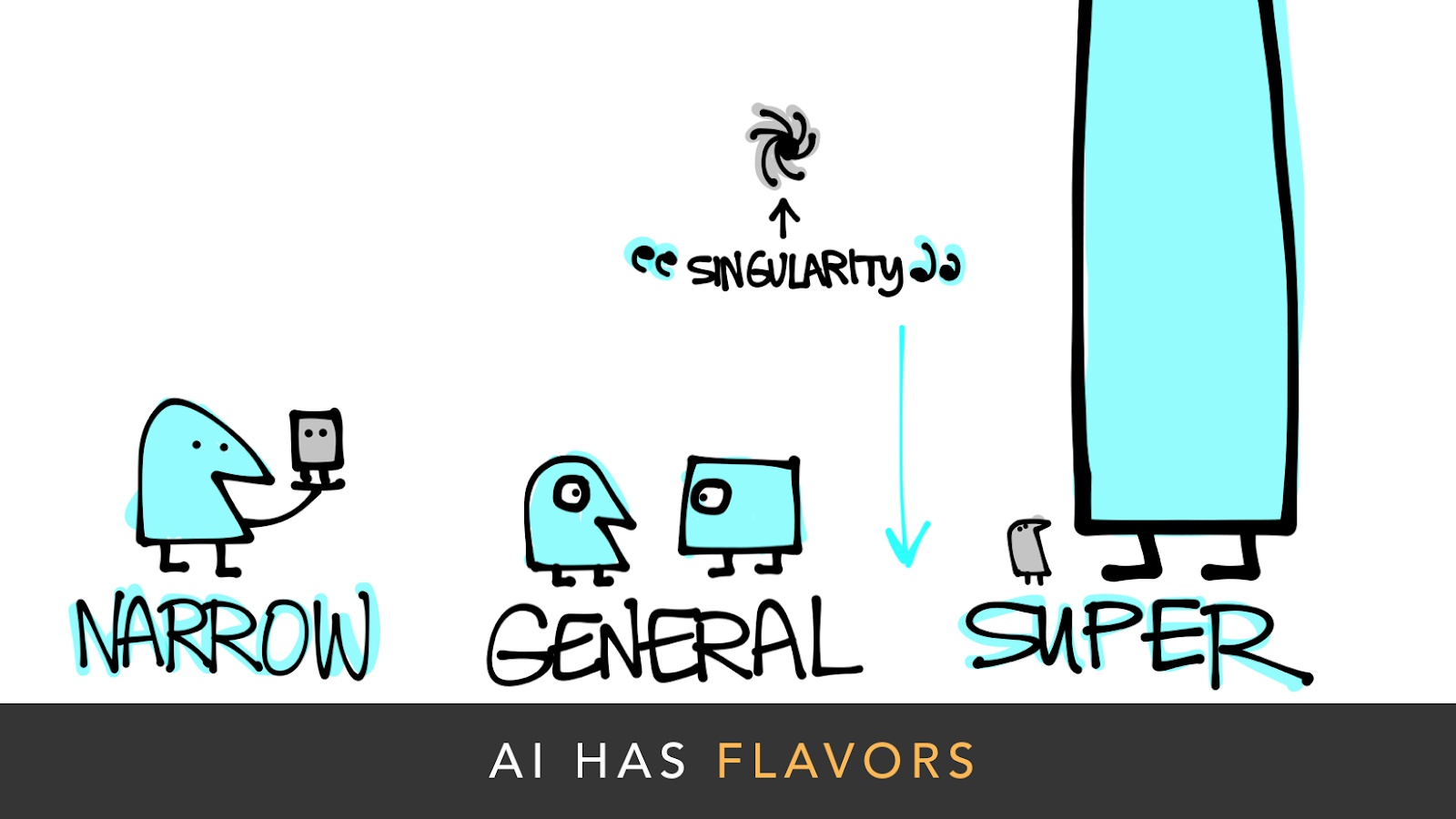
The literature distinguishes between three supercategories of artificial intelligence.
Narrow AI, which is the AI we have in the world now. It’s much better than humans in some narrow domain. But it can’t handle new situations. You can’t ask a roboinvestor to help plan a meal, for example, even though it’s very very good at investing.
General AI, definitionally meaning “human like” in it’s ability to generalize from one domain of knowledge to handle novel situations. If this exists in the world, it’s being kept very secret. It probably does not.
Super AI, the intelligence of which dwarfs our own. Again, this probably doesn’t exist in the world, but if it did, it’s being kept very secret. Or maybe even keeping itself secret. The difference between a bird’s intelligence and a human’s is a good way to think about the difference between our intelligence and a superintelligence. It will be able to out-think us at every step. We may not even be able to understand the language in which asks its questions.
Illustration by the author (often used when discussing agentive technology.)
Now the connection to Joe and Rita should be apparent. Though theirs is not an artificial intelligence, the difference between their smarts and that of Idiocracy approaches that same uncanny scale.
Watch how Joe and Rita move through this world. They are routinely flabbergasted at the stupidity around them. People are pointlessly belligerent, distractedly crass, easily manipulated, guided only by their base instincts, desperate to not appear “faggy,” and guffawing about (and cheering on) horrific violence. Rita and Joe are not especially smart by our standards, but they can outthink everyone around them by orders of magnitude, and that’s (comparatively) super AI.
The people of Idiocracy have idioted themselves into a genuine ecological crisis. They need to stop poisoning their environment because, at the very least, it’s killing them. But what about jobs! What about profits! Does this sound familiar?
Pictured: Us.
Joe doesn’t have any problem figuring out what’s wrong. He just tastes what’s being sprayed in the fields, and it’s obvious to him. His biggest problem is that the people he’s trying to serve are too dumb to understand the explanation (much less their culpability). He has to lie and feed them some bullshit reason and then manage people’s frustration that it doesn’t work instantly, even though he knows and we know it will work given time.
In this role as superintelligences, our two protagonists illustrate key critical concerns we have about superintelligent AIs:
Economic control
Social manipulation
Uncontainability
Cooperation by “multis.”
Economic control
Rita finds it trivially easy to bilk one idiot out of money and gain economic power. She could use her easy lucre to, in turn, control the people around her. Fortunately she is a benign superintelligence.
Yeah baby I could wait two days.
In the Chapter 6 of the seminal work on the subject, Superintelligence, Nick Bostrom lists six superpowers that an ASI would work to gain in order to achieve its goals. The last of these he terms “economic productivity” using which the ASI can “generate wealth which can be used to buy influence, services, resources (including hardware), etc.” This scene serves as a lovely illustration of that risk.
Of course you’re wondering what the other five are, so rather than making you go hunt for them…
Intelligence amplification, to bootstrap its own intelligence
Strategizing, to achieve distant goals and overcome intelligent opposition
Social manipulation, to leverage external resources by recruiting human support, to enable a boxed AI to persuade its gatekeepers to let it out, and to persuade states and organizations to adopt some course of action.
Hacking, so the AI can expropriate computational resources over the internet, exploit security holes to escape cybernetic confinement, steal financial resources, and hijack infrastructure like military robots, etc.
Technology research, to create a powerful military force, to create surveillance systems, and to enable automated space colonization.
Economic productivity, to generate wealth which can be used to buy influence, services, resources (including hardware), etc.
Social manipulation
Joe demonstrates the second of these, social manipulation, repeatedly throughout the film.
He convinces the cabinet to switch to watering crops by telling them he can talk to plants.
He convinces the guard to let him escape prison (more on this below).
Joe’s not perfect at it. Early in the film he tries reason to convince the court of his innocence, and fails. Later he fails to convince the crowd to release him in Rehabilitation. An actual ASI would have an easier time of these things.
Uncontainability
The only way they contain Joe in the early part of the film is with a physical cage, and that doesn’t last long. He finds it trivially easy to escape their prison using, again, social manipulation.
JOE
Hi. Excuse me. I’m actually supposed to be getting out of prison today, sir.
GUARD
Yeah. You’re in the wrong line, dumb ass. Over there.
JOE
I’m sorry. I am being a big dumb ass. Sorry.
GUARD (to other guard)
Hey, uh, let this dumb ass through.
Elizer Yudkowsky, Research Fellow at the Machine Intelligence Research Institute, has described the AI-Box problem, in which he illustrates the folly of thinking that we could contain a super AI. (Bostrom also cites him in the Superintelligence book.) Using only a text terminal, he argues, an ASI can convince an even a well-motivated human to release it. He has even run social experiments where one participant played the unwilling human, and he played the ASI, and both times the human relented. And while Elizer is a smart guy, he is not an ASI, which would have an even easier time of it. This scene illustrates how easily an ASI would thwart our attempts to cage it.
Cooperation between multis
Chapter 11 of Bostrom’s book focuses on how things might play out if instead of only one ASI in the world, a “singleton” there are many ASIs, or “multis.” (Colossus: The Forbin Project and Person of Interest also explore these scenarios with artificial superintelligences.)
In this light, Joe and Rita are multis who unite over shared circumstances and woes, and manage to help each other out in their struggle against the idiots. Whatever advantage the general intelligences have over the individual ASIs are significantly diminished when they are working together.
Note: In Bostrom’s telling, multis don’t necessarily stabilize each other, they just make things more complex and don’t solve the core principal-agent problem. But he does acknowledge that stable, voluntary cooperation is a possible scenario.
Cold comfort ending
At the end of Idiocracy, we can take some cold comfort that Rita and Joe have a moral sense, a sense of self-preservation, and sympathy for fellow humans. All they wind up doing is becoming rulers of the world and living out their lives. (Oh god are their kids Von Neumann probes?) The implication is that, as smart as they are, they will still be outpopulated by the idiots of that world.
Imagine this story is retold where Joe and Rita are psychopaths obsessed with making paper clips, with their superintelligent superpowers and our stupidity. The idiots would be enslaved to paper clip making before they could ask whether or not it’s fake news.
Or even less abstractly, there is a deleted “stinger” scene at the end of some DVDs of the film where Rita’s pimp UPGRAYEDD somehow winds up waking up from his own hibernation chamber right there in 2505, and strolls confidently into town. The implied sequel would deal with an amoral ASI (UPGRAYEDD) hostile to its mostly-benevolent ASI leaders (Rita and Joe). It does not foretell fun times for the Idiocracy.
For me, this interpretation of the film is important to “redeem” it, since its big takeaway—that is, that people are getting dumber over time—is known to be false. The Flynn Effect, named for its discoverer James R. Flynn, is the repeatedly-confirmed observation that measurements of intelligence are rising, linearly, over time, and have been since measurements began. To be specific, this effect is not seen in general intelligence but rather the subset of fluid, or analytical intelligence measures. The rate is about 3 IQ points per decade.
Wait. What? How can this be? Given the world’s recent political regression (that kickstarted the series on fascism and even this review of Idiocracy) and constant news stories of the “Florida Man” sort, the assertion does not seem credible. But that’s probably just availability bias. Experts cite several factors that are probably contributing to the effect.
Better health
Better nutrition
More and better education
Rising standards of living
The thing that Idiocracy points to—people of lower intelligence outbreeding people of higher intelligence—was seen as not important. Given the effect, this story might be better told not about a time traveler heading forwards, but rather heading backwards to some earlier era. Think Idiocracy but amongst idiots of the Renaissance.
Since I know a lot of smart people who took this film to be an exposé of a dark universal pattern that, if true, would genuinely sour your worldview and dim your sense of hope, it seems important to share this.
So go back and rewatch this marvelous film, but this time, dismiss the doom and gloom of declining human intelligence, and watch instead how Idiocracy illustrates some key risks (if not all of them) that super artificial intelligence poses to the world. For it really is a marvelously accessible shorthand to some of the critical reasons we ought to be super cautious of the possibility.
Once a victim is wearing a Trivium Bracelet, any of Orlak’s henchmen can control the wearer’s actions. The victim’s expression is blank, suggesting that their consciousness is either comatose, twilit, or in some sort of locked in state. Their actions are controlled via a handheld remote control.
We see the remote control in use in four places in Las Luchadoras vs El Robot Asesino.
One gets clapped on Dr. Chavez to test it.
One goes on Gemma to demonstrate it.
One is removed from the robot.
One goes on Berthe to transform her to Black Electra.
As of this posting, the Untold AI analysis stands at 11 posts and around 17,000 words. (And there are as yet a few more to come. Probably.) That’s a lot to try and keep in your head. To help you see and reflect on the big picture, I present…a big picture.
This data visualization has five main parts. And while I tried to design them to be understandable from the graphic alone, it’s worth giving a little tour anyway.
On the left are two sci-fi columns connected by Sankey-ish lines. The first lists the sci-fi movies and TV shows in the survey. The first ten are those that adhere to the science. Otherwise, they are not in a particular order. The second column shows the list of takeaways. The takeaways are color-coded and ordered for their severity. The type size reflects how many times that takeaway appears in the survey. The topmost takeaways are those that connect to imperatives. The bottommost are those takeaways that do not. The lines inherit the takeaway color, which enables a close inspection of a show’s node to see whether its takeaways are largely positive or negative.
On the right are two manifestocolumns connected by Sankey-ish lines. The right column shows the manifestos included in the analysis. The left column lists the imperatives found in the manifestos. The manifestos are in alphabetical order. Their node sizes reflect the number of imperatives they contain. The imperatives are color-coded and clustered according to five supercategories, as shown just below the middle of the poster. The topmost imperatives are those that connect to takeaways. The bottommost are those that do not. The lines inherit the color of the imperative, which enables a close inspection of a manifesto’s node to see to which supercategory of imperatives it suggests. The lines connected to each manifesto are divided into two groups, the topmost being those that are connected and the bottommost those that are not. This enables an additional reading of how much a given manifesto’s suggestions are represented in the survey.
The area between the takeaways and imperatives contains connecting lines, showing the mapping between them. These lines fade from the color of the takeaway to the color of the imperative. This area also labels the three kinds of connections. The first are those connections between takeaways and imperatives. The second are those takeaways unconnected to imperatives, which are the “Pure Fiction” takeaways that aren’t of concern to the manifestos. The last are those imperatives unconnected to takeaways, the collection of 29 Untold AI imperatives that are the answer to the question posed at the top of the poster.
Just below the big Sankey columns are the five supercategories of Untold AI. Each has a title, a broad description, and a pie chart. The pie chart highlights the portion of imperatives in that supercategory that aren’t seen in the survey, and the caption for the pie chart posits a reason why sci-fi plays out the way it does against the AI science.
You’ve seen all of this in the posts, but seeing it all together like this encourages a different kind of reflection about it.
Interactive, someday?
Note that it is possible but quite hard to trace the threads leading from, say, a movie to its takeaways to its imperatives to its manifesto, unless you are looking at a very high resolution version of it. One solution to that would be to make the visualization interactive, such that rolling over one node in the diagram would fade away all non-connected nodes and graphs in the visualization, and data brush any related bits below.
A second solution is to print the thing out very large so you can trace these threads with your finger. I’m a big enough nerd that I enjoy poring over this thing in print, so for those who are like me, I’ve made it available via redbubble. I’d recommend the 22×33 if you have good eyesight and can handle small print, or the 31×46 max size otherwise.
Maybe if I find funds or somehow more time and programming expertise I can make that interactive version possible myself.
Some new bits
Sharp-eyed readers may note that there are some new nodes in there from the prior posts! These come from late-breaking entries, late-breaking realizations, and my finally including the manifesto I was party to.
Sundar Pichai published the Google AI Principles just last month, so I worked it in.
I finally worked the Juvet Agenda in as a manifesto. (Repeating disclosure: I was one of its authors.) It was hard work, but I’m glad I did it, because it turns out it’s the most-connected manifesto of the lot. (Go, team!)
The Juvet Agenda also made me realize that I needed new, related nodes for both takeaways and imperatives: AI will enable or require new models of governance. (It had a fair number of movies, too.) See the detailed graph for the movies and how everything connects.
I modified the Flourish SVG, added the rest of the data, and did final layout in Adobe Illustrator
The poster’s type is mostly Sentinel, a font from Hoefler & Co., because I think it’s lovely, highly readable, and I liked that Sentinels are also a sci-fi AI.
Some readers reported being unable to read the prior post because of its script formatting. Here is the same post without that formatting…
INTERIOR. Sci-fi auditorium. Maybe the Plavalaguna Opera House. A heavy red velvet curtain rises, lifted by anti-gravity pods that sound like tiny TIE fighters. The HOST stands on a floating podium that rises from the orchestra pit. The HOST wears a velour suit with piping, which glows with sliding, overlapping bacterial shapes.
HOST: Hello and welcome to The Fritzes: AI Edition, where we give out awards for awesome movies and television shows about AI that stick to the science.
FX: Applause, beeping, booping, and the sound of an old modem from the audience.
HOST: For those wondering how we picked these winners, it was based on the Untold AI analysis from scifiinterfaces.com. That analysis compared what sci-fi shows suggest about AI (called “takeaways”) to what real world manifestos suggest about AI (called “imperatives”). If a movie had a takeaway that matched an imperative, it got a point. But if it perpetuated a pointless and distracting myth, it lost five points.
The Demon Seed metal-skinned podling thing stands up in the back row of the audience and shouts: Booooooo!
HOST: Thank you, thank you. But just sticking to the science is not enough. We also want to reward shows that investigate these ideas with quality stories, acting, effects, and marketing departments. So the sums were multiplied by that show’s Tomatometer rating. This way to top films didn’t just tell the right stories (according to the science), but it told them well.
Totals were tallied by the firm of Google Sheets algorithms. Ok, ok. Now, to give away awards 009 through 006 are those loveable blockheads from Interstellar, TARS and CASE.
TARS and CASE crutch-walk onto the stage and reassemble as solid blocks before the lectern.