Profiling “CAT” scan

fifthelement-122

After her escape from the nucleolab, Leeloo ends up on a thin ledge of a building, unsure where to go or what to do. As a police car hovers nearby, the officers use an onboard computer to try and match her identity against their database. One officer taps a few keys into an unseen keyboard, her photograph is taken, and the results displays in about 8 seconds. Not surprisingly, it fails to find a match, and the user is told so with an unambiguous, red “NO FILE” banner across the screen.

fifthelement-128

This interface flies by very quickly, so it’s not meant to be read screen by screen. Still, the wireframes present a clear illustration of what the system doing, and what the results are.

The system shouldn’t just provide dead ends like this, though. Any such system has to account for human faces changing over the time since the last capture: aging, plastic surgery, makeup, and disfiguring accidents, to name a few. Since Leeloo isn’t inhuman, it could provide some results of “closest matches,” perhaps with a confidence percentage alongside individual results. Even if the confidence number was very low, that output would help the officers understand it was an issue with the subject, and not an issue of an incomplete database or weak algorithm.

One subtle element is that we don’t see or hear the officer telling the system where the perp is, or pointing a camera. He doesn’t even have to identify her face. It automatically finds her in the camera few, identifies her face, and starts scanning. The sliding green lines tell the officer what it’s finding, giving him confidence in its process, and offering an opportunity to intervene if it’s getting things wrong.

Resistance Chutes

Barbarella-079

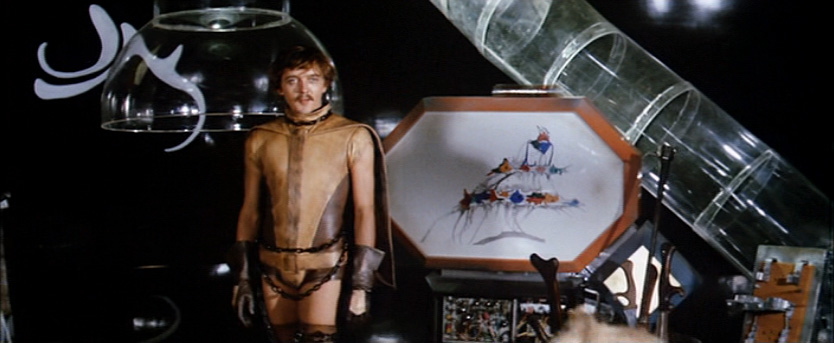
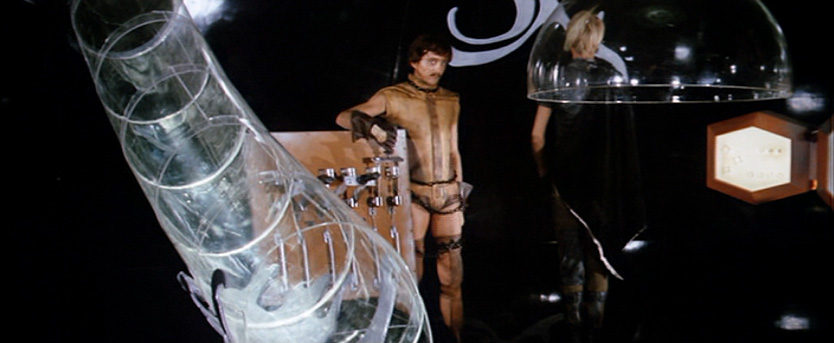
In order to conduct its subversions, the Resistance has a set of secret pneumatic chutes throughout SoGo. To monitor them, they have a map of the city with the chutes drawn as lines and places within the city illuminated with small lights.

The purpose of the lights is a bit vague, since just before Barbarella leaves Resistance Headquarters, Dildano glances at the map to see a red dot flashing at the very top. Gesturing at the light he remarks, “The time is right. The Queen is in her Chamber of Dreams.” But we know from the end of the film that the Queen’s Dream Chamber is on the lowest level of the city, close to Mathmos. (It would seem the Resistance has some severe information gathering issues.) So is each location able to change color to represent prominent individuals? What if two prominent people are in the same place? How does Dildano indicate which prominent person he wishes to track? We never see these controls, and per the axiom of providing inputs near outputs, we would want them to be somewhere around here.

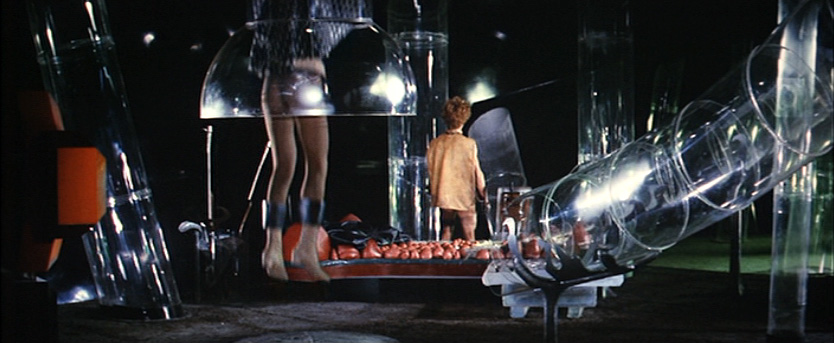
We do get to see one interface in action, though. The chutes themselves are controlled by a set of rather rickety knife switches with large handles. A Resistance member throws one of the switches to initiate suction in a particular tube. (Fans of Futurama should note some similarities to the public transportation system in New New York.)

Barbarella-081

One the switch is thrown, a traveler extends his or her arms upwards, and then the tube handles the rest. The exits is ungraceful, tumbling travelers onto the floor in conspicuous places somewhere in SoGo.

Barbarella-096

Portable brainwave detector

Barbarella-032

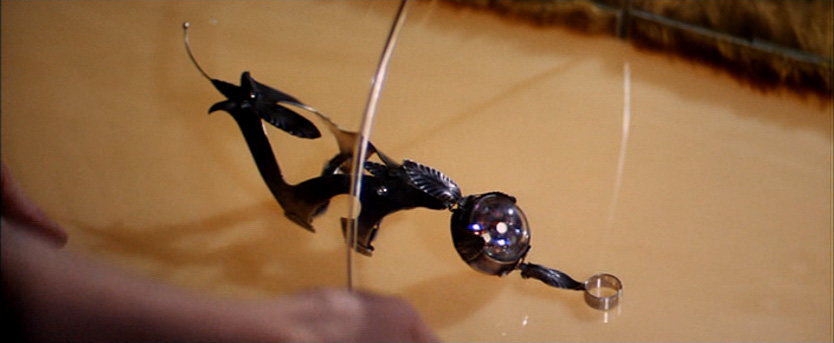
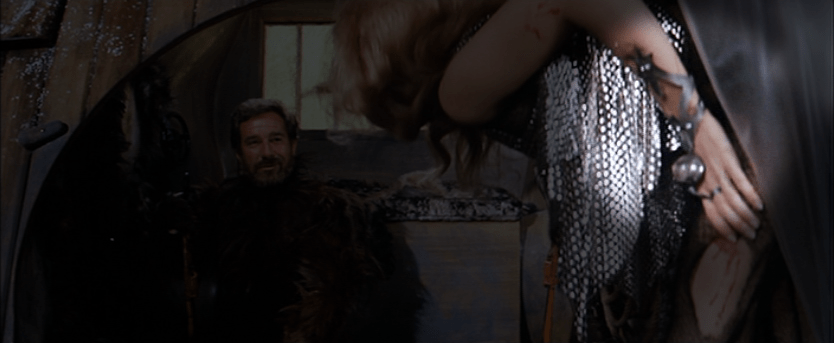
Through the atom transmitter Dianthus bestows several gifts on Barbarella to help her with her mission. The first of these is the “portable brainwave detector…to test for Durand-Durand’s presence.” To operate it, Barbarella must press “a contact,” (Dianthus is offscreen when he indicates the contact, but later we see her operating the leaf-like button near the wrist) and if Durand-Durand is around, the ball of lights will glow and an alarm will sound.

vlcsnap-00002

The device is wearable, wrapping around Barbarella’s forearm, and held in place by a ring. This aspect of the design is good, since it means the device is ever-present for operation, and the design of it makes it lovely enough to be overlooked as a fashion accessory. In fact many characters see her wearing it and make no mention.

PBD_worn

Manual activation is less than ideal, though, since this might tip off the suspect. This is especially true with the blinking, glowing ball of light and audio feedback. And, in fact, this is what happens later in the film when Durand-Durand trips over the device. The blinking light and audio catch his attention, betray the device for what it is, and blow Barbarella’’s cover in the process.

Portable Brainwave Device

The best feedback would be invisible, like a haptic vibration through the cuff to her skin. Ideally, the device would be constantly on, to detect the subject passively, the moment he came into range. But presuming battery life is the issue, the activation cue should be something much more subtle, like Barbarella’s touching the back of the ring with the thumb of the same hand. Such a gesture would match the existing design of the object, be discreet to an observer, and yet still discrete enough to prevent accidental activation.

Dianthus calling

Barbarella-022

Alphy’’s first action in the film is to announce a call from Dianthus, President of Earth and Rotating Premier of the Sun System. During Alphy’’s announcement, a free-standing mock-classical sculpture of a woman shifts to enlarge the crescent frame she holds above her shoulder. This becomes the organically-shaped view screen for the videophone conference between Barbarella and the President.

Barbarella-017

When it is fully extended, the frame fills with the video feed from Dianthus. No camera mechanism is seen. The gaze matching (see Chapter 4, Volumetric Projection) is handled somewhat mysteriously. For an early part of the conversation Dianthus is looking directly at her breasts rather than her eyes. Barbarella was steeped in the sexual freedom utopia tropes of its day, but this actually seems to be an error in presentation, since neither acknowledges it. Also Dianthus appears at several distances and heights during the course of the fall, sometimes sitting and sometimes standing. He must have had a cameraman. This isn’t inconceivable for a President of Earth, but not yet scalable for mass market use.

Barbarella-Dianthus-gaze

When during the call Barbarella gets upset at the possibility of “archaic insecurity,” she crosses to the far side of the statue. This reveals that the display surface is two-dimensional, and displays perfectly from both sides. During her movement, Dianthus follows her and turns around to talk with her from the other side of the statue. We do see at the beginning of the conversation that his camera moves, so he has some kind of different setup than hers. This raises some curious questions about what Dianthus is seeing from his side of the exchange, but alas, we are never shown, so it is an exercise left for the designer/fan.

As with the Purple Drank, controls are never seen for this communication. Alphy handles absolutely everything.

Security and Control’s control

The mission is world-critical, so like a cockpit, the two who are ultimately in control are kept secure. The control room is accessible (to mere humans, anyway) only through a vault door with an armed guard. Hadley and Sitterson must present IDs to the guard before he grants them access.

Sitterson and Hadley pass security.

Truman, the guard, takes and swipes their cards through a groove in a hand-held device. We are not shown what is on the tiny screen, but we do hear the device’s quick chirps to confirm the positive identity. That sound means that Truman’s eyes aren’t tied to the screen. He can listen for confirmation and monitor the people in front of him for any sign of nervousness or subterfuge.

Hadley boots up the control room screens.

The room itself tells a rich story through its interfaces alone. The wooden panels at the back access Bronze Age technology with its wooden-handled gears, glass bowls, and mechanical devices that smash vials of blood. The massive panel at which they sit is full of Space Age pushbuttons, rheostats, and levers. On the walls behind them are banks of CRT screens. These are augmented with Digital Age, massive, flat panel displays and touch panel screens within easy reach on the console. This is a system that has grown and evolved for eons, with layers of technology that add up to a tangled but functional means of surveillance and control.

The interfaces hint at the great age of the operation.

Utter surveillance

In order for Control to do their job, they have to keep tabs on the victims at all times, even long before the event: Are the sacrifices conforming to archetype? Do they have a reason to head to the cabin?

The nest empties.

To these ends, there are field agents in the world reporting back by earpiece, and everything about the cabin is wired for video and audio: The rooms, the surrounding woods, even the nearby lake.

Once the ritual sacrifice begins, they have to keep an even tighter surveillance: Are they behaving according to trope? Do they realize the dark truth? Is the Virgin suffering but safe? A lot of the technology seen in the control room is dedicated to this core function of monitoring.

The stage managers monitor the victims.

There are huge screens at the front of the room. There are manual controls for these screens on the big panel. There is an array of CRTs on the far right.

The small digital screens can display anything, but a mode we often see is a split in quarters, showing four cameras in the area of the stage. For example, all the cameras fixed on the rooms are on one screen. This provides a very useful peripheral signal in Sitterson and Hadley’s visual field. As they monitor the scenario, motion will catch their eyes. If that motion is not on a monitor they expect it to be, they can check what’s happening quickly by turning their head and fixating. This helps keep them tightly attuned to what’s happening in the different areas on “stage.”

For internal security, the entire complex is also wired for video, including the holding cages for the nightmare monsters.

Sitterson looks for the escapees amongst the cubes.

The control room watches the bloody chaos spread.

One screen that kind of confuses us appears to be biometrics of the victims. Are the victims implanted with devices for measuring such things, or are sophisticated non-invasive environmental sensors involved? Regardless of the mechanisms, if Control has access to vital signs, how are they mistaken about Marty’s death? We only get a short glance at the screen, so maybe it’s not vital signs, but simple, static biometrics like height, and weight, even though the radiograph diagram suggests more.

Sitterson tries to avoid talking to Mordecai.

Communications

Sitterson and Hadley are managing a huge production. It involves departments as broad ranging as chemistry, maintenance, and demolitions. To coordinate and troubleshoot during the ritual, two other communications options are available beyond the monitors; land phone lines and direct-connection, push-to-talk microphones.

Hadley receives some bad news.