Lifeclock: The central conceit

LogansRun004

The central technological conceit of the movie is the lifeclock, a rosette crystal that is implanted in each citizen’s left palm at birth. This clock changes color in stages over the course of the individual’s lifetime.

Though the information in the movie is somewhat contradictory as to the actual stages, the DVD has an easter egg that explains the stages as follows.

White white Birth to 8 years
Yellow yellow 9 to 15 years
Green green 16 to 23 years
Red red 24 years to 10 days before Lastday (30 years)
Blinking Red red_blink from 10 days before Lastday to Lastday
Black black End of Lastday (Carousel/death)

LOGANS_RUN_blinking_520

Lifeclocks derive their signal and possibly power from a local-area broadcast in the city. When Logan and Jessica leave the city their lifeclocks turn clear.

The signal of the lifeclock is so central to life that most citizens dress exclusively in colors that match their lifeclock color. Only certain professions, such as Sandmen and the New You doctor, are seen to wear clothing that lacks clear reference to a lifeclock color, even though the individuals in these professions have lifeclocks and are still subject to carousel at Lastday. We can presume, though are not shown explicitly, that certain rights and responsibilities are conferred on citizens in different stages, such as legal age of sexual consent and access to intoxicants, so the clothing acts as a social signal of status.

LogansRun018

As an interface the lifeclock is largely passive, and can be discussed for its usability in two main ways.

Color

The first is the color. Are the stages easily discernable by people? The main problem would be between the red and green stages since the forms of red-green color blindness affects around 4% of the population. To accommodate for this, reds are made more discernable with a brighter glow than the green. As a wavelength, red carries the farthest, and blinking is of course a highly visible and attention-getting signal, which makes it difficult for an individual to socially hide that his or her time for carousel has come.

LogansRun228

Black is a questionable signal since this indicates actual violation of the law but does not draw any attention to itself. Casual observation of a relaxed hand with a black lifeclock might even be mistaken for a colored lifeclock in shadow, but as the citizenry has complete faith in the system and a number of countermeasures in place to ensure that everyone either attends carousel or is terminated, perhaps this is not a concern.

But if we’re just going on human signal processing, the red should be reserved for LastWeek, and a blinking red for after LastDay. That leaves a color gap between 24 and 30. I’d make this phase blue, since it looks so clearly different from red. The new colors would be as follows.

White white Birth to 8 years
Yellow yellow 9 to 15 years
Green green 16 to 23 years
Blue blue 24 years to 10 days before Lastday (30 years)
Red red from 10 days before Lastday to Lastday
Blinking Red red_blink End of Lastday (Carousel/death)

Location on the body

The second question is the location of the lifeclock. Where should it be placed? It is a social signal, and as such needs to be visible. The parts of the body that are most often seen uncovered in the film are the hand, the neck, and the head. The neck and head are problematic since these are not visible to the citizen himself, useful for reinforcing compliance with the system. This leaves the hand.

LogansRun_placement

Given the hand, the palm seems an odd choice since in a relaxed position or when the hand is in use, the palm is often hidden from view of other people. The colored clothing seen in the film show that a citizen’s life stage is not really considered a private matter, so a location on the back of the hand would have made more sense. To keep it in view of its owner, a location on the fleshy pad between the thumb and the forefinger would have made a better, if less cinematic, choice.

Profiling “CAT” scan

fifthelement-122

After her escape from the nucleolab, Leeloo ends up on a thin ledge of a building, unsure where to go or what to do. As a police car hovers nearby, the officers use an onboard computer to try and match her identity against their database. One officer taps a few keys into an unseen keyboard, her photograph is taken, and the results displays in about 8 seconds. Not surprisingly, it fails to find a match, and the user is told so with an unambiguous, red “NO FILE” banner across the screen.

fifthelement-128

This interface flies by very quickly, so it’s not meant to be read screen by screen. Still, the wireframes present a clear illustration of what the system doing, and what the results are.

The system shouldn’t just provide dead ends like this, though. Any such system has to account for human faces changing over the time since the last capture: aging, plastic surgery, makeup, and disfiguring accidents, to name a few. Since Leeloo isn’t inhuman, it could provide some results of “closest matches,” perhaps with a confidence percentage alongside individual results. Even if the confidence number was very low, that output would help the officers understand it was an issue with the subject, and not an issue of an incomplete database or weak algorithm.

One subtle element is that we don’t see or hear the officer telling the system where the perp is, or pointing a camera. He doesn’t even have to identify her face. It automatically finds her in the camera few, identifies her face, and starts scanning. The sliding green lines tell the officer what it’s finding, giving him confidence in its process, and offering an opportunity to intervene if it’s getting things wrong.

Portable brainwave detector

Barbarella-032

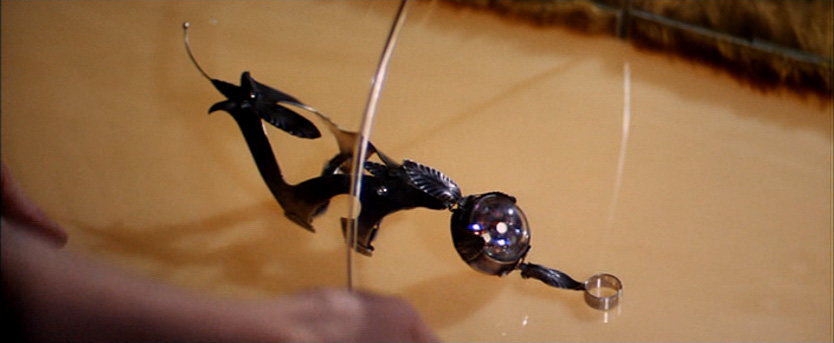
Through the atom transmitter Dianthus bestows several gifts on Barbarella to help her with her mission. The first of these is the “portable brainwave detector…to test for Durand-Durand’s presence.” To operate it, Barbarella must press “a contact,” (Dianthus is offscreen when he indicates the contact, but later we see her operating the leaf-like button near the wrist) and if Durand-Durand is around, the ball of lights will glow and an alarm will sound.

vlcsnap-00002

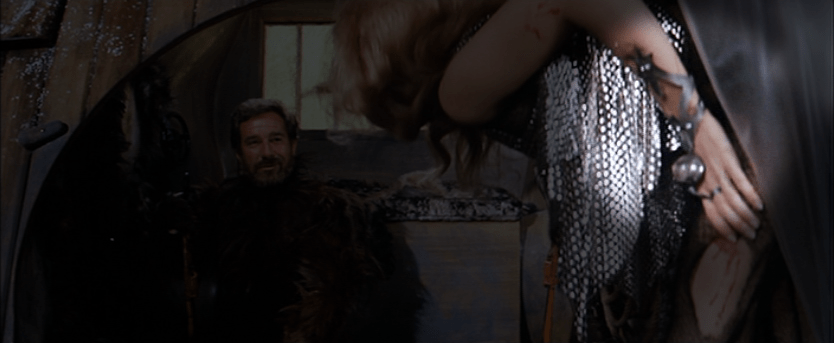
The device is wearable, wrapping around Barbarella’s forearm, and held in place by a ring. This aspect of the design is good, since it means the device is ever-present for operation, and the design of it makes it lovely enough to be overlooked as a fashion accessory. In fact many characters see her wearing it and make no mention.

PBD_worn

Manual activation is less than ideal, though, since this might tip off the suspect. This is especially true with the blinking, glowing ball of light and audio feedback. And, in fact, this is what happens later in the film when Durand-Durand trips over the device. The blinking light and audio catch his attention, betray the device for what it is, and blow Barbarella’’s cover in the process.

Portable Brainwave Device

The best feedback would be invisible, like a haptic vibration through the cuff to her skin. Ideally, the device would be constantly on, to detect the subject passively, the moment he came into range. But presuming battery life is the issue, the activation cue should be something much more subtle, like Barbarella’s touching the back of the ring with the thumb of the same hand. Such a gesture would match the existing design of the object, be discreet to an observer, and yet still discrete enough to prevent accidental activation.

Remote Monitoring

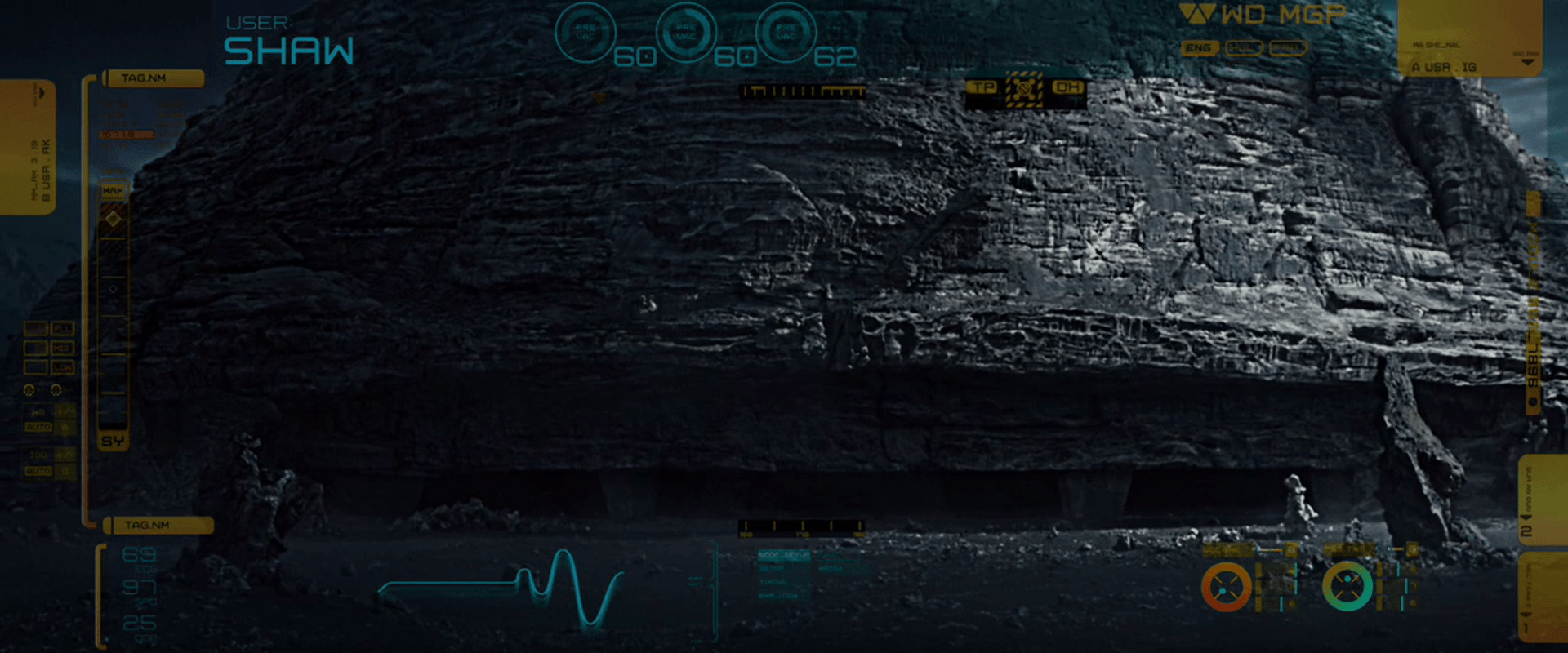
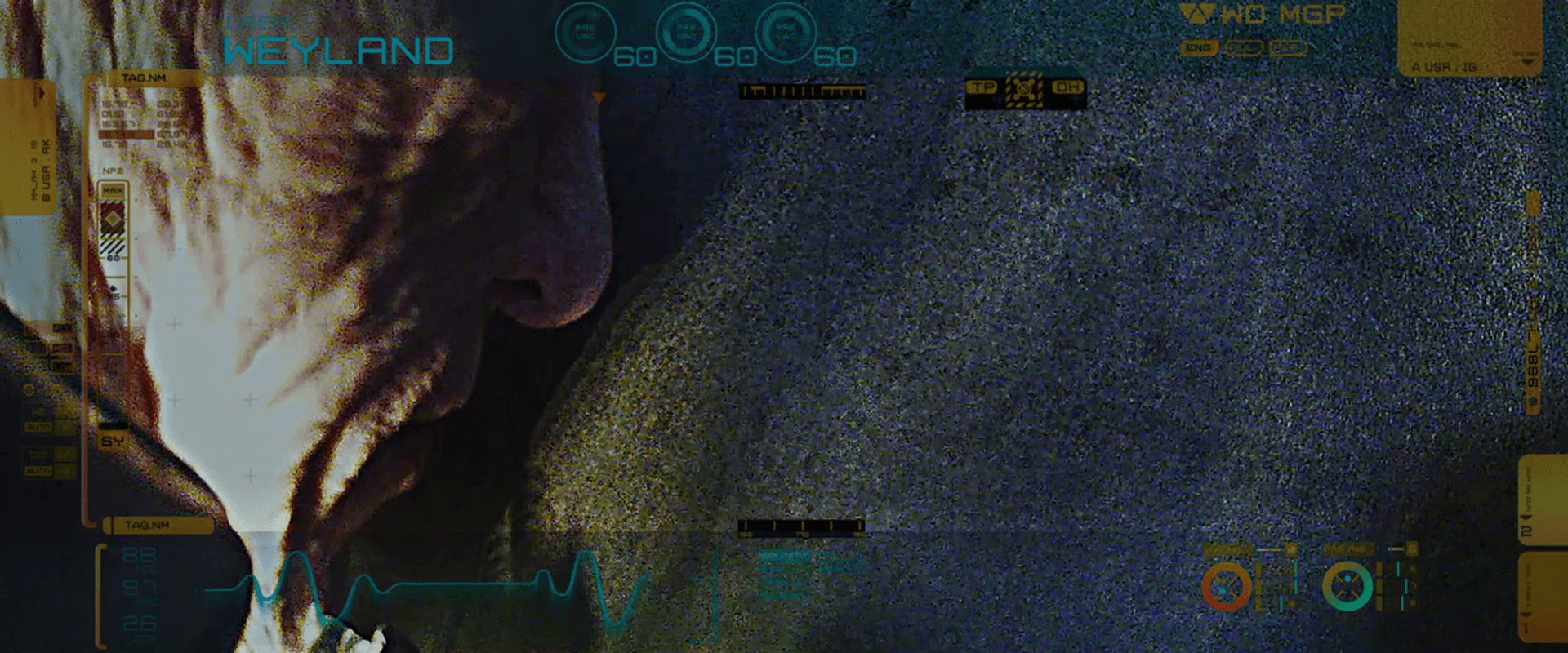
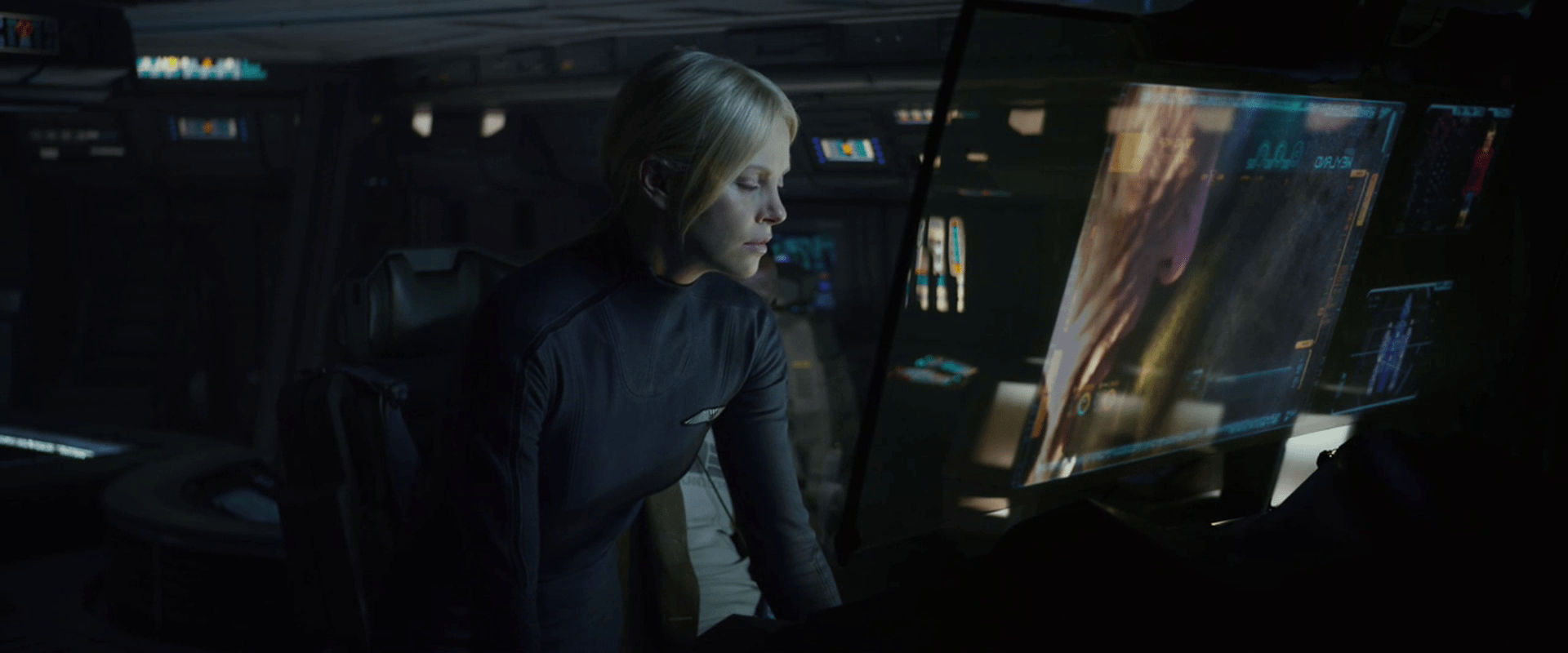
The Prometheus spacesuits feature an outward-facing camera on the chest, which broadcasts its feed back to the ship, where the video it overlaid with the current wearer’s name, and inscrutable iconographic and numerical data along the periphery. The suit also has biometric sensors, continuously sending it’s wearer’s vital signs back to the ship. On the monitoring screen, a waveform in the lower left appears is similar to a EKG, but is far too smooth and regular to be an actual one. It is more like an EKG icon. We only see it change shape or position along its bounding box once, to register that Weyland has died, when it turns to a flat line. This supports its being iconic rather than literal.

Prometheus-109

In addition to the iconic EKG, a red selection rectangle regularly changes across a list in the upper left hand corner of the monitor screens. One of three cyan numbers near the top occasionally changes. Otherwise the peripheral data on these monitoring screens does not change throughout the movie, making it difficult to evaluate its suitability.

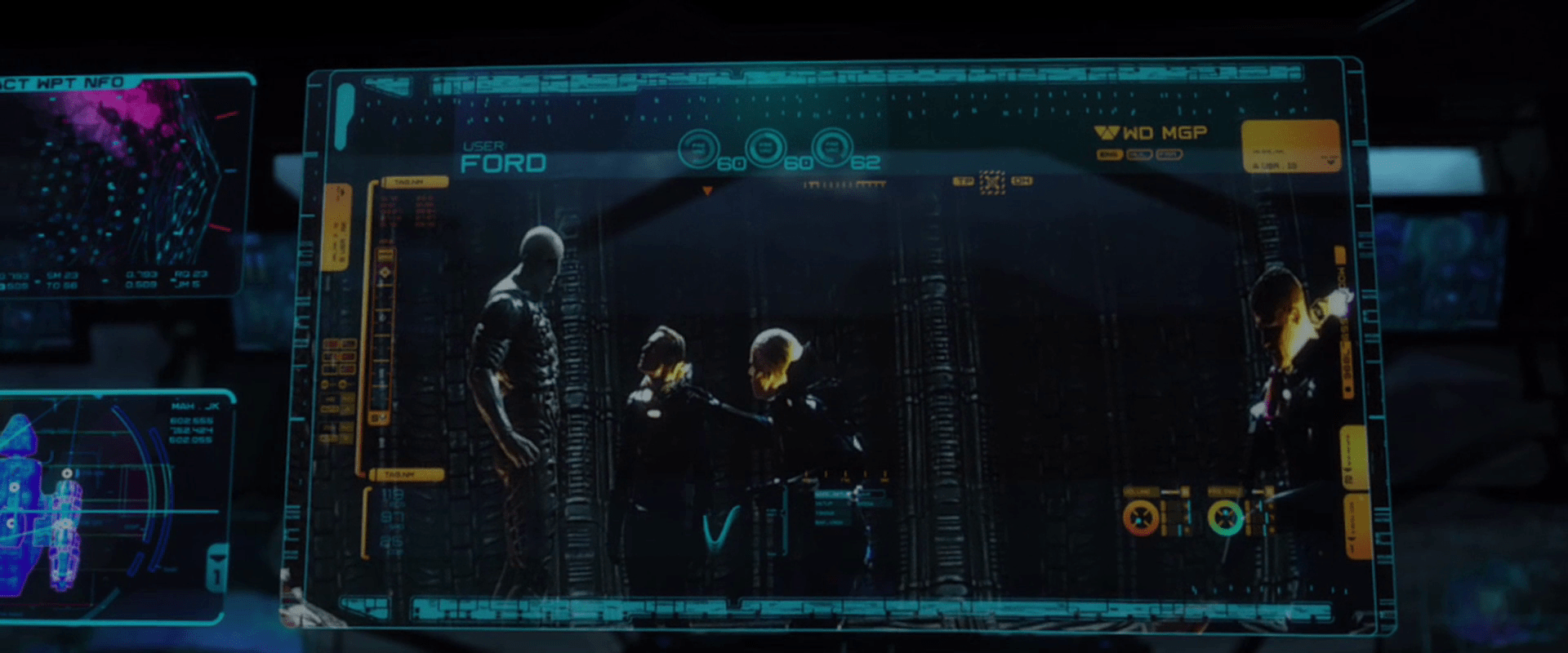
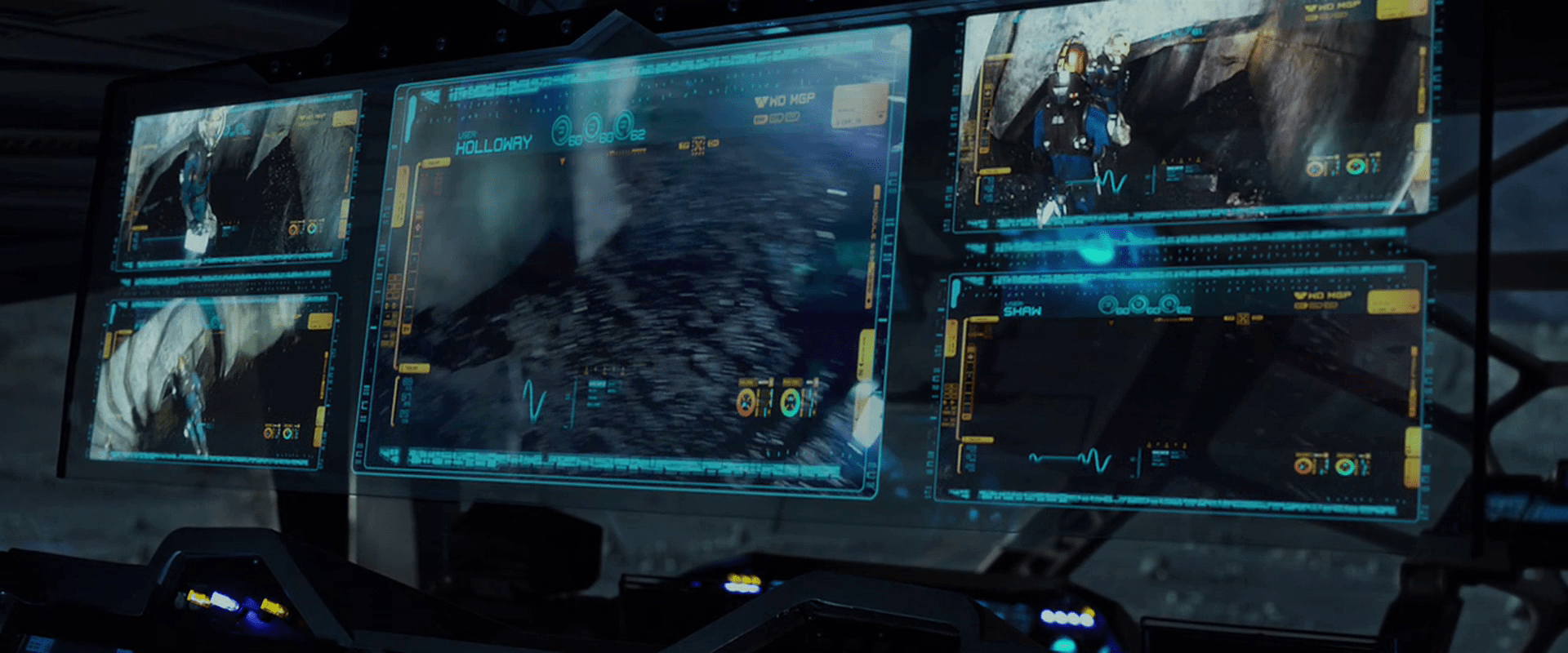
The monitoring panel on Prometheus features five of the monitoring feeds gathered on a single translucent screen. One of these feeds has the main focus, being placed in the center and scaled to double the size of the other monitors. How the monitoring crewperson selects which feed to act as the main focus is not apparent.

Prometheus-110

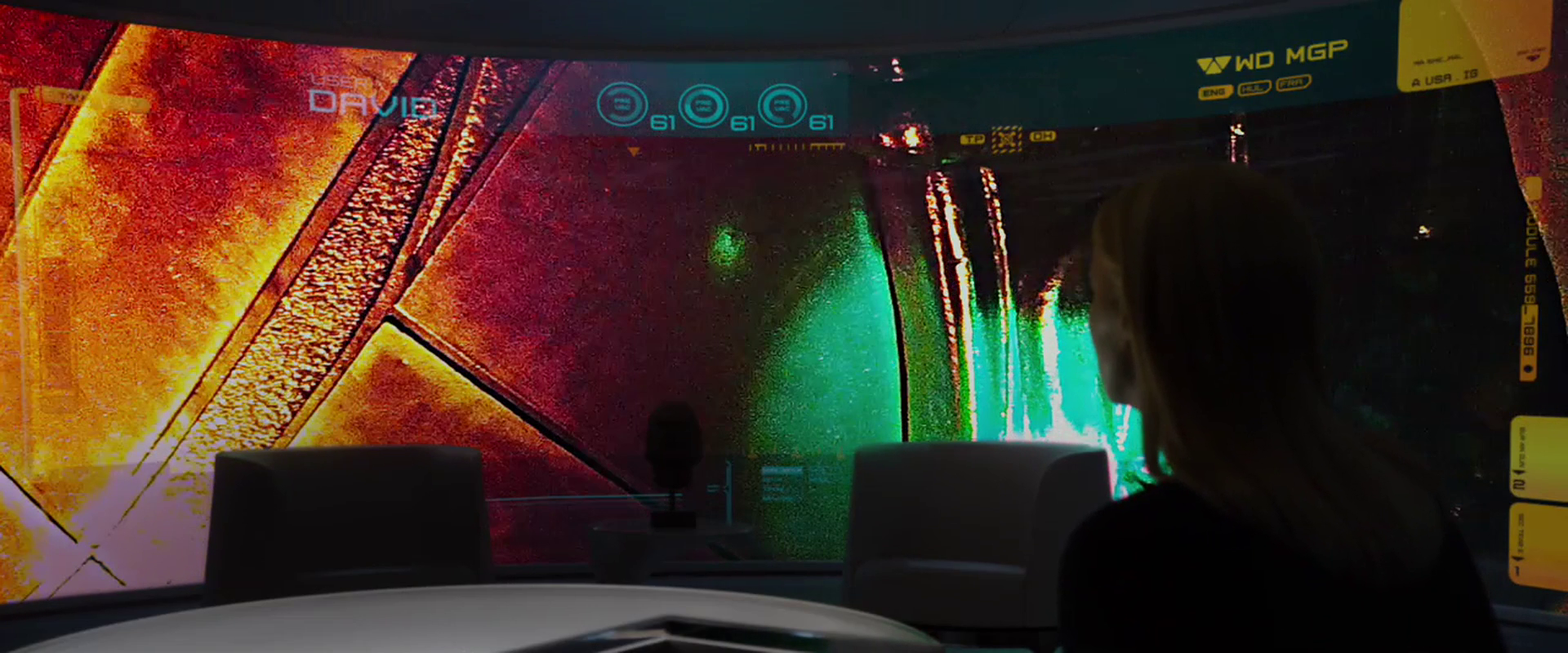
Vickers has a large, curved, wall-sized display on which she’s able to view David’s feed at one point, so these video feeds can be piped to anyone with authority.

Prometheus-203

David is able to turn off the suit camera at one point, which Vickers back on the Prometheus is unable to override. This does not make sense for a standard-issue suit supplied by Weyland, but it is conceivable that David has a special suit or has modified the one provided to him during transit to LV-223.

The ritual interfaces

We know in the film that Control has been working behind the scenes long before the event takes place. The Chem department, for example, has somehow gotten Jules to bleach her hair, and the hair dye “works its way into the blood” as a way to slow her cognition, and make her conform more the Whore archetype. Additionally, they have been lacing Marty’s marijuana to keep him dazed & confused. (Though, key to the plot, they missed his secret stash.) There’s even an actor placed en route to the eponymous cabin who unsettles the victims with his aggression and direct violent insults to Jules, setting the stage for their suffering. Though these things occur “off stage” of the actual cabin (and the Chem team works off screen), they help tell the story about how deeply embedded Control is in the world, and set the stage for the surveillance interfaces on stage.

Marking the deaths: on screen & ritually

The goal of the scenario is the suffering and death of the victims, in the right order. To provide a visual marker on the monitoring screens, a transparent red overlay is placed over victims who are believed to have been killed.

The choice of red has a natural association with the violence, but red has a number of problems. Visually, it vibrates against blue (according to opponent process of color theory, the red and blue receptors in our retinas are in the same place and can’t perceive both at the same time). It’s also typically used to grab attention, which in this case is the exact wrong signal. Jules is no longer in the picture, and so specifically no attention is needed for her. Better would be to dim her section on the monitor, or remove her altogether, if marking progress is unimportant.

Hadley orders Thorazine

In addition to marking the deaths in the digital interfaces, the deaths must be marked ritually for the system to work. To this end, Sitterson and Hadley act as the human interface that transfers the information from the electronic systems to the Bronze-Age mechanical systems behind him. Though this could be accomplished mechanically, there are ritual words that must be spoken and an amulet that must be kissed by a supplicant.

Sitterson, the senior of the two, recites, “This we offer in humility and fear / For the blessed peace of your eternal slumber / As it ever was.”

After these ritual actions, Hadley raises a roll top wooden panel to reveal a simple switch. Pulling it down initiates a chain of mechanics that ultimately break a vial of blood into a funnel, which channels the blood into grooves carved into a sacrificial slab.

Sitterson and Hadley mark the first sacrifice

The roll top door acts as a physical barrier against accidental activation, and the mechanical switch requires a manageable, but deliberate, amount of force. Both of these features in the interface ensure that it is only done when intended, and the careful mechanical construction ensures that it is done right.

Security and Control’s control

The mission is world-critical, so like a cockpit, the two who are ultimately in control are kept secure. The control room is accessible (to mere humans, anyway) only through a vault door with an armed guard. Hadley and Sitterson must present IDs to the guard before he grants them access.

Sitterson and Hadley pass security.

Truman, the guard, takes and swipes their cards through a groove in a hand-held device. We are not shown what is on the tiny screen, but we do hear the device’s quick chirps to confirm the positive identity. That sound means that Truman’s eyes aren’t tied to the screen. He can listen for confirmation and monitor the people in front of him for any sign of nervousness or subterfuge.

Hadley boots up the control room screens.

The room itself tells a rich story through its interfaces alone. The wooden panels at the back access Bronze Age technology with its wooden-handled gears, glass bowls, and mechanical devices that smash vials of blood. The massive panel at which they sit is full of Space Age pushbuttons, rheostats, and levers. On the walls behind them are banks of CRT screens. These are augmented with Digital Age, massive, flat panel displays and touch panel screens within easy reach on the console. This is a system that has grown and evolved for eons, with layers of technology that add up to a tangled but functional means of surveillance and control.

The interfaces hint at the great age of the operation.

Utter surveillance

In order for Control to do their job, they have to keep tabs on the victims at all times, even long before the event: Are the sacrifices conforming to archetype? Do they have a reason to head to the cabin?

The nest empties.

To these ends, there are field agents in the world reporting back by earpiece, and everything about the cabin is wired for video and audio: The rooms, the surrounding woods, even the nearby lake.

Once the ritual sacrifice begins, they have to keep an even tighter surveillance: Are they behaving according to trope? Do they realize the dark truth? Is the Virgin suffering but safe? A lot of the technology seen in the control room is dedicated to this core function of monitoring.

The stage managers monitor the victims.

There are huge screens at the front of the room. There are manual controls for these screens on the big panel. There is an array of CRTs on the far right.

The small digital screens can display anything, but a mode we often see is a split in quarters, showing four cameras in the area of the stage. For example, all the cameras fixed on the rooms are on one screen. This provides a very useful peripheral signal in Sitterson and Hadley’s visual field. As they monitor the scenario, motion will catch their eyes. If that motion is not on a monitor they expect it to be, they can check what’s happening quickly by turning their head and fixating. This helps keep them tightly attuned to what’s happening in the different areas on “stage.”

For internal security, the entire complex is also wired for video, including the holding cages for the nightmare monsters.

Sitterson looks for the escapees amongst the cubes.

The control room watches the bloody chaos spread.

One screen that kind of confuses us appears to be biometrics of the victims. Are the victims implanted with devices for measuring such things, or are sophisticated non-invasive environmental sensors involved? Regardless of the mechanisms, if Control has access to vital signs, how are they mistaken about Marty’s death? We only get a short glance at the screen, so maybe it’s not vital signs, but simple, static biometrics like height, and weight, even though the radiograph diagram suggests more.

Sitterson tries to avoid talking to Mordecai.

Communications

Sitterson and Hadley are managing a huge production. It involves departments as broad ranging as chemistry, maintenance, and demolitions. To coordinate and troubleshoot during the ritual, two other communications options are available beyond the monitors; land phone lines and direct-connection, push-to-talk microphones.

Hadley receives some bad news.