Odyssey Controls

Interior view of a spaceship cockpit with multiple control panels and screens, showing a dark space environment. Two seats are visible, with one pilot engaged in operating the controls.

The Odyssey is a large spaceship (larger than the NASA Space Shuttle) that is largely automated and capable of holding its crew in suspended animation. As the Odyssey gets closer to the unknown object (the TET), Jack and Vika wake up to take manual control of the ship.

Two crew members in a spacecraft cockpit, focused and engaged, with control panels in the background.

Jack and Vika—commander and co-pilot, respectively—sit in a standard command deck position close to the front of the ship. They have twin chairs, and mirror-image controls. This is an almost identical functional set up to the Space Shuttle’s command deck.

Interior view of a spacecraft cockpit featuring multiple control panels, screens displaying flight data, and pilot seats.
The cockpit for the Endeavor. Source: NASA

Several glass panels on the dash serve as moving displays of information, but a significant amount of the control space is given over to physical buttons and switches. NASA standard components make up a large number of these physical controls, including the numeric keypad and OMS (Orbital Maneuvering System) thrust stick.

A close-up of a hand gripping a control joystick in a spacecraft cockpit, with various buttons and displays visible in the background.

An interesting note here is just how sparse the Odyssey’s command deck is compared to NASA’s Endeavour (the complicated-looking picture above). Since the space shuttle is intended to be flown by human hands if necessary, it has controls for every action possible. (Minimizing modality and allowing the control to be optimized for the task.) In contrast, the Odyssey’s control setup is evidence that most functions on the ship are largely automated.

With most of the controls under automation, the only controls left would be those vital to manual flight operations, such as orbital maneuvers, and controls that activated pre-planned modes in the automated systems.

Close-up of hands operating a control panel with illuminated buttons.

Even in a critical and unplanned situation, e.g. uncontrolled descent towards the TET without communications back to Earth, Jack and Vika are efficient and confident with their motions. This implies excellent training on the equipment, a solidly laid-out control scheme, and proper differentiation of roles between Commander and Co-pilot.

The Odyssey is not a small feat of design, planning, and engineering.

A special mention should be made here for the ship’s interior airlock doors. The doors have large grab surfaces, easy-shut hinges, and a simple circular sealing mechanism. Jack is able to seal the door and confirm that the door is sealed simply by rotating the main handle. When the handle is in the proper place there is a visual and auditory confirmation of sealing. He is able to do this quickly and without error, just before the Odyssey is swallowed by the TET.

Focus on the workflow

The Odyssey does not reinvent spacecraft controls, it simply makes it easier for a two-person crew to control the ship while far away from any help. By focusing only on what Jack and Vika need in their command interface, and letting proven technology handle the rest, the Odyssey’s designers were able to strip away most of the complexity in the command deck but leave vital controls for the crew.

As we see at the very end of Oblivion, the effective design of the Odyssey’s control deck not only saved most of the Odyssey’s crew, but probably saved Humanity as well.

Odyssey Communications

A close-up of a control panel displaying a video feed of a woman speaking, with NASA logos visible in the background.

The TET is far enough away from Earth that the crew goes into suspended animation for the initial travel to it. This initial travel is either automated or controlled from Earth. After waking up, the crew speak conversationally with their mission controller Sally.

This conversation between Jack, Vika, and [actual human] Sally happens over a small 2d video communication system. The panel in the middle of the Odyssey’s control panel shows Sally and a small section of Mission Control, presumably back on Earth. Sally confirms with Jack that the readings Earth is getting from the Odyssey remotely are what is actually happening on site.

Interior view of a futuristic spaceship cockpit, featuring numerous control panels, screens, and empty pilot seats.

Soon after, mission control is able to respond immediately to Jack’s initial OMS burn and let him know that he is over-stressing the ship trying to escape the TET. Jack is then able to make adjustments (cut thrust) before the stress damages the Odyssey.

FTL Communication

Communication between Odyssey and the Earth happens in real-time. When you look at the science of it all, this is more than a little surprising.

Vika tells Sally that the Odyssey was traveling for at least 39 days in suspended animation. We see in the same scene that the Odyssey’s engines are thrusting that whole time. Even the low thrust of an ion engine would send the Odyssey a long way out into the Solar System in 39 days.

Current communication technology in space relies on radio communication for voice and video. NASA is testing out laser-based signaling, which would provide higher bandwidth but doesn’t travel faster than the speed of light. Time lag is a constant in both technologies.

In space, real-time communication and measurable distance do not go together at all. There should be a lag, especially at the distances implied by the story.

A woman with closed eyes lying inside a pod, with a control panel displaying data in the background. The pod has a NASA logo and a Russian flag emblem.

How Far?

The engines on the Odyssey look a lot like NASA’s prototype ion engines. This would fit nicely with the compact nuclear reactor on board, which would be the perfect size for generating living power and engine power for low-thrust ion engines.

Ion engines don’t have the same thrust capacity as our current rockets, but have the advantage of constant thrust over long distances that chemical rockets can’t match. NASA’s Dawn probe has an acceleration of about 0.22m/s/s (very, very rough math). A quick run through a calculator at (http://www.cthreepo.com/lab/math1/) says that over 39 days (Odyssey’s travel time), they would go about 8 astronomical units (AUs). That is 8x the distance from the Earth to the Sun just with Dawn’s level of thrust. That is a low end calculation, and doesn’t factor in any thrust from a more traditional rocket on the Earth end, or any slingshot maneuvers to add speed.

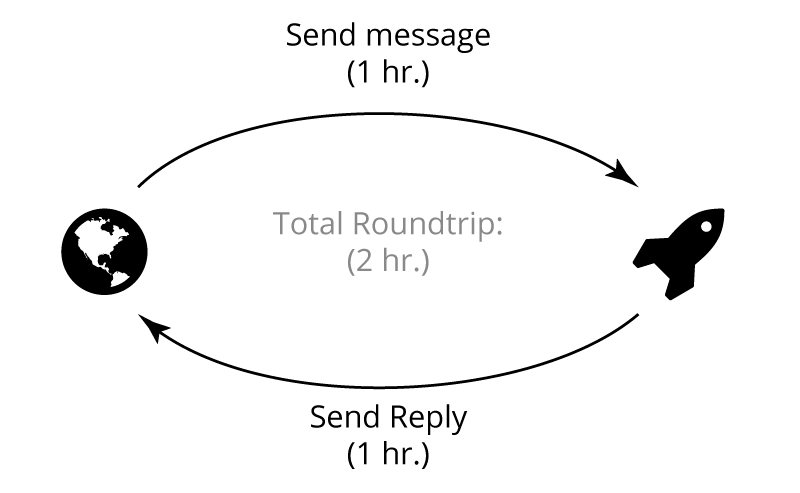
8 AUs would be more than an hour of light speed lag. That means that the Odyssey should take almost two hours to complete a single back-and-forth of a conversation.

Communication-Time

If the compact nuclear reactor was actually able to produce thrust (unlikely, but possible), then in 39 days the Odyssey could have traveled even further.

At any distance beyond the Moon’s orbit, light-speed communication would become increasingly delayed. If the TET was even in a Mars orbit, it could take between 4 and 24 minutes for radio and video signals to go back and forth between Earth and the Odyssey. Further distances increase the lag time significantly.

This means that Humanity has…gasp…developed Faster-than-Light communications technologies by the time Oblivion occurs (and, yes, even before the TET could have provided the advanced alien tech to make it happen).

Close-up of a control panel displaying a distorted screen with horizontal lines and static.

Despite this FTL comm system, as the Odyssey approaches, the TET is able to disrupt the comm signal and cut off Earth from Odyssey. Jack looks concerned by this (as well as Sally’s order to cut his thrust), and stops trying to fight being drawn into the TET.

An unanswerable question here is: what kind of technology from the TET would be able to disrupt an FTL signal? Wouldn’t that require them to be time travelers? Wouldn’t this be a different movie, then?

Don’t Trust New Technology

Neither Jack nor Vika interact with the communication system during the flight that we see besides talking to it. When the signal cuts out, neither of them rushes to check settings or flip switches to try and get the signal back. Instead, they go to a backup plan and focus on what they are able to do without help from Earth. The screen that held Sally’s image cuts over to a secondary information display as soon as it detects that the signal is gone.

Close-up of a digital display panel showing numerical data, indicators, and system information related to a launch control interface.

This implies two things:

  1. The crew were trained to not rely on the communication system
  2. The communications system is a ‘black box’ to Jack and Vika: it either works or it doesn’t.

Given the previous realization that the comm system is built around an FTL link, both of these make sense. It is unlikely that a single person (or even two people) would be able to understand the equipment behind a new FTL system well enough to maintain it or fix it in an emergency. Similarly, the early Astronauts of NASA weren’t expected to maintain the advanced computers (for the time) on their ships.

If the FTL system was recently invented, and rushed through testing for this mission, it also makes sense that Jack and Vika don’t rely on it. NASA now is very careful about testing equipment to make sure that they will always work, or at least work well enough that they can be constantly relied on. (see the Kepler mission http://en.wikipedia.org/wiki/Kepler_(spacecraft) for what happens when a well-tested and critical component fails).

Jack and Vika reveal their training during the emergency situation: They have no time to think, so they fall back on memorized actions. The lack of interaction with the communications system implies that there was no training around trying to make it work.

Have a Backup Plan

Designers planning to introduce new and advanced technology into important situations should always be sure they have a backup plan for when that advanced technology fails. Likewise, if a highly efficient workflow has advanced technology introduced to improve that efficiency, make sure that failures in the new technology won’t make the workflow slower than before.

Technology should assist and improve, never impede users. And if it’s valuable enough to warrant the risk, give users a backup plan.

Bike interfaces

There is one display on the bike to discuss, some audio features, and a whole lot of things missing.

image00

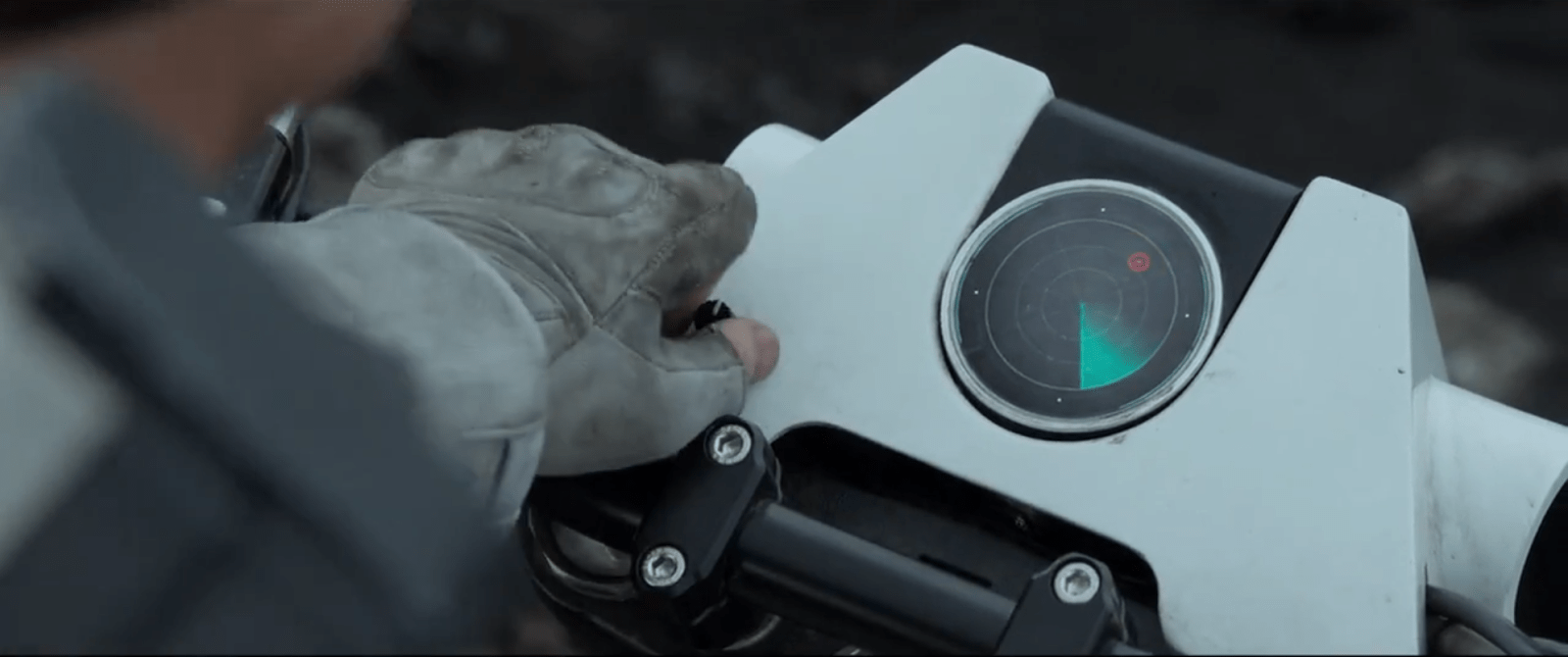
The bike display is a small screen near the front of the handlebars that displays a limited set of information to Jack as he’s riding.  It is seen used as a radar system.  The display is circular, with main content in the middle, a turquoise sweep, and a turquoise ring just inside the bezel. We never see Jack touch the screen, but we do see him work a small, unlabeled knob at the bottom left of the bike’s plates.  It is not obvious what this knob does, but Jack does fiddle with it.

While riding, the bike beeps loud enough for Jack to be able to listen to and understand changes in the screen’s status.  At slower speed and at a stop, the beeping is quieter, as if the bike adjusted the sound level to shout over the wind-noise at speed.  On screen, pulsing red dots representing targets.  After he stops, Jack removes his goggles to look at the screen, but we see him occasionally glance down at the screen while riding with goggles on.  It appears like the radar is legible in either case.

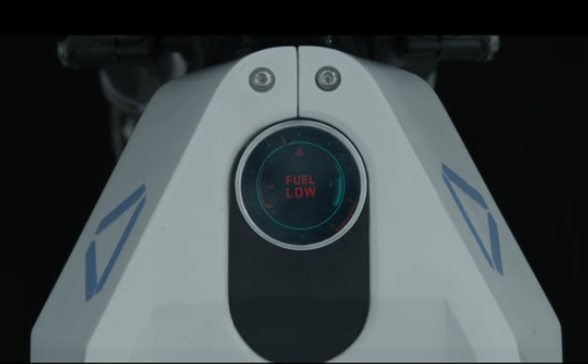
After most of the bike-related events in Oblivion, Jack gets the bike back when it has been ridden.  At one point we see an alternate display that shows large letters that says “Fuel Low”.  At that point the turquoise ring has only a sliver of thickness left.

There are several things that riders of modern motorcycles would expect to be included in a dashboard display, such as a speedometer and temperature gauge. But, we see neither an indication of speed nor some sense of whether the engine is getting too hot.  Similarly, we see no indication of running lights. Where are these things? How are they not needed?

image01

Basically useable…

Yes, the bike’s display shows very basic information that Jack needs for short range exploration and riding.  Jack is able to tell by the loud beeps which direction he should be going, and whether he’s on the right track.  These tones appear to change based on distance to target (hot/cold), with the screen acting as the directional finder.  He only needs to glance down at the display to confirm what the audio feedback is telling him and get a map view of the terrain.

…But is it enough?

This bike would not be road legal today, as it has only the most basic information Jack needs to go exploring: Where to head, and how much fuel he has left. There’s a lot missing.

The most obvious missing piece is the distance to go.  The beacon shows up on orbital scans, so Vika should have an approximate location and distance to go off of.  Jack would then know how long it would take to get there, and whether he had enough fuel for the trip.

He’s also missing a good terrain view in front of him.  On a bike, he isn’t able to traverse just anywhere.  A map and terrain display would let him plan out a route that the bike could handle, instead of guessing and hoping he doesn’t run into a sheer cliff.

Given that Jack is exploring far away from civilization, medical help, the Bubbleship, or even some kind of storage area for first aid or food would be useful.  A bike like this should also have some sort of safety gear.  Jack appears to dislike things like helmets or bulky armor, so the bike should have some indication of built-in safety systems like a deployable, wrap-around airbag.

Given the presence of Scavs, the bike should also have some kind of anti-theft mechanism on it. A lock that only allows Jack to operate the bike, or automatic locking of the wheels would make it difficult for the Scavs to steal it and use the TET technology inside.  Instead, we see that the bike is stolen after Jack descends into the cave, leaving Jack stranded.

To improve the wayfinding, the TET, Vika, or Jack could plot a general course that is relatively safe, fuel efficient, and on the way to the target for the bike.  The bike could then use Jack’s already-present communications system to guide Jack along the route using purely auditory feedback and artificial surround sound (or real surround sound if the earbud is advanced enough).

Why Waste Jack?

Jack is probably expensive in time and material to create, and giving him some protection would save the TET resources.  Even if the TET didn’t care about its crews, it should care about valuable technology that can be used against it.

Aside from the safety factor, which is probably due to the TET’s underlying lack of care about individual Jacks, Jack’s bike is able to navigate him where he needs to go and get him back.  The bike’s radar works even at full speed to point Jack in the right direction thanks to noise-adjusted audio feedback.  Only the addition of some simple anti-theft devices would make the bike more effective for both Jack and the TET.

The bike is not a good example for real-world bikes of the future, but does help set Oblivion in a world where the “employer” doesn’t care about the “employee” beyond their basic ability to get the job done.

Jack’s Bike

image03

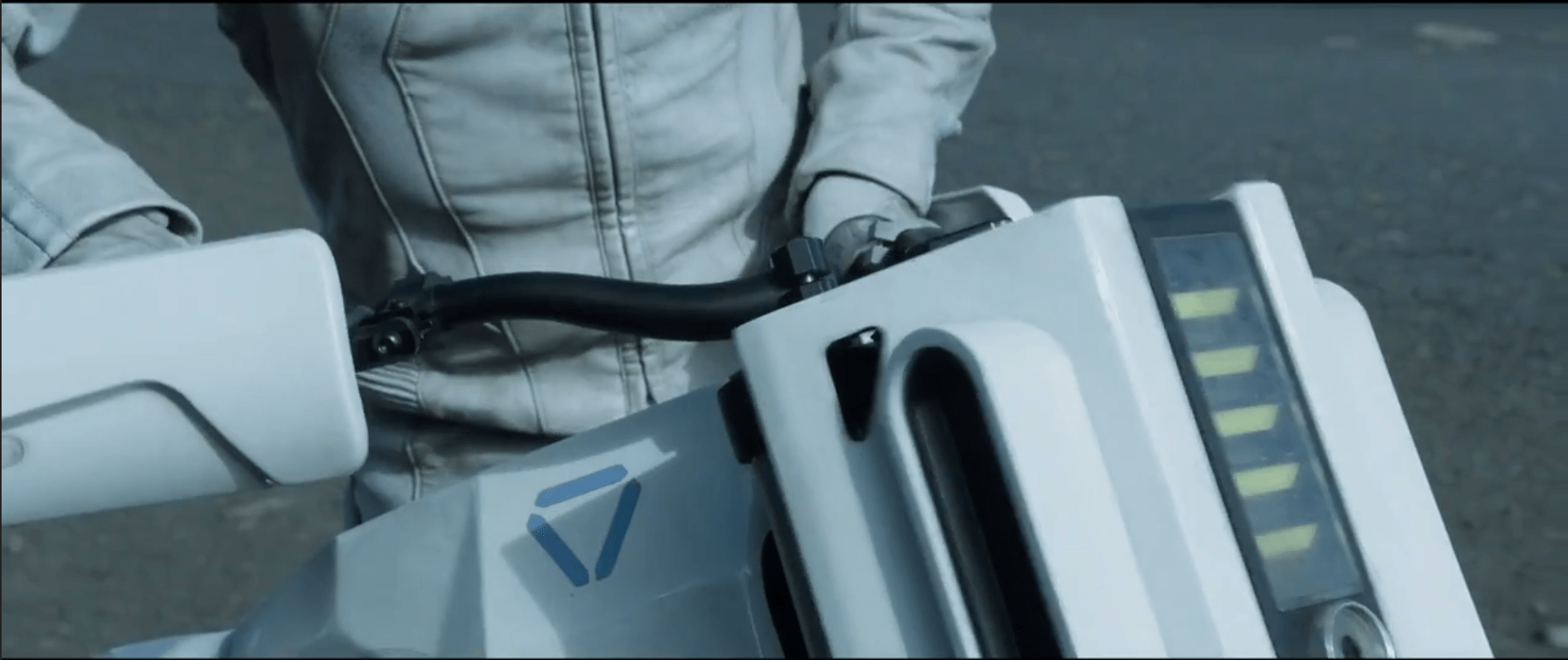
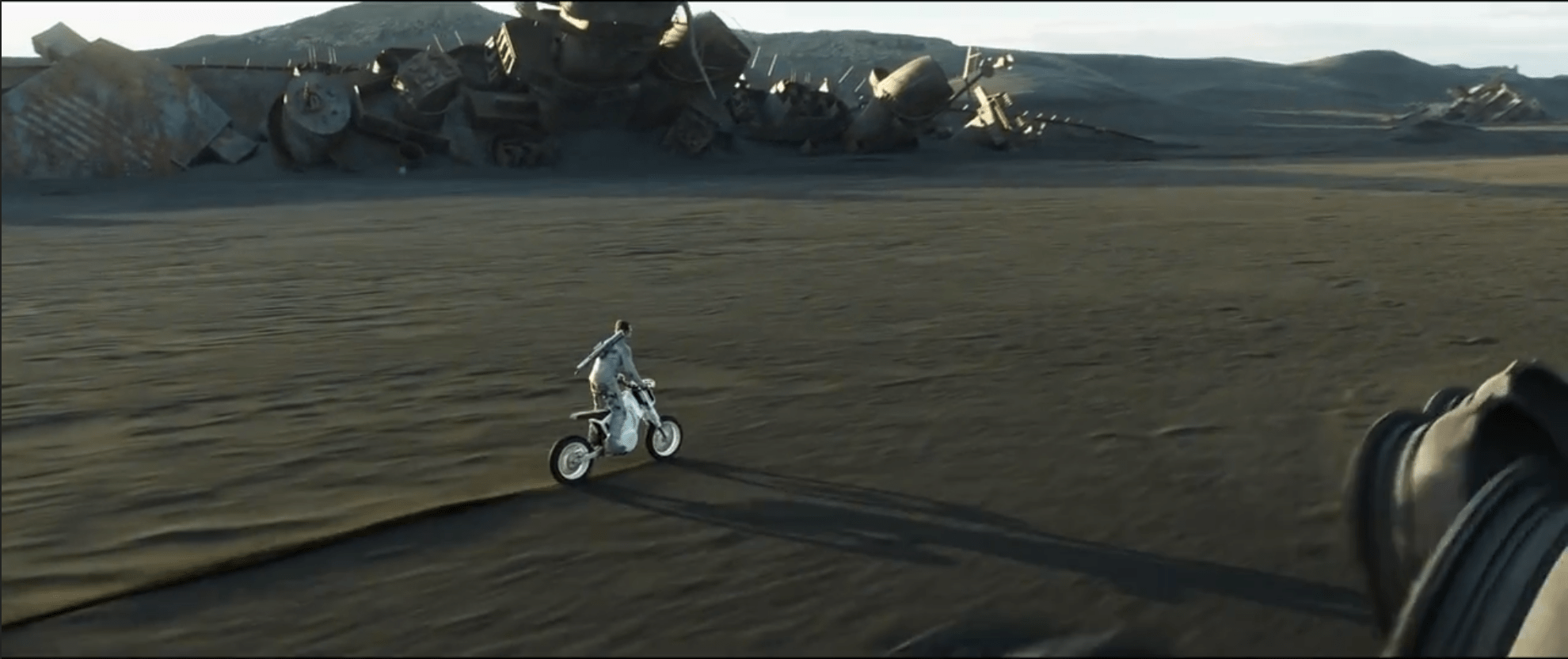
Jack’s Bike is a compact, moto-cross-like motorcycle. It’s stored folded up in a rear cargo area of the Bubbleship when not in use. To get it ready to ride Jack:

  1. Unlocks the cargo pod from a button on his wrist
  2. Pulls it out of the Bubbleship
  3. Unfolds its components (which lock automatically into place)
  4. Rides off.

When Jack mounts the bike it automatically powers on and is ready to ride.

image01

The bike is heavy, as shown by Jack’s straining to lift it out as well as the heavy sound it makes when he drops it on the ground. It is very solid, and no parts shift even when dropped from lifting height.

Purpose?

image02

There is no obvious reason for Jack to use a bike instead of the Bubbleship. The bike does contain a small radar system, but such functionality could be easily integrated into the Bubbleship. Otherwise the Bubbleship is faster, more comfortable, has longer range, ignores the problems presented by difficult terrain, and has a better connection to the rest of Jack’s support network. So there’s no obvious functional advantage.

It makes more sense that this bike is a release for Jack’s exploratory personality. We see several times that Jack goes and does something brash or dangerous, simply to do something different and make his day more interesting. It’s part of who he is and how he engages with the world.

If so, then Jack simply likes taking the bike out for a ride. He is happy when he takes it out of the Bubbleship, and he does several unnecessary jumps on the bike just for fun. Even though the Bubbleship could have found the signal quicker and easier than the Bike, the bike was a more entertaining way to spend the day. We also see that, when things get serious, Jack quickly calls for Drone backup and is happy to see the Bubbleship waiting for him at the surface.

Let’s presume the TET saw these behaviors (or lost several early Jacks to boredom when this option wasn’t available), and created the bike to make him more happy and effective.

Delight Your Users

image00

So here’s an interesting lesson: The most efficient tool for the job might not always be the most effective. A user’s experiential needs are just as important as their need to get the job done, and considering those needs may lead to a design that is satisfyingly fun.

That can be hard for designers who are focused on improving efficiency, and can be even more difficult for product teams. But if you can figure it out, it’s worth it.

After all, you don’t want to have to keep replacing your Jacks.

A Deadly Pattern

The Drones’ primary task is to patrol the surface for threats, then eliminate those threats. The drones are always on guard, responding swiftly and violently against anything they do perceive as a threat.

An explosion in a dimly lit library with debris scattered around and a hovering robotic device amidst the chaos.

During his day-to-day maintenance, Jack often encounters active drones. Initially, the drones always regard him as a threat, and offer him a brief window of time speak his name and tech number (for example, “Jack, Tech 49”) to authenticate. The drone then compares this speech against some database, shown on their HUD as a zoomed-in image of Jack’s mouth and a vocal frequency.

vlcsnap-2015-02-03-22h07m47s249

Occasionally, we see that Jack’s identification doesn’t immediately work. In those cases, he’s given a second chance by the drone to confirm his identity.

A man with a glowing headband appears concerned, reaching out with his hand, in a dimly lit environment.

Although never shown, it is almost certain that failing to properly identify himself would get Jack immediately killed. We never see any backup mechanism, and when Jack’s response doesn’t immediately work, we see him get very worried. He knows what happens when the drone detects a threat.

Zero Error Tolerance

This pattern is deadly because it offers very little tolerance for error. The Drone does show some desire to give Jack a second chance on his vocal pattern, but it is unclear how many total chances he gets.

On a website, if I enter my password wrong too many times it will lock me out. With this system, the wrong password too many times will get Jack killed.

There are many situations where Jack may not be able to immediately respond:

  • Falling off his bike and knocking himself out
  • Focus on repairing a drone, when a second drone swoops in to check the situation out
  • Severe shock after breaking a limb
  • etc…

As we see in the crashed shuttle scene, the Drones have no hesitation in killing unconscious targets. This means that Jack has a strong chance of being killed by his Drone protector in some of the situations where he needs help the most.

A futuristic robotic sphere with the number 166 displayed on its surface, emitting flames and smoke from its underside.

A more effective method could be a passive recognition system. We already know that the drone can remotely detect Jack’s biosignature, and that the Tet has full access to the Drone’s HUD feed.

The Drone then could be automatically set to not attack Jack unless the Tet gives a very specific override. Or, alternatively, the Drone could be hard-wired to never attack Jack at all (though this would complicate the movie’s plot). In any situation where it looks like the Drone might attack anyways, the remote software Vika uses could act as a secondary switch, providing a backup confirmation message.

That said, we must acknowledge that this system excels at is keeping Jack nervous and afraid of active drones.  While they help him, he knows that they can turn on him at any moment.  This serves the TET by keeping Jack cowed, obedient, and always looking over his shoulder.

Ethical Ramifications

The Drones are built as autonomous sentries, able to protect extraordinarily expensive infrastructure against attack. They need to be able to eliminate that threat, quickly and efficiently. Current militaries are facing the exact same issues. Even though they have pledged (for now) to not build autonomous kill systems, modern military planners may find value in having a robot perform a drudging, dangerous task like patrolling remote infrastructure.

The question asked best in Oblivion is “What should constitute a threat?

A desolate landscape with wreckage and flames, suggesting a recent disaster or battle scene.

Drones fire mercilessly on unarmed civilians and armed enemy militia, but do not attack armed friendly soldiers (Jack). This already implies some level of advanced threat analysis, even if we abhor the choices the Drone makes.

The Future

Military Planners will need to answer the same question: How does the algorithm determine a threat? With human labor becoming more and more expensive both monetarily and emotionally, the push for autonomous drone systems will become even stronger for future conflicts.

There is still enough time to research and test potential concepts before we have to make a decision on autonomous drones.

Interaction Design Lessons:

  1. Don’t threaten civilians and non-combatants.
  2. Give clear feedback of limits and consequences if a deadly pattern is about to be activated.
  3. Give users a second chance.

Bubbleship Comms

image01

Jack communicates with Vika via the HUD in the Bubbleship, and a small earbud that provides two-way audio.

He talks normally to Vika, who responds in kind. There is no visible confirmation of his connection to Vika, and no obvious way for him to send information back other than the sound of his voice.

As shown during the lightning strike sequence, Jack’s earbud is connected directly to the Bubbleship. All of his audio and telemetry requires the Bubbleship to connect with Vika’s control tower. When the Bubbleship’s power goes out, Jack’s communication is cut too.

Eye in the Sky

Vika has complete control over the communications in the Bubbleship. She is able to see Jack’s video, hear his audio, and send him mission updates whenever she so chooses. Jack only has control over his connection to Vika by going places where the direct comms can’t reach.

Given the post apocalyptic wasteland they inhabit and the strength of other systems Jack uses, Jack should always have a communication link back to Vika. Current infrastructure, like the Drones or the TET when it is overhead, should act as a repeater system for Jack’s earbud.

A handful of orbiting drones and a satellite radio phone attached to Jack’s belt could easily provide near 100% uptime in communications and give a backup to systems like the Bubbleship. Judging by Jack’s reaction during the lightning strike, power failures in the Bubbleship happen often enough for him to have a routine for them.

Jack should also have an easy way to pause or mute communications. When he is in a stressful situation, he may not want the distraction of audio. The audio might also leak from the earphone in quiet places, leaving him vulnerable to Scav ambush.

Any two-way communication system should have equal control for equal parties.

Electronic Shielding

Ideally, comm failures should never happen in the first place. Modern aircraft are well shielded against lightning strikes, and do not fall from the sky (a Guardian post indicates that each commercial aircraft is hit, on average, once per year). The Bubbleship should be at least as well shielded as a modern commercial aircraft, and be able to maintain contact with its control tower during routine thunderstorms.

image00

Advances in technology should not forget basic safety techniques from the generation of technology it is replacing.

The Bubbleship Cockpit

image01

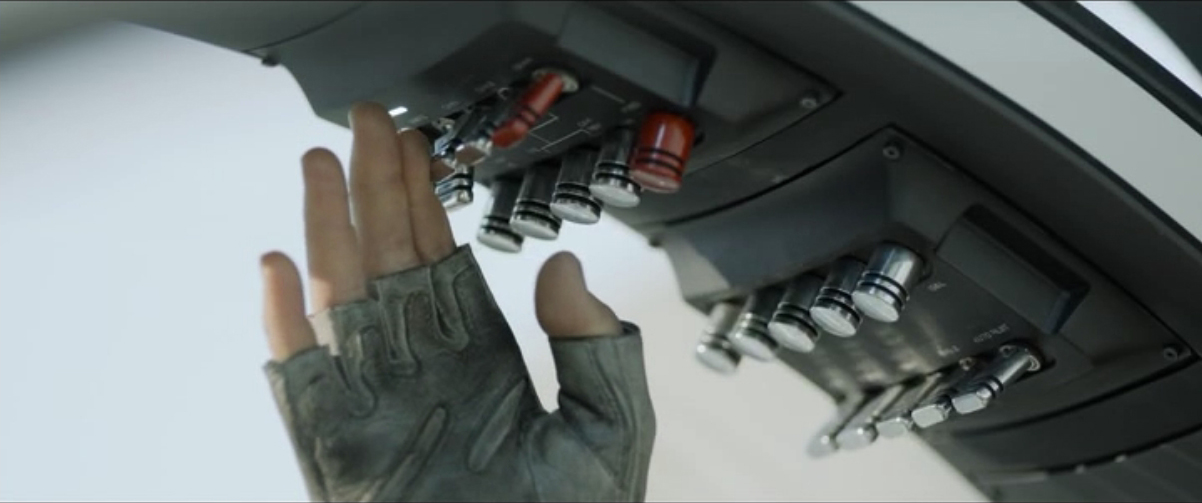
Jack’s main vehicle in the post-war Earth is the Bubbleship craft. It is a two seat combination of helicopter and light jet. The center joystick controls most flight controls, while a left-hand throttle takes the place of a helicopter’s thrust selector. A series of switches above Jack’s seat provide basic power and start-up commands to the Bubbleship’s systems.

image05

Jack first provides voice authentication to the Bubbleship (the same code used to confirm his identity to the Drones), then he moves to activate the switches above his head.

image06

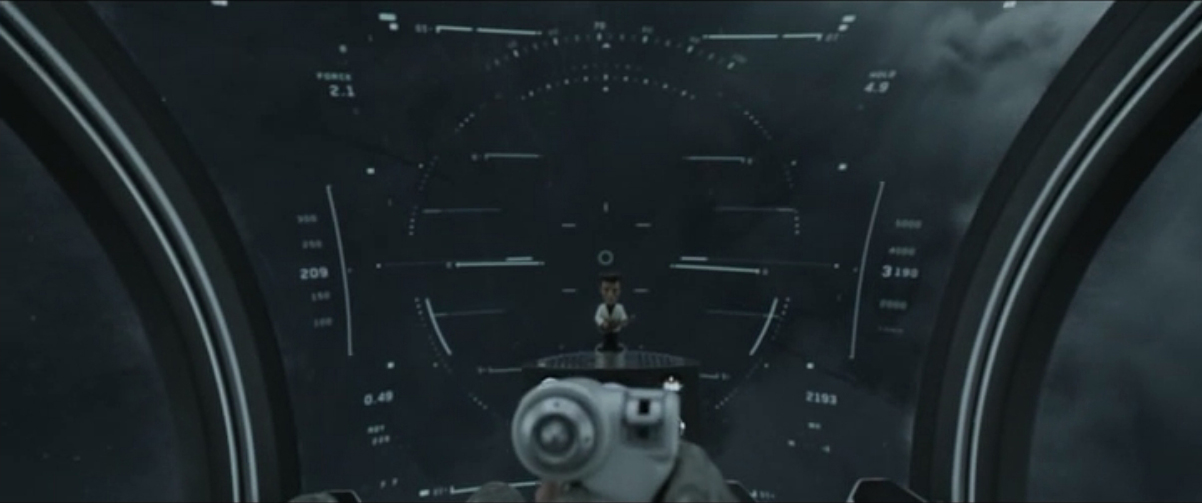
The switches are large, all move the same direction for startup, and are labeled. Two of the controls are color coded red, and Jack switches the red control last. We never see the round knobs in use. They could be circuit breakers for the major systems. All are positioned nicely to prevent accidental use. Overall, it is setup almost exactly like a modern-day helicopter, with two distinct additions: Cockpit-wide HUD, and Swivel Controls. While not technical, the cockpit also has a little Elvis bobblehead—whose name is Bob—that keeps Jack company.

image02

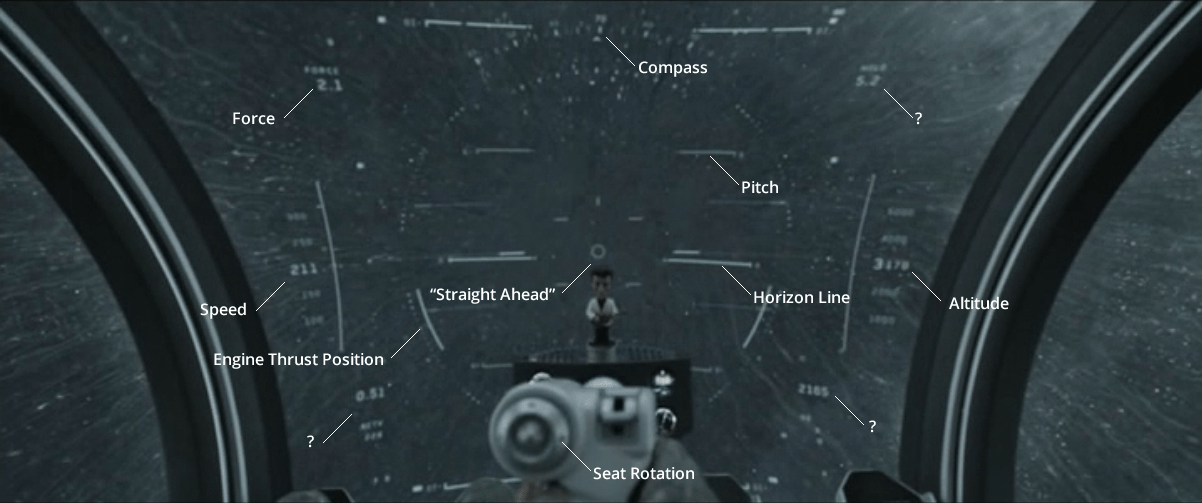
The main HUD provides standard information that Jack needs to pilot, even in zero visibility. It displays thrust output of his engines, an artificial horizon, altitude, and other indicators (shown in the above image and labeled in the image below).

image04

The HUD is displayed on the front glass, and is tied to the Bubbleship’s main power. When the power goes out, the HUD goes out. It is not wired to a separate backup circuit. Fortunately, Jack has a physical gimbal that remains operational even when the power is out.

image03

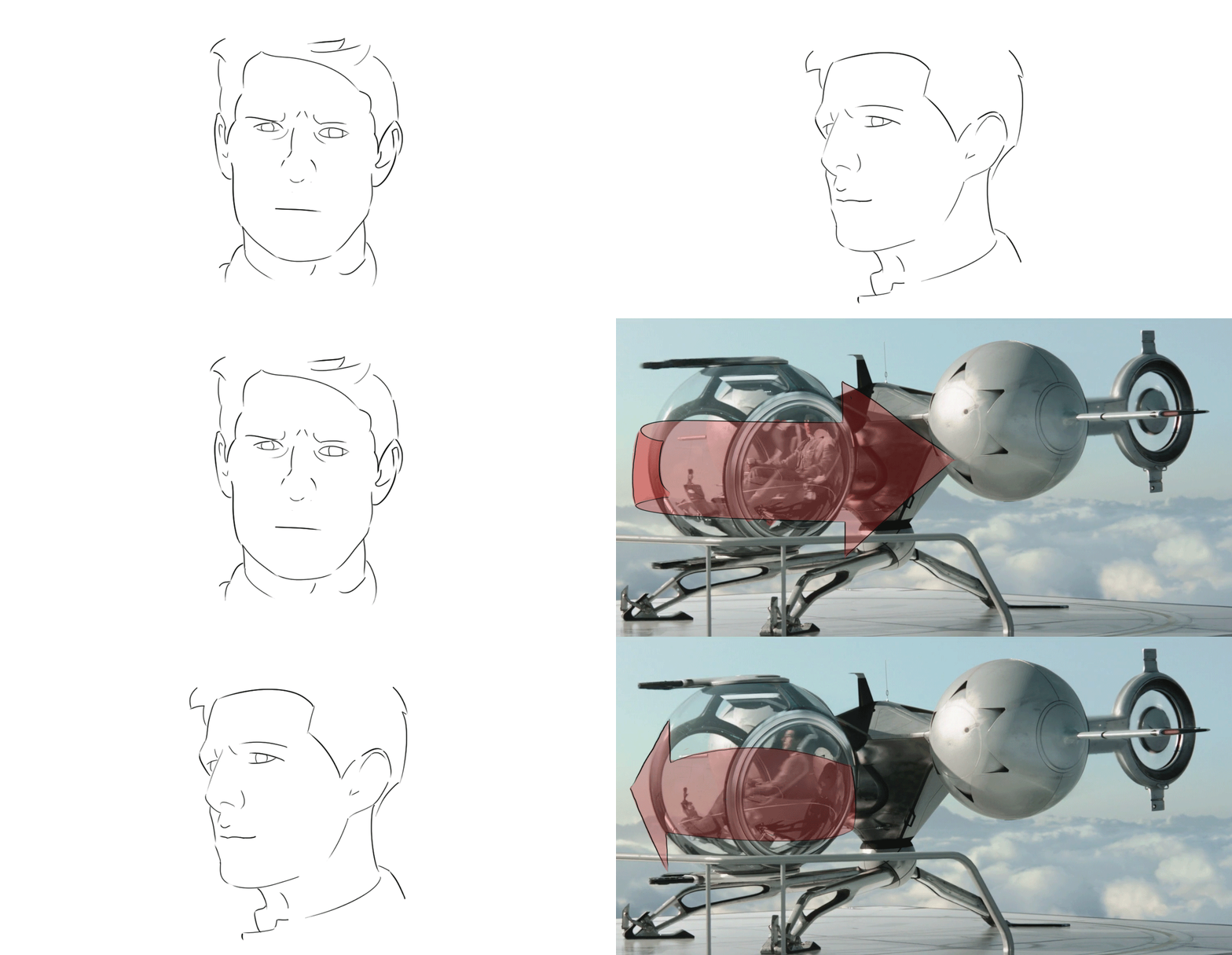
Another major addition is the swivel seating. Using a dedicated control on his joystick, Jack can move his seat around to get a better view as he is flying, without redirecting the Bubbleship in that direction.

image07

It is not clear based on the evidence shown whether Jack has set seat positions (one click per a certain degree of rotation), or whether he is able to hold down the control and rotate the seat based on the click duration. Jack is very familiar with this interface and piloting scheme. Even in an emergency situation when the Bubbleship’s power goes out and he loses control, Jack does not panic and goes through his emergency checklist. We see later that the Bubbleship does have an eject system (a large red handle in the top of the command pod), that detaches the entire passenger compartment and deploys a parachute. Jack decides that he does not need this rescue system and can pilot his way to safety.

Click-to-swivel

We see that Jack is often the only person in the Bubbleship, and that he often uses the seat swivel to get a better view of what he needs to survey. Piloting is a high-concentration activity, with a large amount of muscle memory training. A pilot can be expected to know how his (or her) craft will react to specific inputs at specific times. Moving around the seat allows Jack a better view of his surroundings, but could interrupt the muscle memory he uses for his daily piloting and emergency maneuvering. Given the muscle memory requirement, Jack is probably able to control the swivel based on a number of clicks, not a duration. Specific swivel points has several advantages:

  • The pilot can memorize control relationships for each swivel spot
  • Jack can click the position he wants, then forget about that control while he continues piloting
  • Less cognitive load to learn and operate
  • Automatic Swivel

Click-to-swivel has advantages, but it is not the most advantageous control scheme for the level of technology shown. We know that Jack has destinations in mind when he is traveling, or Vika has given him a waypoint. We also know that the Drones have a low level intelligence capable of free flight and complicated maneuvers. Jack could easily activate an autopilot mode (straight and level, emergency maneuvers, return to base, go to the secret cabin), then he could ‘free swivel’. This free swivel movement would be based on his eyes and head movement, with the seat merely following where Jack wants to look. Otherwise, the Bubbleship could follow his head movements for regular flight inputs, augmented by the control stick inputs.

image00

The Bubbleship would need some intelligence then to know the difference between when Jack actually wants to go somewhere, and when he is merely looking at his dashboard. Artificial intelligence is a given here. A good method would be focus tracking. When the Bubbleship tracks Jack’s focal point, it would know whether he’s looking at a spot on the horizon, or whether he’s looking at a point inside the cockpit. It would also be an effective way to focus the Bubbleship’s weapons pod for convergence—the guns would always meet at the point Jack was focused on, instead of firing wildly based on his joystick inputs.

Highly Refined

Modern day flight controls are highly refined tools with a well practiced group of users and a solid history of training programs. It makes sense to pull from this history when designing for a new flight machine, especially when its controls map so well to modern day equipment. The largest improvements can come from automation, especially when there is a solidly tested machine intelligence able to augment pilot intentions (see: the Drone, to be published later). By taking away the monotonous tasks from the pilot, and allowing them to focus on the difficult decisions, a machine can make the pilot’s life easier and safer.

Home 49

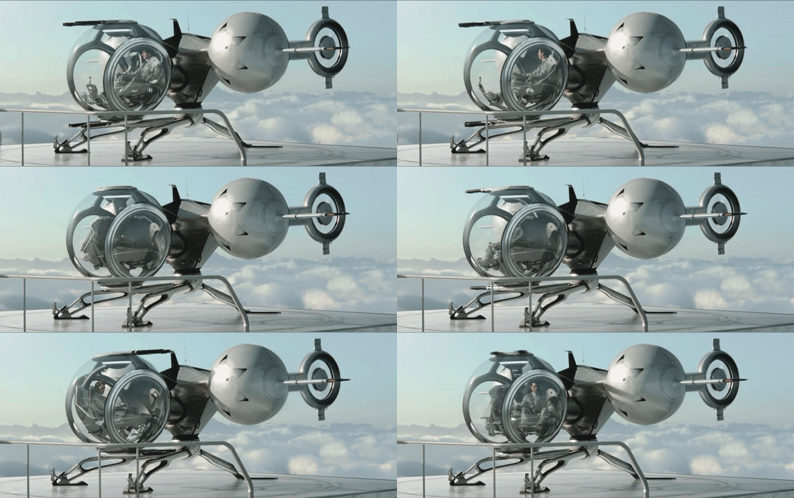
A futuristic spacecraft flying near a large, elevated structure above the clouds, surrounded by a dramatic sky.

Home 49 is a connected system that provides for the daily needs of Jack and Vika. It handles everything from morning breakfast, to video storage of previous missions, to maintenance of drones, to Jack’s personal weapons. The Home acts as both a residence and a watchtower, and is built on a slim stilt that reaches from ground level to above the cloud layer. This isolates Home 49 from the ground.

A woman in a sleek, modern kitchen standing by a counter with dishes, against a backdrop of a sunset and futuristic decor.

Inside, the home pod is broken down into ‘functional’ spaces. These include the kitchen, bedroom, bathroom, armory, and maintenance shop. It is connected to the exterior doors, windows, observation platform, landing pad, and pool.

The entire facility is a prefabricated structure (or at least a set-plan concept), and we see a nearly identical facility in Area 52. Cosmetic differences and changes to color scheme suggest a modicum of customization for each instance of the team.

The Breakfast console interface is multimodal, changing as Vika’s tasks change. Its contents are heavily mediated by Sally is an intermediary agent during most of Vika’s console tasks, though her perspective and information seems limited to that received from the drones or from Vika.

A person's hand interacting with a futuristic touchscreen interface displaying maps and data in a spacecraft setting.

The Breakfast console seems to scale with the task, and is capable of highlighting particular subtasks in progress, while displaying a wealth of peripheral or supplemental data.

An Efficient Home

Diagram of a futuristic flying vehicle with labeled sections including Control Tower, Kitchen, Lounge/Dining Room, Pool, Balcony, Lounge, Bedroom, Landing Pad, and Support Stalk.

Home 49 appears to suit Jack and Vika’s needs perfectly. We never see them in need of information, or struggling to complete a task. Vika is able to quickly get to the information she is looking for, and controls always appear to be at a comfortable height.

A scene depicting two individuals in a futuristic setting, engaged in conversation near a large glass panel that reflects the sky.

A close-up of a hand pointing at two illuminated control buttons on a sleek, modern interface. The top button displays a lock symbol, while the bottom button features a triangle shape.

Special mention here goes to the door control, which requires almost no effort to activate. Opening the door is a generic gesture of touching the left hand pane of glass (from the inside, not the outside). Less used controls are etched into the glass on the right.

The only thing that would make the control easier would be to make it constantly visible. The button is in a logical spot and is used every day, so there is little likelihood of the users forgetting how to open the door. Etching a control for opening the door would provide an added level of comfort and reminder for the crew.

With invisible controls, even with constant use, there is a chance of accidentally hitting the wrong button.

In this case, an automatic door like at a grocery store would be a serious security and safety concern for the TET. Making an automatic door secure would require a complete redesign of the lock controls and the procedure for entering the home.

A woman walking on a balcony with a drink in her hand, overlooking a sunset.

Considering how high up the home is, accidentally opening the door when Vika is merely looking to select an option would be a dangerous issue in high winds. Thankfully, the home has extensive balconies which would mitigate an accidental door opening.

A person walking through a futuristic, dimly lit room with high-tech storage and equipment in the background.

When working on the drone, Jack always appears to have the needed tools at hand and within easy reach. His Armory is always ready, and his weapons are always prepared for a mission.

The Tet’s Hidden Goals

As revealed later, this home also serves the Tet’s goals perfectly. Home 49 is a confined space that is well above a height where Vika would feel any connection to the ground (either emotionally or physically). The home is wired with several sensors and cameras to watch over the two occupants.

Everything inside is crafted to appear human. The language, interactions, and accessories all reinforce memories of life before the War. This reinforcement hides the Tet’s alien technology under a layer of familiarity, and Jack never questions that he isn’t working on Human built machines.

Everything but the door

The only interface in Home 49 that can be found lacking is the main door control. It is invisible until pressed, and only works from the inside. We see elsewhere that the Drones have built in voice recognition, and only respond to their proper maintenance crew. This system could be implemented on the door to prevent unwanted entry by other maintenance crews.

A tense moment between two characters in a futuristic setting, with one person dressed in a sleek outfit and the other in a light dress. They are interacting in a well-lit space featuring large windows and an ocean view.

Failing that, better labels on the control when the door is inactive would provide better touch targets and easier use after a long day fixing Drones.

Otherwise, we see that the home serves Jack and Vika’s (and the Tet’s) needs well. Though, if the Tet really wanted to keep the team inside, it would have a way to remotely lock the doors. Considering how bad a fire hazard locked doors would be, I’m glad that the Tet overlooked that small feature.

Lessons:

  1. Don’t prevent evacuations in the event of an emergency
  2. Give your users a way to be alone when they want
  3. Every-day tasks should be easiest and most seamless

Report Card: Wall•E

Wall-E-Report-Card

Wall•E is a humorous, robo-everything, sci-fi dystopia. This puts some challenges for the interfaces, as they have to sometimes break believability for the joke. Still, the humor is meant to be all in-world (or diegetic), so we can apply a thorough real-world critique.

Sci: A- (3.5 of 4) How believable are the interfaces?

It’s funny. Wall-E is a mix of both realistic interfaces that you might find in the real world, and cinematic interfaces that really only work for the narrative.

The Realistic

WallE-ReportCard01

The Dust Storm alert is an effective warning and call to immediate action. The immediacy of the Storm Warning and its announcement of direction and distance would be a good extension for current weather radios.

WallE-ReportCard04

Every critical automatic system should have an emergency ‘off’ button that is well labeled. Otto’s control might be poorly placed, but its use and implications are obvious to the captain in his moment of need.

WallE-ReportCard08

The Hover Chair is a multi-use, omni-terrain mobility device that is comfortable and thoroughly addictive. It would be the ultimate Rascal scooter, and likely be as popular in real life as it is on the Axiom.

WallE-ReportCard07

In many ways, The Social Network has already pervaded our society in programs like Skype. The major and dangerous change on the Axiom is that one program is getting all of a person’s attention at all times.

The Cinematic

WallE-ReportCard06

The Dropship. Very Inefficient. It shows that BNL likes complicating things, but isn’t very convincing as an activation sequence for an inter-planetary exploration pod.

WallE-ReportCard05

The Lifeboat is excellent way to show how automated all of BNL’s technology has become, but a terrible layout for an emergency tool.

WallE-ReportCard03

The project team (in the world of Wall•E) that built the Gatekeeper must have had an enormous budget, a massively talented team, and a top-flight project manager. It’s so exquisitely overbuilt in almost every possible way.

Regardless of which type they are, each says something very fundamental about Buy-N-Large’s design/engineering studios. A few of these interfaces feel so complicated and overly antagonistic to their users that it’s amazing they weren’t redesigned or updated at some point. Other interfaces feel like something that a person would encounter in those situations.

Fi: A (4 of 4) How well do the interfaces inform the narrative of the story?

Each interface shows BNL’s goal of saving people from thought and effort. Even when this costs people their privacy, their independence, or their ability to think critically it feels deliberate and intentional. Useful to the user? No. Useful to BNL? Yes. This is the core of BNL’s role in the story as the corporate antagonist, and the interfaces are crucial to telling that story.

Interfaces: B- (2.5 of 4)
How well do the interfaces equip the characters to achieve their goals?

I can see the Hover Chair as a product in a TV advertisement, and many of the interfaces like the Lifeboat and Otto’s Manual Control will likely be needed in real-life situations. The Hover Chair and Lifeboat serve as excellent prototypes of what not to do, and Otto’s control was designed exceptionally well).

Other cases, like the Audio Buttons and Eve’s Gun speak to specific situations on a post-apocalyptic Earth that will be hard to replicate. Hopefully, today’s arms manufacturers won’t create such dangerous energy weapons capable of being fired so easily. But there’s no way of knowing what kind of situations BNL had to plan for in their design, so no way of knowing just how bad the design actually is.

Final Grade A- (10 of 12), BLOCKBUSTER

Buy-N-Large is a case study in a pathologically helpful corporation stripping power and authority (and even critical thought) from citizens’ everyday life. What might look great on a vacation commercial ends up instead acting like the worst kind of drug on a person’s willpower and desire to think critically.

Designers should be careful of falling into these traps, and look to the Social Network as a lesson in what can happen when you only care about moment-to-moment happiness and profit.

Related lessons from the book

  • Eve’s drop-off pod includes lots of immediate feedback that tightens the feedback loops. (page 20)
  • Eve Extends her Hand to Shoot (just like the sixth gestural pidgin word, page 101).
  • Wall-E’s range vision adhered to much of the Augmented Reality lessons (chapter 8), such as augmenting the periphery (page 162) and context awareness (page 165).
  • Otto’s off switch and the Lifeboat Auto-Destruct confirm that red means danger. (page 44)

New lessons

  • Eve’s drop-off pod, the Lifeboat controls all scream for Labels, labels, labels.
  • The Hover Chair implies many things
    • A system should never fail into a worse state. (a New Lesson first seen on this blog with Logan’s Run.)
    • Build assistants not solutions.
    • Optimizing for the worst within us drags everyone down.
    • Let users easily pause virtual worlds (out of respect for the real one).
    • Explicitly in the Social Network writeup: Work With the Human Need and Build Products for More than just Fleeting Pleasure.

IMDB: https://www.imdb.com/title/tt0910970/Currently streaming on:

The HoverChair Social Network

WallE-SocialNetwork03

The other major benefit to the users of the chair (besides the ease of travel and lifestyle) is the total integration of the occupant’s virtual social life, personal life, fashion (or lack-thereof), and basic needs in one device. Passengers are seen talking with friends remotely, not-so-remotely, playing games, getting updated on news, and receiving basic status updates. The device also serves as a source of advertising (try blue! it’s the new red!).

A slight digression: What are the ads there for? Considering that the Axiom appears to be an all-inclusive permanent resort model, the ads could be an attempt to steer passengers to using resources that the ship knows it has a lot of. This would allow a reprieve for heavily used activities/supplies to be replenished for the next wave of guests, instead of an upsell maneuver to draw more money from them. We see no evidence of exchange of money or other economic activity while on-board the Axiom

OK, back to the social network.

Security?

It isn’t obvious what the form of authentication is for the chairs. We know that the chairs have information about who the passenger prefers to talk to, what they like to eat, where they like to be aboard the ship, and what their hobbies are. With that much information, if there was no constant authentication, an unscrupulous passenger could easily hop in another person’s chair, “impersonate” them on their social network, and play havoc with their network. That’s not right.

It’s possible that the chair only works for the person using it, or only accesses the current passenger’s information from a central computer in the Axiom, but it’s never shown. What we do know is that the chair activates when a person is sitting on it and paying attention to the display, and that it deactivates as soon as that display is cut or the passenger leaves the chair.

We aren’t shown what happens when the passenger’s attention is drawn away from the screen, since they are constantly focused on it while the chair is functioning properly.

If it doesn’t already exist, the hologram should have an easy to push button or gesture that can dismiss the picture. This would allow the passenger to quickly interact with the environment when needed, then switch back to the social network afterwards.

And, for added security in case it doesn’t already exist, biometrics would be easy for the Axiom. Tracking the chair user’s voice, near-field chip, fingerprint on the control arm, or retina scan would provide strong security for what is a very personal activity and device. This system should also have strong protection on the back end to prevent personal information from getting out through the Axiom itself.

Social networks hold a lot of very personal information, and the network should have protections against the wrong person manipulating that data. Strong authentication can prevent both identity theft and social humiliation.

Taking the occupant’s complete attention

While the total immersion of social network and advertising seems dystopian to us (and that’s without mentioning the creepy way the chair removes a passenger’s need for most physical activity), the chair looks genuinely pleasing to its users.

They enjoy it.

But like a drug, their enjoyment comes at the detriment of almost everything else in their lives. There seem to be plenty of outlets on the ship for active people to participate in their favorite activities: Tennis courts, golf tees, pools, and large expanses for running or biking are available but unused by the passengers of the Axiom.

Work with the human need

In an ideal world a citizen is happy, has a mixture of leisure activities, and produces something of benefit to the civilization. In the case of this social network, the design has ignored every aspect of a person’s life except moment-to-moment happiness.

This has parallels in goal driven design, where distinct goals (BNL wants to keep people occupied on the ship, keep them focused on the network, and collect as much information as possible about what everyone is doing) direct the design of an interface. When goal-driven means data driven, then the data being collected instantly becomes the determining factor of whether a design will succeed or fail. The right data goals means the right design. Wrong data goals mean the wrong design.

Instead of just occupying a person’s attention, this interface could have instead been used to draw people out and introduce them to new activities at intervals driven by user testing and data. The Axiom has the information and power, perhaps even the responsibility, to direct people to activities that they might find interesting. Even though the person wouldn’t be looking at the screen constantly, it would still be a continuous element of their day. The social network could have been their assistant instead of their jailer.

One of the characters even exclaims that she “didn’t even know they had a pool!”. Indicating that she would have loved to try it, but the closed nature of the chair’s social network kept her from learning about it and enjoying it. By directing people to ‘test’ new experiences aboard the Axiom and releasing them from its grip occasionally, the social network could have acted as an assistant instead of an attention sink.

WallE-SocialNetwork05

Moment-to-moment happiness might have declined, but overall happiness would have gone way up.

The best way for designers to affect the outcome of these situations is to help shape the business goals and metrics of a project. In a situation like this, after the project had launched a designer could step in and point out those moments were a passenger was pleasantly surprised, or clearly in need of something to do, and help build a business case around serving those needs.

The obvious moments of happiness (that this system solves for so well) could then be augmented by serendipitous moments of pleasure and reward-driven workouts.

We must build products for more than just fleeting pleasure

WallE-SocialNetwork09

As soon as the Axiom lands back on Earth, the entire passenger complement leaves the ship (and the social network) behind.

It was such a superficial pleasure that people abandoned it without hesitation when they realized that there was something more rewarding to do. That’s a parallel that we can draw to many current products. The product can keep attention for now, but something better will come along and then their users will abandon them.

WallE-SocialNetwork07

A company can produce a product or piece of software that fills a quick need and initially looks successful. But, that success falls apart as soon as people realize that they have larger and tougher problems that need solving.

Ideally, a team of designers at BNL would have watched after the initial launch and continued improving the social network. By helping people continue to grow and learn new skills, the social network could have kept the people aboard the Axiom it top condition both mentally and physically. By the time Wall-E came around, and life finally began to return to Earth, the passengers would have been ready to return and rebuild civilization on their own.

To the designers of a real Axiom Social Network: You have the chance to build a tool that can save the world.

We know you like blue! Now it looks great in Red!