Alien head sterilizer

Prometheus-158

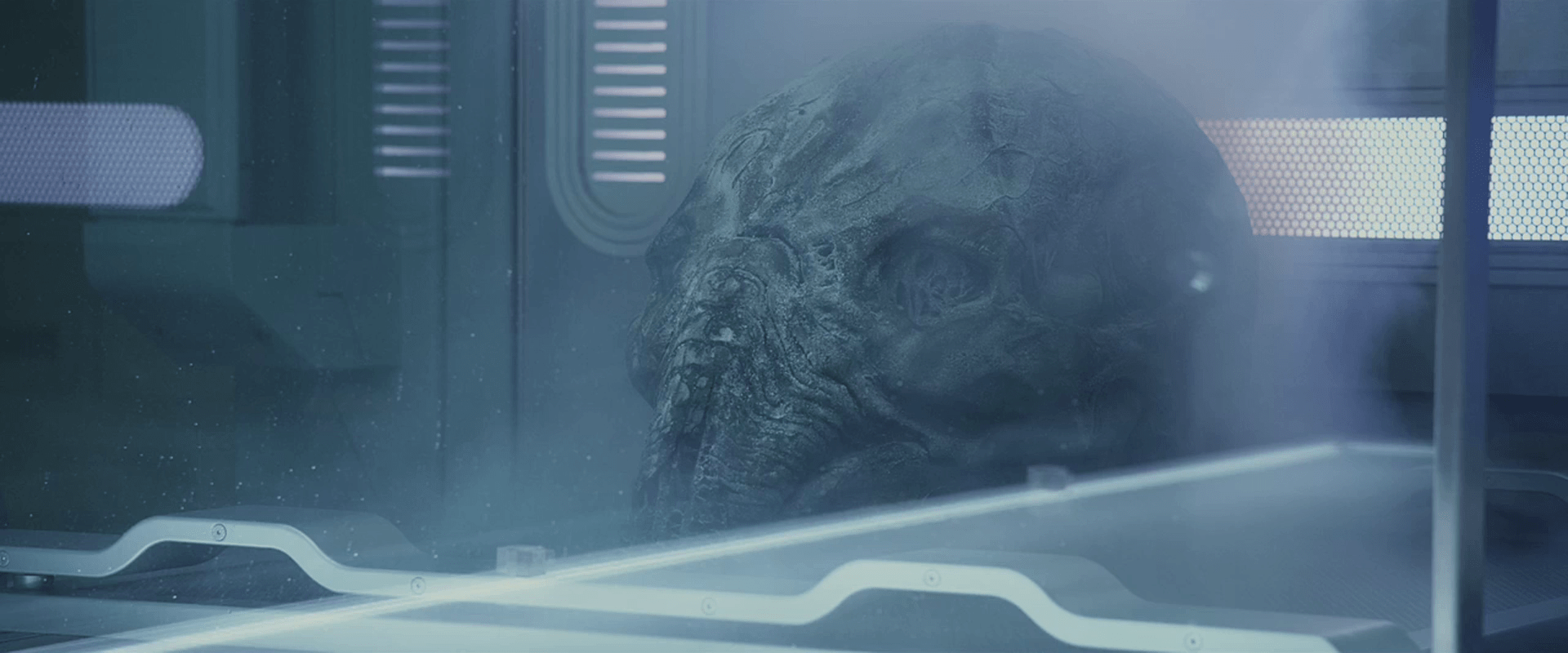
In the lab, Shaw and Ford investigate the alien head from the complex. They first seek to sterilize it. Though we don’t see how the process is initiated, after it is, a “dumb waiter” raises the head from some storage space to a glass-walled chamber where it is sprayed with some white mist. A screen displays an animation of waves passing along the surface of the head.

When the mist clears, a screen reads “SAMPLE STERILE. NO CONTAGION PRESENT,” which Ford dutifully repeats even though Shaw has a screen that says the exact same thing. Obscure metrics and graphs fill the edges of the screen.

Prometheus-156

It might have been tempting for the designers to simply supply the analysis, i.e., “no contagion,” but by providing the data from which the analysis derives, the scientists can check and verify the data for themselves, so the combination is well considered.

There are several problems with this sterilization system.

The text of the analysis reads well and unambiguously, but the graphics would be more informative if they indicated their values within clear ranges. As they are, they push the burden of understanding the context of the values onto the scientists’ memories. If this was a very commonplace activity, this might not be much of an issue.

More importantly are the problems with the industrial design. First, this device seems surprisingly head-sized. Wouldn’t a crewmember be the most likely thing they’d have to sterilize? Shouldn’t it be bigger? But moreover, this device is in the wrong place on the ship. If it was infected with an alien pathogen, sterilizing it here is already too late. The pathogen has already spread everywhere between the airlock, the storage space, and on the hands of whoever had to move it between. It would be better if possibly unsterile material could be loaded into a decontamination system outside the ship, and then only once sterilized then pass through to the interior.

MedPod

Early in the film, when Shaw sees the MedPod for the first time, she comments to Vickers that, “They only made a dozen of these.” As she caresses its interface in awe, a panel extends as the pod instructs her to “Please verbally state the nature of your injury.”

Prometheus-087

The MedPod is a device for automated, generalized surgical procedures, operable by the patient him- (or her-, kinda, see below) self.

When in the film Shaw realizes that she’s carrying an alien organism in her womb, she breaks free from crewmembers who want to contain her, and makes a staggering beeline for the MedPod.

Once there, she reaches for the extended touchscreen and presses the red EMERGENCY button. Audio output from the pod confirms her selection, “Emergency procedure initiated. Please verbally state the nature of your injury.” Shaw shouts, “I need cesarean!” The machine informs her verbally that, “Error. This MedPod is calibrated for male patients only. It does not offer the procedure you have requested. Please seek medical assistance else–”

Prometheus-237

I’ll pause the action here to address this. What sensors and actuators are this gender-specific? Why can’t it offer gender-neutral alternatives? Sure, some procedures might need anatomical knowledge of particularly gendered organs (say…emergency circumcision?), but given…

  • the massive amounts of biological similarity between the sexes
  • the needs for any medical device to deal with a high degree of biological variability in its subjects anyway
  • most procedures are gender neutral

…this is a ridiculous interface plot device. If Dr. Shaw can issue a few simple system commands that work around this limitation (as she does in this very scene), then the machine could have just done without the stupid error message. (Yes, we get that it’s a mystery why Vickers would have her MedPod calibrated to a man, but really, that’s a throwaway clue.) Gender-specific procedures can’t take up so much room in memory that it was simpler to cut the potential lives it could save in half. You know, rather than outfit it with another hard drive.

Aside from the pointless “tension-building” wrong-gender plot point, there are still interface issues with this step. Why does she need to press the emergency button in the first place? The pod has a voice interface. Why can’t she just shout “Emergency!” or even better, “Help me!” Isn’t that more suited to an emergency situation? Why is a menu of procedures the default main screen? Shouldn’t it be a prompt to speak, and have the menu there for mute people or if silence is called for? And shouldn’t it provide a type-ahead control rather than a multi-facet selection list? OK, back to the action.

Desperate, Shaw presses a button that grants her manual control. She states “Surgery abdominal, penetrating injuries. Foreign body. Initiate.” The screen confirms these selections amongst options on screen. (They read “DIAGNOS, THERAP, SURGICAL, MED REC, SYS/MECH, and EMERGENCY”)

The pod then swings open saying, “Surgical procedure begins,” and tilting itself for easy access. Shaw injects herself with anesthetic and steps into the pod, which seals around her and returns to a horizontal position.

Why does Shaw need to speak in this stilted speech? In a panicked or medical emergency situation, proper computer syntax should be the last thing on a user’s mind. Let the patient shout the information however they need to, like “I’ve got an alien in my abdomen! I need it to be surgically removed now!” We know from the Sonic chapter that the use of natural language triggers an anthropomorphic sense in the user, which imposes some other design constraints to convey the system’s limitations, but in this case, the emergency trumps the needs of affordance subtleties.

Once inside the pod, a transparent display on the inside states that, “EMERGENCY PROC INITIATED.” Shaw makes some touch selections, which runs a diagnostic scan along the length of her body. The terrifying results display for her to see, with the alien body differentiated in magenta to contrast her own tissue, displayed in cyan.

Prometheus-254

Prometheus-260

Shaw shouts, “Get it out!!” It says, “Initiating anesthetics” before spraying her abdomen with a bile-yellow local anesthetic. It then says, “Commence surgical procedure.” (A note for the grammar nerds here: Wouldn’t you expect a machine to maintain a single part of speech for consistency? The first, “Initiating…” is a gerund, while the second, “Commence,” is an imperative.) Then, using lasers, the MedPod cuts through tissue until it reaches the foreign body. Given that the lasers can cut organic matter, and that the xenomorph has acid for blood, you have to hand it to the precision of this device. One slip could have burned a hole right through her spine. Fortunately it has a feather-light touch. Reaching in with a speculum-like device, it removes the squid-like alien in its amniotic sac.

OK. Here I have to return to the whole “ManPod” thing. Wouldn’t a scan have shown that this was, in fact, a woman? Why wouldn’t it stop the procedure if it really couldn’t handle working on the fairer sex? Should it have paused to have her sign away insurance rights? Could it really mistake her womb for a stomach? Wouldn’t it, believing her to be a man, presume the whole womb to be a foreign body and try to perform a hysterectomy rather than a delicate caesarian? ManPod, indeed.

Prometheus-265

After removing the alien, it waits around 10 seconds, showing it to her and letting her yank its umbilical cord, before she presses a few controls. The MedPod seals her up again with staples and opens the cover to let her sit up.

She gets off the table, rushes to the side of the MedPod, and places all five fingertips of her right hand on it, quickly twisting her hand clockwise. The interface changes to a red warning screen labeled “DECONTAMINATE.” She taps this to confirm and shouts, “Come on!” (Her vocal instruction does not feel like a formal part of the procedure and the machine does not respond differently.) To decontaminate, the pod seals up and a white mist fills the space.

OK. Since this is a MedPod, and it has something called a decontamination procedure, shouldn’t it actually test to see whether the decontamination worked? The user here has enacted emergency decontamination procedures, so it’s safe to say that this is a plague-level contagion. That’s doesn’t say to me: Spray it with a can of Raid and hope for the best. It says, “Kill it with fire.” We just saw, 10 seconds ago, that the MedPod can do a detailed, alien-detecting scan of its contents, so why on LV-223 would it not check to see if the kill-it-now-for-God’s-sake procedure had actually worked, and warn everyone within earshot that it hadn’t? Because someone needs to take additional measures to protect the ship, and take them, stat. But no, MedPod tucks the contamination under a white misty blanket, smiles, waves, and says, “OK, that’s taken care of! Thank you! Good day! Move along!”

For all of the goofiness that is this device, I’ll commend it for two things. The first is for pushing the notion forward of automated medicine. Yes, in this day and age, it’s kind of terrifying to imagine devices handling something as vital as life-saving surgery, but people in the future will likely find it terrifying that today we’d rather trust an error prone, bull-in-a-china-shop human to the task. And, after all, the characters have entrusted their lives to an android while they were in hypersleep for two years, so clearly that’s a thing they do.

Second, the gestural control to access the decontamination is well considered. It is a large gesture, requiring no great finesse on the part of the operator to find and press a sequence of keys, and one that is easy to execute quickly and in a panic. I’m absolutely not sure what percentage of procedures need the back-up safety of a kill-everything-inside mode, but presuming one is ever needed, this is a fine gesture to initiate that procedure. In fact, it could have been used in other interfaces around the ship, as we’ll see later with the escape pod interface.

I have the sense that in the original script, Shaw had to do what only a few very bad-ass people have been willing to do: perform life-saving surgery on themselves in the direst circumstances. Yes, it’s a bit of a stretch since she’s primarily an anthropologist and astronomer in the story, but give a girl a scalpel, hardcore anesthetics, and an alien embryo, and I’m sure she’ll figure out what to do. But pushing this bad-assery off to an automated device, loaded with constraints, ruins the moment and changes the scene from potentially awesome to just awful.

Given the inexplicable man-only settings, requiring a desperate patient to recall FORTRAN-esque syntax for spoken instructions, and the failure to provide any feedback about the destruction of an extinction-level pathogen, we must admit that the MedPod belongs squarely in the realm of goofy narrative technology and nowhere near the real world as a model of good interaction design.
Remote Monitoring

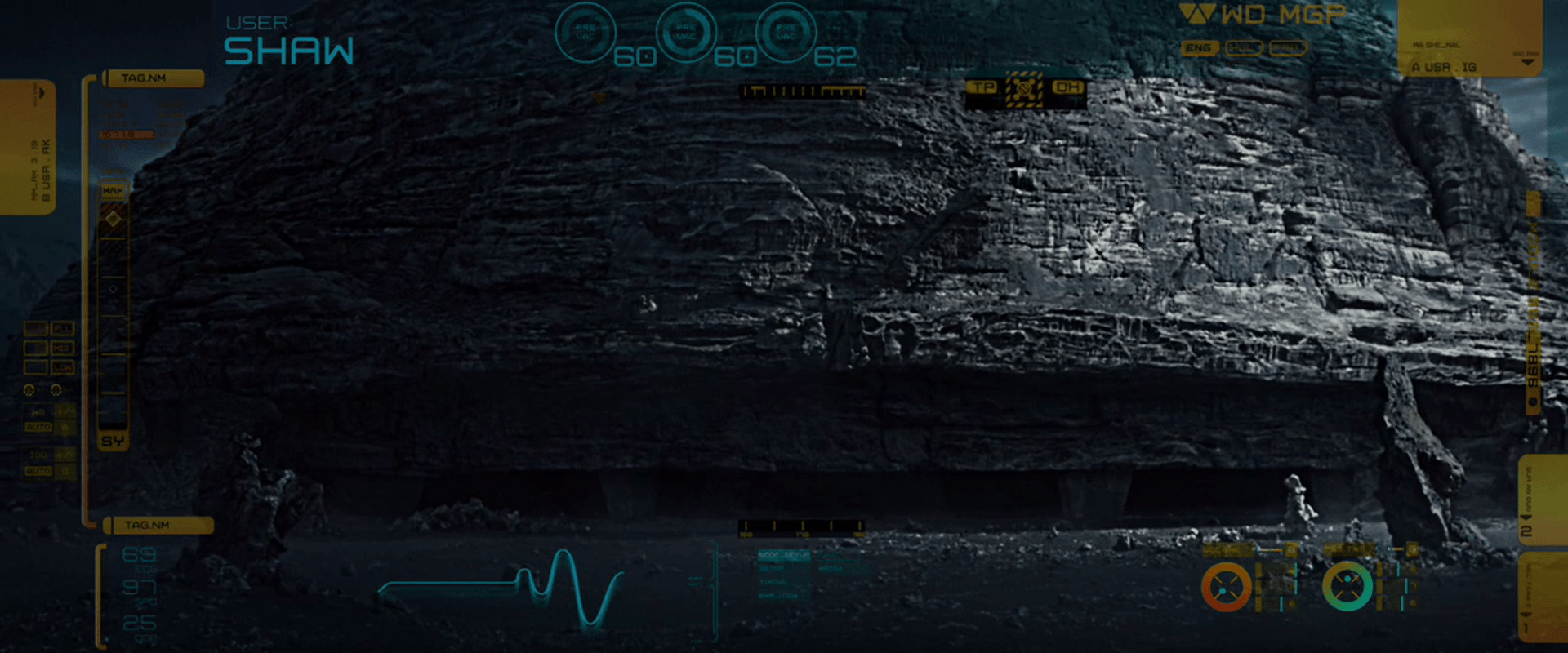
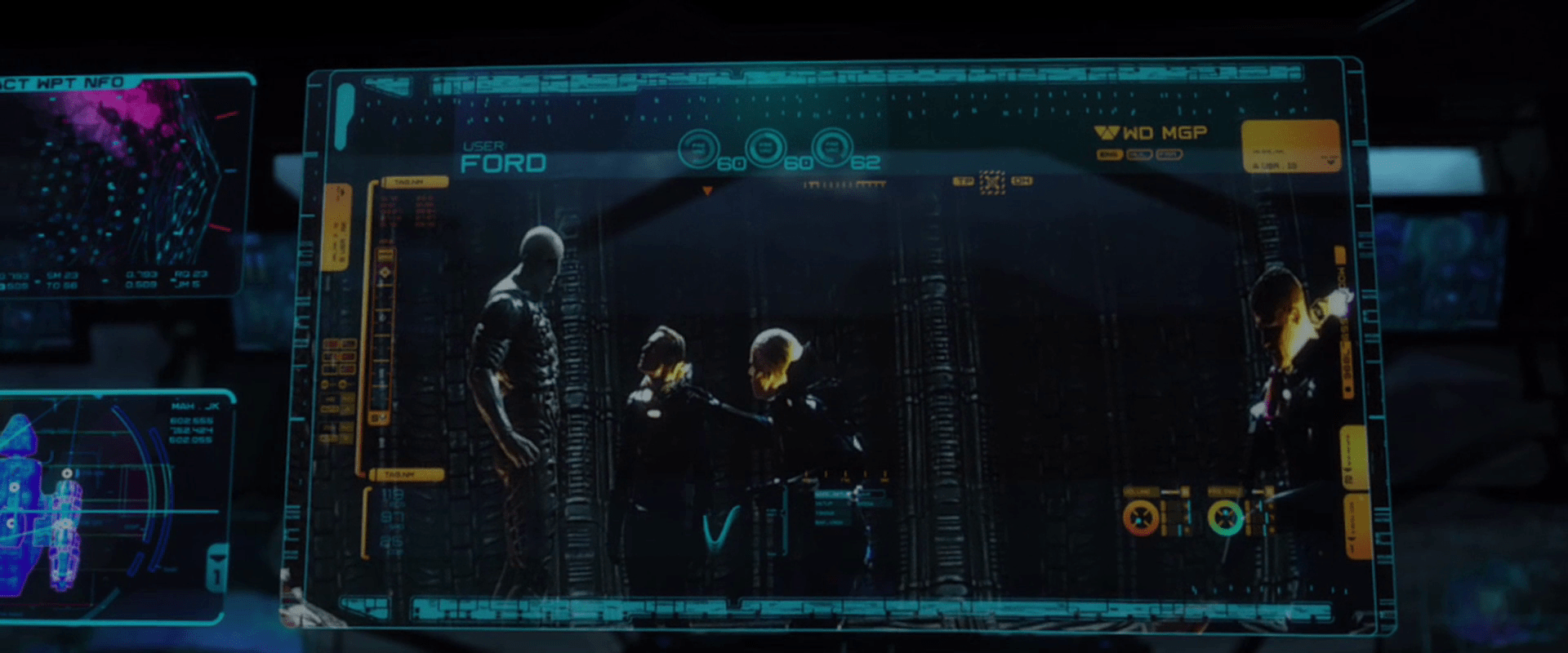
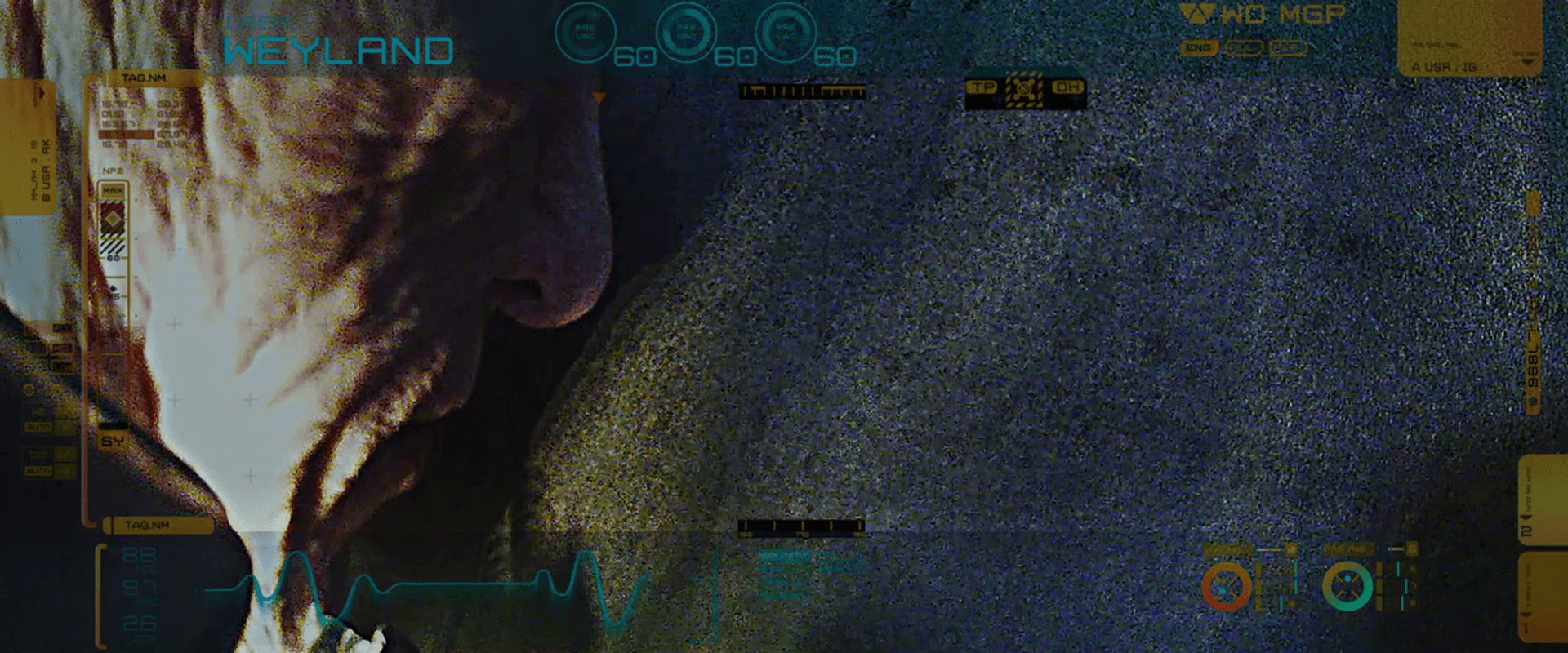
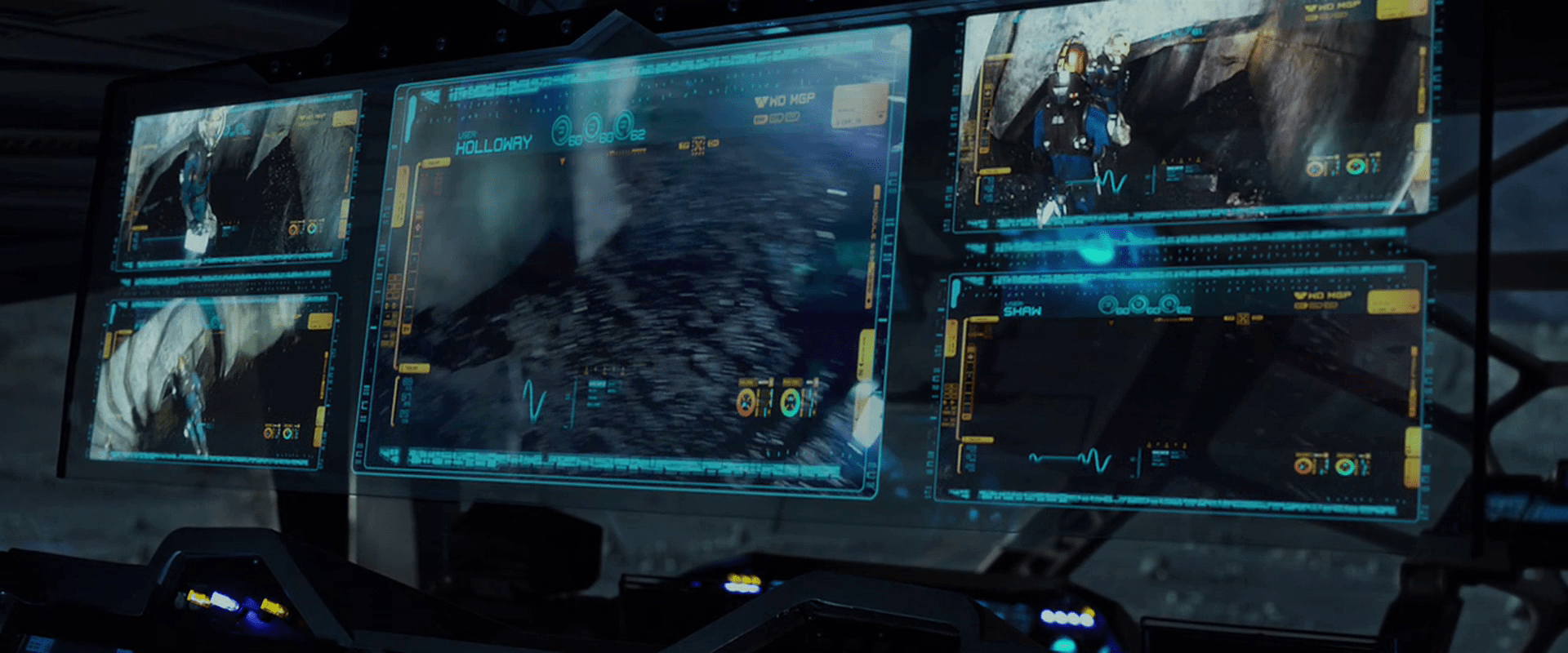
The Prometheus spacesuits feature an outward-facing camera on the chest, which broadcasts its feed back to the ship, where the video it overlaid with the current wearer’s name, and inscrutable iconographic and numerical data along the periphery. The suit also has biometric sensors, continuously sending it’s wearer’s vital signs back to the ship. On the monitoring screen, a waveform in the lower left appears is similar to a EKG, but is far too smooth and regular to be an actual one. It is more like an EKG icon. We only see it change shape or position along its bounding box once, to register that Weyland has died, when it turns to a flat line. This supports its being iconic rather than literal.
Prometheus-109

In addition to the iconic EKG, a red selection rectangle regularly changes across a list in the upper left hand corner of the monitor screens. One of three cyan numbers near the top occasionally changes. Otherwise the peripheral data on these monitoring screens does not change throughout the movie, making it difficult to evaluate its suitability.

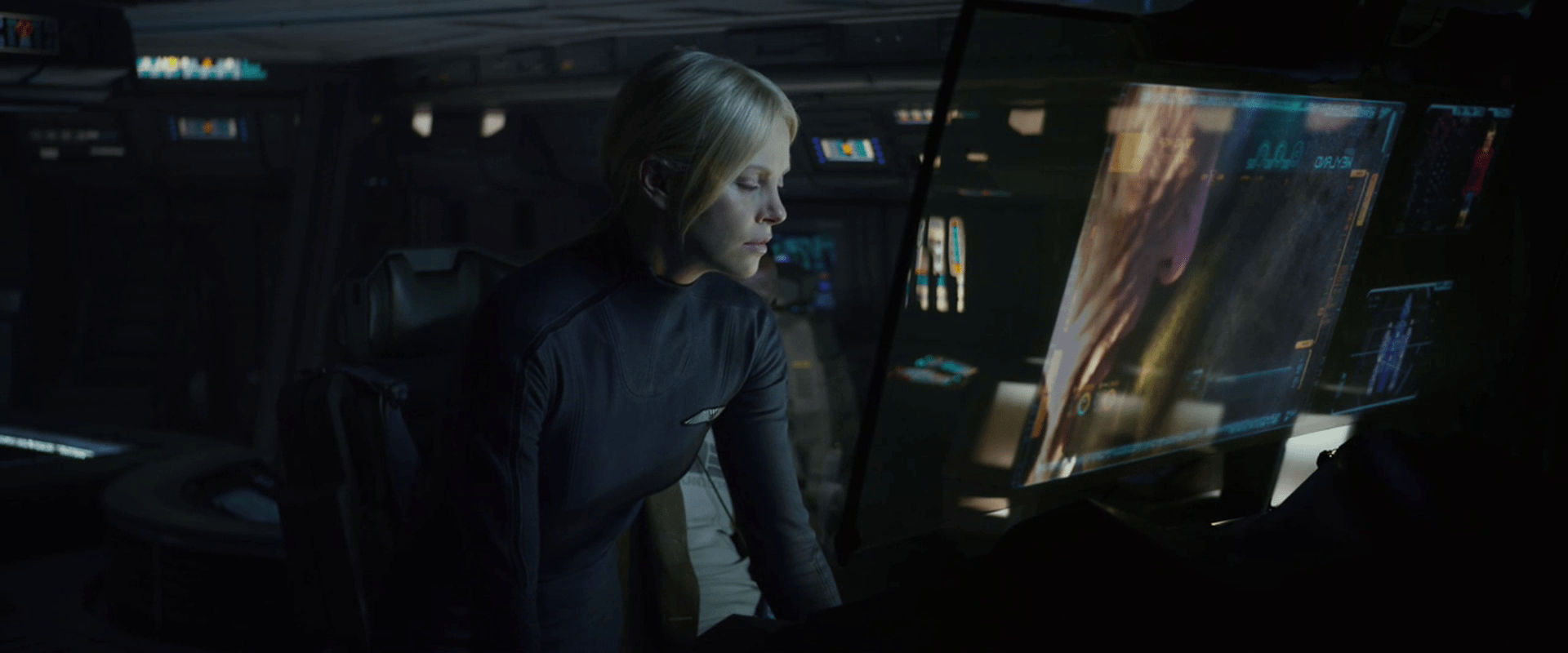
The monitoring panel on Prometheus features five of the monitoring feeds gathered on a single translucent screen. One of these feeds has the main focus, being placed in the center and scaled to double the size of the other monitors. How the monitoring crewperson selects which feed to act as the main focus is not apparent.

Prometheus-110

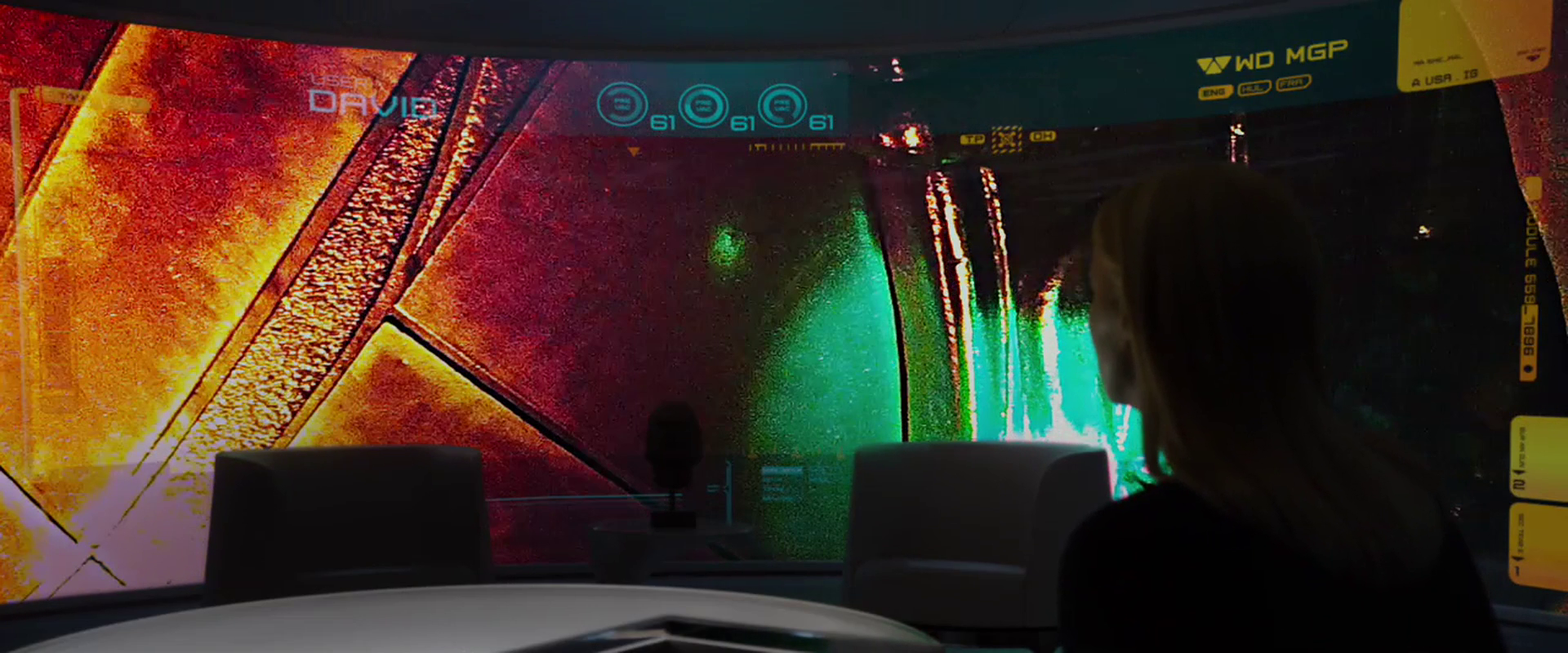
Vickers has a large, curved, wall-sized display on which she’s able to view David’s feed at one point, so these video feeds can be piped to anyone with authority.

Prometheus-203

David is able to turn off the suit camera at one point, which Vickers back on the Prometheus is unable to override. This does not make sense for a standard-issue suit supplied by Weyland, but it is conceivable that David has a special suit or has modified the one provided to him during transit to LV-223.

VP language instructor

During David’s two year journey, part of his time is spent “deconstructing dozens of ancient languages to their roots.” We see one scene illustrating a pronunciation part of this study early in the film. As he’s eating, he sees a volumetric display of a cuboid appear high in the air opposite his seat at the table. The cuboid is filled with a cyan glow in which a “talking head” instructor takes up most of the space. In the left is a column of five still images of other artificial intelligent instructors. Each image has two vertical sliders on the left, but the meaning of these sliders is not made clear. In the upper right is an obscure diagram that looks a little like a constellation with some inscrutable text below it.

On the right side of the cuboid projection, we see some other information in a pinks, blues, and cyans. This information appears to be text, bar charts, and line graphs. This information is not immediately usable to the learner, so perhaps it is material about the entire course, for when the lessons are paused: Notes about the progress towards a learning goal, advice for further study, or next steps. Presuming this is a general-purpose interface rather than a custom one made just for David, this information could be the student’s progress notes for an attending human instructor.

We enter the scene with the AI saying, “…Whilst this manner of articulation is attested in Indo-European descendants as a purely paralinguistic form, it is phonemic in the ancestral form dating back five millennia or more. Now let’s attempt Schleicher’s Fable. Repeat after me.”

In the lower part of the image is a waveform of the current phrase being studied. In the lower right is the written text of the phrase being studied, in what looks like a simplified phoenetic alphabet. As the instructor speaks this fable, each word is hilighted in the written form. When he is done, he prompts David to repeat it.

akʷunsəz dadkta,
hwælna nahast
təm ghεrmha
vagam ugεntha,

After David repeats it, the AI instructor smiles, nods, and looks pleased. He praises David’s pronunciation as “Perfect.”

This call and response seems par for modern methods of language learning software, even down to “listening” and providing feedback. Learning and studying a language is ultimately far more complicated than this, but it would be difficult to show much more of it in such a short scene. The main novelty that this interface brings to the notion of language acquisition seems to be the volumetric display and the hint of real-time progress notes.

HYPSP>S020

In addition to the biometric readout at the foot of the hypersleep chamber, David can also check on the humans in hypersleep via direct visual contact. Though the walls of these chambers are ordinarily opaque, by placing his hand on a corner, David can cause the walls become translucent and the top becomes transparent. This allows him to directly view the body to check on a hypersleeper’s appearance, while maintaining some privacy for the hypersleeper from other straying eyes in the area.

The topmost surface of the chamber also has a translucent interface displaying such information as the sleeper’s name, labeled CRYO SLEEP; something called DREAM STATE, which is numerical (Shaw’s is 0560-09797?); and a few other pieces of inscrutable data.

There are a number of problems with this interface. The translucent interface might be a good idea because it would reduce the time between looking at abstractions of data and looking at a subject. But the data shown on the interface is not clearly biometric. (A solid argument can be made that it would be better to swap the data found on this screen and the data seen in the HYP.SL screen at the head of the bed.) In this case, since the data is not biometric, the overlay might actually occlude important outward signs and is therefore a bit misplaced.

Additionally, since the chambers are situated with their feet towards the wall, the orientation of the typography seems to have poor usability as well. For optimal reading in this portrait orientation, a viewer would have to go as far out of his way as possible in the space. This information should have been laid out along the landscape orientation of the pane, and the information moved to the edge such that an unhindered visual scan of the sleeper is possible.

I was at first confused about a feature of the chambers seen later in the movie, when David is surprised to find evidence that Meredith has exited her chamber and walked to her quarters, long ahead of the others. Why was he surprised? If you were designing a system for a caretaker, wouldn’t you want him to know when something as major as that occurs? Then I realized that Meredith outranks and is resentful of David, so it’s entirely likely that if she could, she would enjoy configuring her personal program to wake her ahead of the others and disable any notification that David would ordinarily receive.

Neuro-Visor

The second interface David has to monitor those in hypersleep is the Neuro-Visor, a helmet that lets him perceive their dreams. The helmet is round, solid, and white. The visor itself is yellow and back-lit. The yellow is the same greenish-yellow underneath the hypersleep beds and clearly establishes the connection between the devices to a new user. When we see David’s view from inside the visor, it is a cinematic, fully-immersive 3D projection of events in her dreams, that is presented in the “spot elevations” style that is predominant throughout the film (more on this display technique later).

Later in the movie we see David using this same helmet to communicate with Weyland who is in a hypersleep chamber, but Weyland is somehow conscious enough to have a back-and-forth dialogue with David. We don’t see either David’s for Weyland’s perspective in the scene.

David communicated with Weyland.

As an interface, the helmet seems straightforward. He has one Neuro-Visor for all the hypersleep chambers, and to pair the device to a particular one, he simply touches the surface of the chamber near the hyper sleeper’s head. Cyan interface elements on that translucent interface confirm the touch and presumably allow some degree of control of the visuals. To turn the Neuro-Visor off, he simply removes it from his head. These are simple and intuitive gestures that makes the Neuro-Visor one of the best and most elegantly designed interfaces in the movie.

HYP.SL

The android David tends to the ship and the hypersleping crew during the two-year journey.

The first part of the interface for checking in on the crew is a cyan-blue touch screen labeled “HYP.SL” in the upper left hand corner. The bulk of this screen is taken up with three bands of waveforms. A “pulse” of magnification flows across the moving waveforms from left to right every second or so, but its meaning is unclear. Each waveform appears to show a great deal of data, being two dozen or so similar waveforms overlaid onto a single graph. (Careful observers will note that these bear a striking resemblance to the green plasma-arc alien interface seen later in the film, and so their appearance may have been driven stylistically.)

HYP.SL

To the right of each waveform is a medium-sized number (in Eurostile) indicating the current state of the index. They are color-coded for easy differentiation. In contrast, the lines making up the waveform are undifferentiated, so it’s hard to tell if the graph shows multiple data points plotted to a single graph, or a single datapoint across multiple times. Whatever the case, the more complex graph would make identifying a recent trend more complicated. If it’s useful to summarize the information with a single number on the right, it would be good to show what’s happening to that single number across the length of the graph. Otherwise, you’re pushing that trendspotting off to the user’s short term memory and risking missing opportunities for preventative measures.

Another, small diagram in the lower left is a force-directed, circular edge bundling diagram, but as this and the other controls on the screen are inscrutable, we cannot evaluate their usefulness in context.

After observing the screen for a few seconds, David touches the middle of the screen, a wave of distortion spreads from his finger for a half a second, and we hear a “fuzz” sound. The purpose of the touch is unclear. Since it makes no discernable change in the interface, it could be what I’ve called one free interaction, but this seems unlikely since such cinematic attention was given to it. My only other guess is to register David’s presence there like a guard tour patrol system or watchclock that ensures he’s doing his rounds.