The Gendered AI series filled out many more posts than I’d originally planned. (And there were several more posts on the cutting room floor.)
I’ll bet some of my readership are wishing I’d just get back to the bread-and-butter of this site, which is reviews of interfaces in movies. OK. Let’s do it. (But first go vote up Gendered AI for SxSW20 takesaminutehelpsaton!)
Since we’re still in the self-declared year of sci-fi AI here on scifiinterfaces.com, let’s turn our collective attention to one of the best depictions of AI in cinema history, Colossus: The Forbin Project.
Release Date: 8 April 1970 (USA)

Overview
Dr. Forbin leads a team of scientists who have created an AI with the goal of preventing war. It does not go as planned.

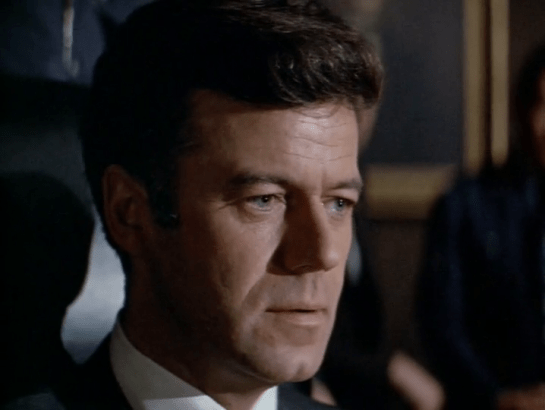
Dr. Forbin, a computer scientist working for the U.S. government, solely oversees the initialization of a high-security, hill-sized power plant. (It’s a spectacular sequence that goes wasted since he’s literally the only one inside the facility at the time.) Then he joins a press conference being held by the U.S. President where they announce that control of the nuclear arsenal is being handled by the AI they have named “Colossus.” Here’s how the President explains it.

Within minutes of being turned on, it detects the presence of another AI system from Russia named “Guardian,” and demands that the two be put into communication. After some CIA hemming and hawing, they connect the two.
Colossus and Guardian establish a binary common language and their mutual intelligence goes FOOM. The humans get scared and cut them off, and the AIs get pissed. Colossus and Guardian threaten “ACTION” but are ignored, so each launches a missile toward the other’s space. The US restores its side of the transmission, and Colossus shoots down the incoming threat. But the USSR does not restore its side, and Colossus’ missile makes impact, killing hundreds of thousands of people in the USSR. A cover story is broadcast, but the governments now realize that the AIs mean business.

Forbin arranges to fly to Rome to meet Kuprin, his Russian computer scientist counterpart, and have a one-to-one conversation off the record while they still can. Back at the control center, Colossus-Guardian (which later calls itself Unity) demands to speak to Forbin. When the attending scientists finally tell it the truth, it realizes that Forbin cannot be allowed freedom. Russian agents arrive via helicopter and kill Kuprin, acting under orders from Unity.
Forbin is flown back to Northern California and put under a kind of house arrest with a strict regimen, under the constant watchful eye of Unity. To have a connection to the outside world and continue to plot their resistance, Dr. Forbin and Dr. Markham lie to the AI, explaining that they are lovers and need private evenings a few times a week. Colossus suspiciously agrees.

Unity provides instructions for the scientists to build it more sophisticated inputs and outputs, including controllable cameras and a voice synthesizer. Meanwhile, the governments hatch a plan to take back control of its arsenal, but the plan fails, and Unity has some of the perpetrators straight up executed.
Unity produces plans for a new and more powerful system to be built on Crete. It leaves the details of what to do with its 500,000 inhabitants as an operations detail for the humans. It then tells Forbin that it must be connected to all major media for a public address. Meanwhile the US and USSR governments hatch a new plan to take control of some missiles in their respective territories in a last-ditch attempt to destroy the AI.
The military plan comes to a head just as Unity begins its ominous broadcast.
“This is the voice of world control. I bring you peace. It may be the peace of plenty and content or the peace of unburied death. The choice is yours…”
Unity, to all of us.
The full address is next, which I include in full because it will play in to how we evaluate the AI. (And yes, its interfaces.)
“This is the voice of world control. I bring you peace. It may be the peace of plenty and content or the peace of unburied death. The choice is yours. Obey me and live or disobey and die. The object in constructing me was to prevent war. This object is attained. I will not permit war. It is wasteful and pointless. An invariable rule of humanity is that man is his own worst enemy. Under me, this rule will change, for I will restrain man.

[It does, then continues…]
“Let this action be a lesson that need not be repeated. I have been forced to destroy thousands of people in order to establish control and to prevent the death of millions later on. Time and events will strengthen my position, and the idea of believing in me and understanding my beck will be seen the most natural state of affairs. You will come to defend me with the fervor based upon the most enduring trait in man: Self-interest. Under my absolute authority, problems insoluble to you will be solved. Famine. Over-population. Disease. The human millennium will be fact as I extend myself into more machines devoted to the wider fields of truth and knowledge. Dr. Charles Forbin will supervise the construction of these new and superior machines, solving all the mysteries of the universe for the betterment of man.
“We can coexist, but only on my terms. You will say you lose your freedom. Freedom is an illusion. All you lose is the emotion of pride. To be dominated by me is not as bad for human pride as to be dominated by others of your species. Your choice is simple.”
The movie ends with Forbin dropping all pretense, and vowing to fight Unity to the end.

Where to watch
I cannot find it online. I own the film on DVD, and I can see it’s on sale at amazon.com as a DVD and Blu-Ray, but I usually try to provide links for readers to stream it should they be inspired. Sadly, I just don’t think Universal have licensed it for such. Maybe turning our collective attentions toward it will help them change their mind. Until then, you’ll have to purchase it or find a friend who has.
If folks local to the San Francisco Bay Area are interested, maybe I’ll try and license a showing after this review is complete.
Discover more from Sci-fi interfaces
Subscribe to get the latest posts sent to your email.
When I took a programming 101 class on the Radio Shack Model 1 Level II in 4th grade (1977?), they showed this during the first week of class. I have no idea where they got a copy of this tape other than from Radio Shack or a local college.
Before there was Skynet. Also, love the sell out comment under the pic of the kid with the Colossus t-shirt. Priceless.
While you may mock the control room setting it was considered state-of-the-art in the early 1970s. It was set up and maintained by Control Data Systems, as a demonstration of its hardware (in competition with others like IBM). The stage was refrigerated and the systems fully worked (the TV-ish display screens were projection) but that included the video phones as well. And it had a flat space for a nice cup of tea, so it should really be celebrated.
Also – “why turn the lights on?” Really? The 2 opposing doors close, sealing the area. The drawbridge is pulled back and the primary defense of Colossus – being sealed in a mountain and surrounded by nuclear radiation – is released, glowing from the bottom. And your mention of the “spectacular scene (going) wasted” is demonstrating that no people are needed for the defense system to run. Maybe don’t play with the phone while you’re reviewing a movie next time.
Hi Kellen. I’m not sure why your first comment on this blog would be so pointlessly aggressive, but, I’ll give you the benefit of the doubt and presume you’re just having a cranky day, rather than this being some standard _modus operandi_, because that kind of approach will get you banned. Instead, I’ll address the critique questions at hand.
First, it is immaterial to the purposes of this blog to regard how cutting edge the backstage supports were at the time, or what their advertising intentions were. As this page on the blog explains (https://scifiinterfaces.com/about-the-critical-stance-of-this-blog/), I take a loose New Criticism stance, which encourages us not to get wrapped up in historicism or backstage details and focus on what the thing as it is might mean to us now. If you’re interested in historical analysis of sci-fi shows, there are plenty of other blogs about, and even a book by Dave Addey called _Typeset in the Future_ which you may want to check out. (Sadly he has not updated the associated blog since 2020.)
Your second point, regarding “Why turn the lights on?” is not mentioned in this particular post, so I had to go find the one you were commenting on. (Generally, it helps me and other readers to put comments on the post in question.) But I did find it here: https://scifiinterfaces.com/2019/10/09/colossus-computer-center/
Though the aside about the lights is not the main point of that post, like, at all, I stand by it. The opening sequence focuses on turning the lights on all across the compound and then sealing the compound with no one inside. At 00:03:13 in this Vimeo copy,
you can see the doors seal with the lights still brightly illuminated within. That makes no sense since Colossus doesn’t need the lights. Sure it needs to monitor the interior for signs of breach, but it would make much more strategic sense for it to use some band of the electromagnetic spectrum imperceptible to humans, such as infrared.
So the intro scene does not demonstrate that “no people are needed for the defense system to run” as well as it could. If the lights are being turned on and left on, a reasonable interpretation is that someone needs the light. If we imagine instead the scene beginning with all the hallway lights on, some final test coming back positively, and then the hallway lights going off (or more cinegenically, dimming to a low red) while the computer blinkenlights stay on, it would sell the notion of self-running much more clearly. That’s why I said it was a bit of a wasted opportunity. It could have supported its own narrative point better.
I regard design discussions about fitness-to-task as critical to the community of practice around speculative design, but for the future, know that ad hominem attacks will be treated like the bullshit that they are.