The Content

Props be unto us

33% of readers like that this is content that can’t be found anywhere else.

20% like learning more about interfaces in their favorite shows.

10% like how it sharpens their thinking around interaction design.

20% of people added a response of “all of the above” (the many slices) which is just awesome.

like.png

Your wish list

Many people asked for more frequent posts, and I wholly agree, but can’t do much about it. This is a labor of love, not a job, and I’m fitting it in to my schedule amongst work, marketing my new book, working on new stuff, and being a dad. (Wait. You know that I see maybe $5/month from this, right?)

I’d put the amount of work to review an average movie at 60 hours of work between screen cap, writing, formatting, and social medializing. The only chance I have of upping the frequency is to have more time (unlikely) or more authors, and while I have worked with a great team of them, none of them seem to have the time to do more than they already are/have. So, yeah, once/week is about as much as I can wrangle. Glad to know there’s demand?

moreof.png

More advice

Similarly to frequency, there was interest in more advice on which shows to watch. I’m going to presume that’s the report cards at the end of each review. That’s obviously tied to frequency of posts, so is similarly constrained.

More sub-genres

There was interest in more sub-genres (like anime, horror-sci-fi, or comedy) and I’m down for that. I had one author who had expressed interest in starting to cover B-movies, which I loved, but he wound up not having the time. I’ll use the requested shows as an indicator of which sub-genres.

Note though that I don’t feel especially equipped to review anime. (I took a risk with Ghost in the Shell. Anime fans: Did it work?) I feel that to do it right takes some background knowledge of the genre as a whole, the common tropes, sometimes the language, and the culture from which it emerged, and I’m lacking on all those fronts. 🙁 I have an author who is better equipped, but she’s also strapped for spare time. I’ll hit her up and see if she’s interested in going in again on some of the requested shows.

More authors

There were 8% who were expressed interested in different authors. I’m down for having more voices to bring more content and different perspectives to the site. Which leads us to…

Your opportunity/general shout-out

This and nearly all of the above problems could be solved with more contributors, let me put this out there: I am always looking for more authors with whom to collaborate and get more content. It’s not easy (here is the outline of the amount of work it takes) and my time to collaborate/be a thought partner/editor is constrained, but my authors do report it’s fun and rewarding. So, hit me up: chris [at] scifiinterfaces.com

Shows

sci-fis.png

There was a clear winner in the wish list for new reviews.

  • The Expanse (5)
  • Star Trek (3) (Since this was asked before Discovery, I presume this means the whole franchise, not just the new one)
  • District 9 (2), robot HUD and ship controls
  • Babylon 5 (2)
  • Westworld (2) (1 request said particularly as it relates to game design)

Great. A nice list. Some problems with it though.

The Problem of TV Shows

As much work as reviewing movies is, reviewing television shows is at least an order of magnitude more than that. (Black Mirror and similar anthology shows are an exception. Except as of the latest season finale we get that it’s a single diegesis which only goes to prove the point…)

Take an example from Star Trek. To review just one technology from the show thoroughly/confidently across the entire franchise (and here I have to make a shout-out to Quora author Cliff Gilley on this post), I have to watch 546 hours hours of television and movies. That’s 23 days straight without sleeping. Dedicated to viewing, understanding, screen capping as I go, cataloging, thinking about rules and exceptions. Maybe an AI could do it. But I ain’t AI. I did it for combadges, but that was greatly aided by the Memory Alpha wiki, which helped me filter out the shows in which the technology isn’t. Not all shows have that awesome of a wiki behind it.

This doesn’t mean I’m against reviewing TV shows on principle, but holy cow is it daunting when I think of the number of movies I could get reviewed in that same amount of time.

In addition to the daunting work, I usually like to wait for a series to be completed before I attempt to review the interfaces. That’s partly so I don’t have to go back and update analyses to incorporate new interactions that appear later, or refer to interfaces by the when they appear. A post named Teleporter Interface (2015–2017) doesn’t exactly roll across the tongue, keyboard, or the eyes.

I’ve made some exceptions. I have the first drafts of reviews for Firefly around here someplace since I wrote the book, and I just need to wrap up the three ongoing properties before I want to revisit those for publication. And I didn’t wait for the Marvel Cinematic Universe to be complete before I started reviewing those movies, so exceptions can be made, I just have to have really good reasons to break the “rules.”

Those particular shows

So with that in mind, I have seen season one of The Expanse. I intend to go back and watch the next seasons. But given the cliff hanger at the end of season 1, I really feel I ought to let that one finish before I review.

With the new trailer for Season 2 of Westworld out, I suspect I should wait for that one, too, though I’m really itching to review that one.

And holy shit Star Trek. Unless I stick to the movies, I could spend the rest of my life reviewing those shows alone, and I’m just not up for it yet. If you want to help start, again: Hit me up.

Star-Treks.png

I loved District 9 and got to include a few of the interfaces for the book, so I have a leg up on that one. Quite possible.

There were a bunch of fun one-off requests as well. Here they are, with any notes by me in [brackets].

  • Continuum
  • Destination Moon [a fun older movie! Love it.]

  • Doctor Who [I want to do this especially given the new Doctor, but it has decades of material for me to review. I was last a regular watcher when the Doctor wore a striped scarf (!)]

  • Person of Interest (particularly seeing all the “inputs” the machine uses and the limited “outputs”) [Oh man me, too. Especially since it ties in to my interest in AI and I loved this show. They had done their homework on ASI and the show was fun and compelling to boot. And the show is over. So I’m down.]

  • Battlestar Galactica (reboot) The mini-series is done.

  • Blakes 7

  • Contact [So few interfaces in this one it might be pretty easy.]

  • Continuum

  • Dark Star [Oh man. This one would be tough and fun. but awesome.]

  • Edge of Tomorrow

  • Guardians of the Galaxy 1 & 2 [These are pretty likely since they’re in the MCU and that’s a vein I’m currently mining.]

  • Gunbusters

  • Killjoys

  • The Last Starfighter [Near and dear to my heart.]

  • Lexx

  • Moon [Great, constrained interface design in this.]

  • Red Dwarf

  • Star Trek The Motion Picture (specifically the bridge and icon system)

  • Stargate

  • Starship Operators

To whoever listed Jurassic Park, it’s already done! Same with The Fifth Element. Also I’m not going to review Ender’s Game because Card is such a toxic asshole I don’t even want to indirectly reward him.

If you’re reading this and you think you’d want to review one or more of these, please let me know.

Next up: I begin providing responses to some one-off comments and suggestions.

Using the Site

Most readers see the site as a fun distraction, but nearly a third use it as inspiration for their design or sci-fi work. Around 16% just love getting more into the sci-fi they love. Fist bumps, fanpeeps.

usingit.png

Alerts

Seems like half of you subscribe by RSS, 16% by Facebook and 16% by tweet. The RSS news came as lots of added answers, so is that choppy chunk on top.  One enterprising reader has set up an IFTTT alert. (Sweet.) The RSS news was an informative surprise. I presumed most folks were receiving alerts via Twitter and Facebook, and click through to the blog. I now should start thinking about the fact that many articles are read without the “chrome” of the blog ever been seen.

alerts.png

Sharing/social

I asked about sharing content as that’s how I have any hope of growing my audience. And for all the time this takes me and the other authors, I’d love to see the audience grow. But you’re only likely to share when the content is particularly awesome, in-depth, or about something that’s always bothered you.

Some folks said they didn’t know I did social media in relation to the site, and that makes sense knowing how many people subscribe by RSS. The social media links are visible on the website. They wouldn’t appear on emails. So, for you RSS readers…

  • I tweet notifications of new content from @scifiinterfaces. I also post to this (linked) page on Facebook.
  • Final reviews also get posted to reddit, so if you’re a redditor, there’s lots of related content on the FUI subreddit.
  • Videos take a massive amount of work, but when I have them, I have a channel on Youtube.

There are also links to Make It So, to t-shirts, and errata from the book that you may have never seen. The tip button folks didn’t know about is at the top-right of every page on the site, but not in the RSS feed.

Some readers reported that they don’t know anyone else with their same interest in sci-fi interfaces, so let me take the chance to recommend the Facebook group and reddit as a place you can get to know other folks with these same interests. Some warning: Nearly all other sites with a similar focus tends to collect examples with very little analysis. But still.

Next up we’ll talk about the important thing, and that’s what you think of the content.

The Readership: Who are you people?

I only asked after time zone, rather than location, which in retrospect was not smart. I was trying to figure when the best time to post was, but now I realize that wasn’t the only use of such information. Too late now. Maybe next year.

Looks like you’re concentrated in the middle of the Americas, and Lisbon/UK time zones. But there’s also readers on the continental-American coasts, Alaska(!), Europe, Southeast Asia, and what I suspect is Melbourne/Sydney. Hey look a chart.

TimeZones.png

WordPress gives me stats about the readership, too, but only down to the country. It largely agrees with the poll results, but I see that Japan may be happy reading but not so happy responding to polls. (A poll which was, admittedly, written in English.) If I crudely overlay the WordPress map to this map, looks like my anchors are North America, UK & Europe, and Eastern Australia. No surprise. English speaking worlds. (Though, I miss you, Ireland, South Africa, and New Zealand.)

overlay.png

Your jobs

I’m impressed with the breadth of jobs in the poll. We’re a bunch of smarties and creative types.

  • 7 UX
  • 6 Software (not in a design capacity)
  • 6 Visual design for software
  • 3 I make sci-fi interfaces
  • 3 Education

A handful of game designers/developers (and author…) I wish we all lived near each other. We could have a sci-fi game night at someone’s place.

  • Tabletop Gamer
  • Game development & Education
  • Game designer, author, and publisher of Traveler5 materials
  • Former game developer; working as freelance now

Then an interesting set of one-offs.

  • Sci-fi writing & editing
  • Writer
  • AI programmer for games
  • Smart spaces/interactive installations
  • Visual effects (3D environments not sci-fi interfaces)
  • Management
  • Aerospace Engineering
  • Big data
  • Marketing, but I studied interface / interaction design
  • Advertising
  • Software development
  • Multiple: web design in higher education, art, graphic design on the side
  • Not related to science [sic]

Your social media

The poll showed a breakout that’s pretty similar to wider trends in the world, though Facebook is less popular than in the wider world and Twitter is more popular amongst you. Also there’s a stronger showing for Google Plus, and some fun one-offs, below.

socmedia.png

Hearing about scifiinterfaces

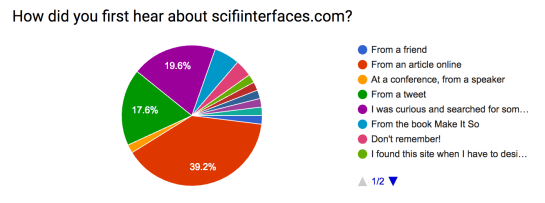
Seems like most folks heard about the site through an online article. (Was it a particular one? Comment? I owe someone some thanks.) Some of you just went out and found it and some saw a tweet about it. One actually transcribed the URL printed in the related book. Damn. Props.

firstlearn.png

So that’s who’s out there, roughly where you are, and what you do. Next up we’ll talk about how you use the site. 

Readership poll results

Last summer, at the 5 year anniversary of the blog, I ran a readership poll. Thanks to everyone who took a few minutes back then to answer it (now closed). I know when I answer a poll I’m always curious about the results. So I presume you are, too. Here ya go.

Crap

First apologies on some aspects of the poll. I should have made some things multiple-choice, but by the time I caught it was too late. Shifting midway through the poll would mean I’d have to divide the results between radio-button and checkbox responses, and that would have been headachey. Next time, next time.

Overview

There were a total of 51 responses.

Overall, looks like me and the other authors are doing pretty good. 8 out of 10. Personally, I’ve always been a solid B+/A- student, so this plays out. 5 responders think the site is near god-like (that or they’re prone to hyperbole) and a couple of folks said we’re doing below average. Sorry, you two. Thanks for sticking with it.

How doing.png

The overview done, I thought my roundup and response to the poll was going to be a simple thing, but I was wrong. Between the aggregated data and the individual responses, it was too much for a single post. Also, I realized that some of my responses might raise some conversation from the group of us at large, which works much better if the post is limited to one concept so the comments don’t get muddled. So I’ll be breaking the results into three bigger posts.

  1. The readership (you)
  2. How the site is used
  3. Your wishlist

Followed by a smattering of one-off comments-and-responses.

This also buys me some time while I’m preparing other material. But you’d guessed that. 

A shout out for sci-fi 3D file systems

Hey readers. One of scifiinterface’s writers, Hugh Fisher, is embarking on a cross-show analysis of speculative 3D file browsers. He first started thinking of it when viewing Hackers and remembering Jurassic Park. What others can you think of? (Yes, we know of Johnny Mnemonic, but it’s 3D cyberspace, not files, innit?)

Please list others you can think of in the comments (which is here for those reading RSS). The more detail you can provide, the better. And thanks in advance!

Report Card: The Star Wars Holiday Special

When The Star Wars Holiday Special aired, it was only one year after the first movie, and while Star Wars was an obvious success at the time, no one knew it was bound to become one of the world’s biggest media juggernauts, which would still be producing blockbuster movies in the same diegesis four decades later (with no end in sight). So we can understand, if not forgive, that it was produced as an afterthought, rather than giving it the full attention and deliberateness we’ve since come to expect from the franchise. In short it was a crass way to keep audiences—and the toy purchasing public—thinking about Star Wars until Empire could be released a year and a half later.

Report-Card-SWHS.png

It was doomed from the start. CBS wanted to camp on the movie’s success, and stupidly thought to force-choke it into a variety show format, like The Sonny & Cher Jedi Hour or Donny & Marie, Sith Lords, Variety Show. At the time, Lucas couldn’t be bothered to provide much beyond the framework story and a “Wookiee Bible,” (mentioned here) which explained the background and behavior of the Wookiees, including the fact that they were the center of the story and they can only growl. The first director quit after shooting a few scenes. Other than The Faithful Wookiee, the whole thing seems obviously rushed to production. It had about 30 minutes of script that had to be stretched into 90 minutes of airtime. Though they pulled in some respectable TV names of the time (Harvey Korman, Bea Arthur, Art Carney) to carry the thing and even had the stars of the original cast, those actors couldn’t do much with what amounted to a salad of terrible ideas written by and for goldfish: people pegging the S meter on the Myers-Briggs test.

SWHS_generalalert-11

I’m quite fascinated by the Special partly for its narrative—for there is one, dishwater-flavored though it is—which requires us to be in the narrative and yet out of it at the same time, depending on the need, switching back and forth at a moment’s notice. For instance, you must dismiss the fact that Malla would have any interest in pausing her day for 5 minutes to stare at a security camera feed from inside a shop, because you know the point is the scene in the shop. Or, we dismiss the awkwardness of Itchy watching cross-species VR erotica in the family living room because we know that the point is the Mermeia Wow number. Or, we dismiss the tragic implication that Malla may be mentally challenged, because she takes a comedy cooking skit as literal instructions she should attempt to follow, because we know the point is the “comedy.” But how do we (or the toy-purchasing kids that were the target audience) know which parts to dismiss and which parts to indulge? There are no explicit clues. These are fascinating mental jumps for us to have to make.

It’s also interesting from a sci-fi interfaces point of view because, like most children’s shows, the interfaces are worse than an afterthought. They are created by adults (who don’t understand interaction design) merely to signal high-techn-ess to kids, whom they mistakenly believe aren’t very observant, and they do so under insane budgetary and time constraints. So they half-ass what they can, at best, half-ass, and the result is, well, the interfaces from The Star Wars Holiday Special.

Ordinarily I like to reinforce the notions that what designers are doing in reading this blog is building up a necessary skepticism against sci-fi (and plundering it for great ideas, intentional or otherwise), but in this case I can’t really back that up. What we’re doing here is just staring agape in amazement at what can come out of the illusion machine when everything goes wrong.

But, to compare apples-to-oranges, let’s go through the analysis categories:

Sci F 0 of 4How believable are the interfaces?

They are all not just props but obvious props. Straight up tape recorders. Confusing and contradictory user flows. A secret rebel communication device that shrilly…rings. Generally when they are believable, they are very mundane. Like, I’d say the Chef Gourmaand recipe selector or Saun Dann’s final use of the Imperial Comms (which contradicts Malla’s use of the same device.) The Special interfaces break believability all over the place and in terrible ways.

Fi F 0 of 4How well do the interfaces inform the narrative of the story?

If I’m being charitable, maaaaaybe some of them help set the tone? The holocircus and cartoon player tell of the gee-whiz high-tech world of this galaxy far far away. But the Groomer, the Jefferson Projection, and the living room masturbation chair are pointless (and unnerving) diversions that distract. Any goodness in Lumpy’s cartoon player is strictly accidental and depend on heavy apologetics. The Life Day orbs have some nice features, but they’re almost extradiegetic, a cinematic conceit. Admittedly the show only gave a nod to a central narrative anyway because of its genre, but it cannot be said that the interfaces inform the narrative.

Interfaces F 0 of 4How well do the interfaces equip the characters to achieve their goals?

This is the easiest rating to get, because it’s the thing movies are usually good at. But with the complicated and contradictory flows of the Imperial Comms, “secret” interfaces that rat out the users, extraneous controls and terrible interaction models, these interfaces are a hindrance much more than a help.

Overall F 0 of 12Dreck

Doing this review was so painful, I note it took a little over two years since I started it. In between the first and last post, I’ve had to take a lot of breaks: a manifesto of sorts, a rumination on the Fermi Paradox in sci-fi, and reviews of the Battlestar Galactica mini-series, Johnny Mnemonic, Children of Men, a Black Mirror episode, and Doctor Strange.

I have not had a review at 0 before, so I had to invent the category name. Now if my ratings were recommendations, The Star Wars Holiday Special would get a MUST-SEE, but for cultural reasons. Like, you must see it because otherwise you would not believe it is real. But for inspiration or even skepticism-building, it’s only useful except as a cautionary tale.

For some reason the Special got a lot of attention this past December (c.f. Vanity Fair, Vox, the Nerdist, Newsweek, Mental Floss) which makes me think it was a concentrated stealth push by Disney to coincide with the release of The Last Jedi. Or maybe it’s just other writers, like me, are filled with a kind of psychological wound that the new films always reopen. A fear that we will once again he asked to watch a stormtrooper watch a “holographic” music video with questionable silhouettes.

SWHS-musicVP-09

Whatever their reasons for talking about the Special, for me it serves as a reminder, kind of like The Laughing Gnome or perhaps Spider-Man 3, that even the greats occasionally have to overcome massive, embarrassing, WTF mistakes.

And with that, the review is done. I have gone into the Wampa cave and come out alive. Godspeed, Star Wars Holiday Special.

Star_Wars_Holiday_Special_8x10__67622.1405345638.1280.1280.jpg

Full series, in order: Star Wars Holiday Special (1978)

IMDB: https://www.imdb.com/title/tt0193524/

Life Day Orbs

The last interface in The Star Wars Holiday Special is one of the handful of ritual interfaces we see in the scifiinterfaces survey. After Saun Dann leaves, the Wookiee family solemnly proceeds to a shelf in the living room. One by one they retrieve hand-sized transparent orbs with a few lights glowing inside of each. They gather together in the center of the living room, and a watery light floods them from stage right while the rest of the house lights dim. They hold the orbs up, with heads tilted reverently. Then they go blurry before refocusing again, and now they’re wearing blood red robes and floating in a sea of stars.

SWHS_orbs_17.png

Then we cut to a long procession of Wookiees walking single file across an invisible space bridge into a glowing ball of space light, which explodes in sparkles at no particular time, and to which no one in the procession reacts in any way.

SWHS_orbs_16.png

Break for commercial.

SWHS_orbs_08.png

Lights up, and dozens of blood robed Wookiees are gathered in a dark space at the foot of a great, uplit tree called The Tree of Life. Stars occasionally, but not consistently, appear behind the tree. Fog hugs the floor and covers randomly distributed strings of fairy lights. Everyone carries the glowing orbs. They greet newcomers arriving from the star bridge with moans and bows (n.b. sloppy seiritsu form). Then C3PO and R2D2 appear from behind the Tree and walk out onto an elevated platform to greet Chewbacca (who seems to be some sort of spiritual leader in addition to being a Rebel Leader) with a “Happy Life Day!” An unholy chorus of Wookiee howls emerges from the gathered crowd. C3PO turns to the audience and says, “Happy Life Day, everyone!” C3PO expresses his and R2’s Pinnochio Syndrome to the crowd, though no one asked. Then Leia, Luke, and Han arrive.

Leia speaks (in English) explaining to the Wookiee gathered there the meaning of their own, dearest holiday. She then sings the Life Day Carol. (Again, in English.) No Wookiee has the biological morphology to participate, so they just watch. As a public service, I have transcribed these lyrics. Posthumus props to Carrie Fisher for delivering this with complete earnestness.

Life Day Carol

Sung by Princess Leia

SWHS_orbs_15.png

We celebrate a day of peace
A day of har-moh-neeeee
A day of joy we all can share
Together joyously [thx to scifihugh for this line]
A day that takes us through the darkness
A day that leads into light
A day that makes us want to celebrate
The light

[Horn section gets exuberant]

A day that brings the promise
That one day we’ll be free
To live
To laugh
To dream
To grow
To trust
To know
To be

Once the song is done, the Wookiees gather to file up a ramp and past the humans, greeting them each in turn with nods and exit back over the star bridge.

Then Chewbacca has a sudden dissociative fugue episode, where he relives moments from his recent past. (I’m going to sidestep the troubling but wholly possible implication that he has PTSD from his experiences with the Rebellion.) When he finally recovers, his family is back in their living room, staring at their glowing orbs, which sit in a basket in the center of the dining room table. The robes are gone. They are gathered for a family meal of fruit. (Since Mala’s actual cooking would probably not go down well.) They gather hands and bow their heads reverently in a deeply disturbing, ethnocentric gesture. Fade to black.

SWHS_orbs_12.png

Analysis

The design of ritual is a fascination of mine. So if there’s ever a sci-fi movie showing of The Star Wars Holiday Special, that should be one topic for the hangout afterward. What does it purport to mean? Why do non-Wookiees get the starring role? Why the robes? What’s with the unsettling self-centeredness of having essentially North-American Christian rites?

But in this house we talk interface, and that means those orbs.

Physical Interface

The orbs’ physical interface is fit to task. Because they’re spherical, they can’t be easily set on a surface and put “out of mind.” (Kind of like a drinking horn, but no one gets inebriated in the Star Wars diegesis.) The orbs must be held and cared for, which is a nice way to get participants into a reverent mood. It also means that at least one hand is dedicated to holding it throughout the ceremony, which might put participants into a bit of active meditation, to free the body so the mind can focus and contemplate: Life and Days.

Visual design

The transparency and little lights within are also nice. Like the fairy lights common to many winter celebrations, they engage a sense of wonder and spectacle. Like holding fireflies, or stars in the palm of your hand. They speak a bit to the Pareto Principle, related to the notion that life is rare, precious, and valuable. The transparency also brings the color and motion of the surrounding environment into attention as well, speaking of the connectedness of all things.

SWHS_orbs_04.png

Turning them on

I presume this is automatic, i.e. the lights illuminate just ahead the datetime of the ritual. They either have a calendar or some technology in the home automatically broadcasts the signal to come on. They could even slowly warm up as the ritual approached to help with a sense of anticipation. This automation would make them seem more natural, like a blossoming flower or budding fruit. You know, life.

Activation: Go there

If part of the celebration of Life Day is about togetherness, well then having the activation require literally gathering the family together with the spheres in hand is pretty on point. There’s even feedback for the family that they’re close enough together when the orbs signal the family’s Hue lights to dim and turn on the watery-reflection projection.

Note it also has to have some pretty sophisticated contextual awareness. Note that it only started once all four Wookiees were close together. Recall that Chewie almost didn’t make it home for Life Day. Would they have just been unable to participate without him? Doubtful. More likely they somehow know, like a Nest Thermostat, who’s home and waits for all of them to be in proximity to kick things off.

Note also that it did not start when they were in their storage basket, but only when they’re held up in the living room. So it also has some precise location awareness, to.

Sidenote: Where is there?

Where is the Tree of Life and how does the orb help them get there?

Literal

The Tree of Life is real, on Kazook/Kashyyyk and the orbs provide a trippy means of teleportation to this site. This would mean the Wookiees have access to teleportation tech that they don’t use in any other way—like, say, in their struggle against the Empire. So, this seems unlikely.

Virtual

Since it’s not literal, and I can’t imagine the whole thing being some sort of metaphor, the other possibility is that the tree is virtual. This would help explain why there are only a few dozen Wookiees around this single sacred tree on its high holy day: It’s not bound by actual physical constraints. This raises a whole host of other questions, such as how does it project the perceptual data into the Wookiee’s senses that they’re robed, and walking the star bridge, and at the tree?

SWHS_orbs_13.png

So…pretty nice

All told, the orbs design helps reinforce the themes of Life Day, cheesy and creepy as they are.

You know, when The Star Wars Holiday Special came out, this “technology” was pure fancy. But that now we have cheap, ultrabright LEDs, tiny processors, WIFI chips, identity servers, all sorts of sensors, and Hue lights. If anyone wanted to build working models of these as an homage to an obscure sci-fi interface, it’s entirely possible now.

Snitch phone

If you’re reading these chronologically, let me note here that I had to skip Bea Arthur’s marvelous turn as Ackmena, as she tends the bar and rebuffs the amorous petitions of the lovelorn, hole-in-the-head Krelman, before singing her frustrated patrons out of the bar when a curfew is announced. To find the next interface of note, we have to forward to when…

Han and Chewie arrive, only to find a Stormtrooper menacing Lumpy. Han knocks the blaster out of his hand, and when the Stormtrooper dives to retrieve it, he falls through the bannister of the tree house and to his death.

SWHS_generalalert-09.png
Why aren’t these in any way affiiiiixxxxxxeeeeeeed?

Han enters the home and wishes everyone a Happy Life Day. Then he bugs out.

SWHS_generalalert-12.png
But I still have to return for the insane closing number. Hold me.

Then Saun Dann returns to the home just before a general alert comes over the family Imperial Issue Media Console.

SWHS_generalalert-07.png

This is a General Alert. Calling Officer B4711. Officer B4711. We are unable to reach you on your comlink. Is there a problem. [sic] You are instructed to turn on your comlink immediately.

Dann tells the family he can handle it. He walks to the TV and pulls a card out of his wallet. He inserts it into the console, mashes a few buttons and turns his attention to the screen. After a moment of op-art static, General Alert person appears. He says, “We have two way communication, traitor Saun Dann. Is this a report about the missing trooper?”

Dann (like so many rebels) lies, saying the stormtrooper robbed the house and fled for the hills. GA says, “Very well, we’ll send out a search party.” Sean thanks him and the exchange is over. Sean hits a button, pulls his card out of the console, and returns it to his wallet.

Sadly I must bypass the plot questions about the body of the Stormtrooper that is still lying in the forest floor beneath them that will surely be found, or that GA will eventually not find B4711 in the forest and return demanding answers, or why everyone is acting like welp that’s fixed. For this blog is about interfaces.

Whether the card was meant as identification or payment, the interaction is pretty decent. Saun has no trouble fitting it in the slot, and apparently he has no trouble recalling the number to dial the Empire. The same guy in the message answers the call quickly. After the exchange, it’s quick to wrap up. Pull out card, and call is over. Seriously, that’s as short and simple as we could make it.

What was the card for?

If it was payment, we would expect some charges to appear during and after the fact, so let’s just presume it was an identification card for the Empire to track. Since the Empire is evil, they might hide or not provide feedback that the caller has been identified. So it’s not diegetically surprising to note that there’s none.

For all the interfaces that are utter crap in this show, this one actually passes muster. It tempts me to establish some sort of law—that the more mundane interfaces in a show will always be the more believable ones. I’ll think on that. It would need a name.

rat-prompt.png

If I was to add any improvement, it would be to not burden the citizen’s memory with remembering the general alert or how to act on it. What if you’d just caught the end of it? Rather than burdening memory, the Empire could add a crawl to the feed, that persistently repeats the call to action including contact information. Persuasively, it would be an annoyance that would cause citizens watching TV to really want B4711 to hurry up and turn his damn comlink on, or for someone to rat him out.

There are probably some fascist tactics for incentivizing either the Stormtrooper or a snitch’s compliance, but I’m not a fascist, so let’s not go there.

Instead let’s rejoice that there is but one more interface to review, and we can stop with the Star Wars Holiday Special.

21 Hyperdiegetic Questions about The Faithful Wookiee

Since I only manage to restart The Star Wars Holiday Special reviews right around the time a new Star Wars franchise movie comes out, many of you may have forgotten it was even being reviewed. Well, it is. If you need to catch up, or have joined this blog after I began it years ago, you can head back to beginning to read about the plot and the analyses so far. It’s not pretty.

SWHS-lumpy-and-vader

When we last left the Special, Lumpy was distracted from the Stormtrooper ransack of their home by watching The Faithful Wookiee. The 6 analyses of that film focused on the movie from a diegetic perspective, as if it were a movie like any other on this blog, dealing mostly with its own internal “logic.”

Picking up, we need to look at The Faithful Wookiee from a “hyperdiegetic” perspective, that is, in the context of the other show in which it occurs, that is, The Star Wars Holiday Special. Please note that, departing from the mission statement for a bit, these questions not about the interfaces, but about the backworlding that informs these interfaces.

  1. Who in the Star Wars universe produced this cartoon?
  2. Is it like TomoNews, from a neutral third party telling about actual events that happened in the Star Wars universe?
  3. If so, why is it aimed at kids?
  4. What’s the revenue model?
  5. Why did Lumpy look carefully both ways before playing it?
  6. Why did he later try to hide it from the Imperial Officer? It certainly seems like he thinks it’s incriminating.
  7. If it’s real news, where is the talisman now? Why isn’t someone searching for it in all subsequent films? Because it could still be the most powerful biological weapon ever seen in the Star Wars galaxy. It carries a virus that renders humans unconscious until they get an antidote. It is infectious. Rather than chasing Death Star plans or Small Jedi Life Coaches, they should be chasing that thing.
  8. If not actual news, is it fiction based on (their) real-world people? Like an early Mike Tyson Mysteries?
  9. Is it Rebel propaganda, trying to attract impressionable young minds to the Rebel cause?
  10. If so, why would it imply that general-AI droids are morons, only reporting mission-critical facts on the condition of a spoken data-type error?
  11. If so, why would it imply that the Falcon had life-threateningly bad door designs?
  12. If so, why would it paint Luke to be such a bufoon?
  13. Is it so aspiring Rebels would think, “Hey, if that farmhand goof can be a Rebel hero…”?
  14. And how did they know that Boba Fett and Darth Vader were in cahoots, when it would not be until Empire that they actually go from being not into cahoots to being, definitely, in cahoots?
  15. Do they have some means of predicting Empire behavior? You’d think that power would have been used every single other place ever.
  16. Or, if it’s not a Rebel thing, is it Empire propaganda?
  17. If so, why would it depict Vader as being terrible at basic infosec? (Recall R2 just happens across Fett’s report.)
  18. If so, why would it have the Empire involved in desperately-convoluted, prone-to-failure plot?
  19. If it’s a disinformation campaign, why aim that at kids?
  20. Are Wookiee children secretly running the Rebellion?
  21. And lastly, is the 1234 game, in fact, the first “boss key,” “panic button,” or ⌘-H ever seen in sci-fi? (Boss key: A technological means for quickly hiding questionable screen content from over-the-shoulder observation. You slackers are welcome.)
SWHS-lumpy-game
Bosskey

I’m sure no one at Disney has an interest in addressing how this thing fits canon, but, damn.

It raises questions.

Bitching about Transparent Screens

I’ve been tagged a number of times on Twitter from people are asking me to weigh in on the following comic by beloved Parisian comic artist Boulet.

Since folks are asking (and it warms my robotic heart that you do), here’s my take on this issue. Boulet, this is for you.

Sci-fi serves different masters

Interaction and interface design answers to one set of masters: User feedback sessions, long-term user loyalty, competition, procurement channels, app reviews, security, regulation, product management tradeoffs of custom-built vs. off-the-shelf, and, ideally, how well it helps the user achieve their goals.

But technology in movies and television shows don’t have to answer to any of these things. The cause-and-effect is scripted. It could be the most unusable piece of junk tech in that universe and it will still do exactly what it is supposed to do. Hell, it’s entirely likely that the actor was “interacting” with a blank screen on set and the interface painted on afterward (in “post”). Sci-fi interfaces answer to the masters of story, worldbuilding, and often, spectacle.

I have even interviewed one of the darlings of the FUI world about their artistic motivations, and was told explicitly that they got into the business because they hated having to deal with the pesky constraints of usability. (Don’t bother looking for it, I have not published that interview because I could not see how to do so without lambasting it.) Most of these things are pointedly baroque where usability is a luxury priority.

So for goodness’ sake, get rid of the notion that the interfaces in sci-fi are a model for usability. They are not.

They are technology in narrative

We can understand how they became a trope by looking at things from the makers’ perspective. (In this case “maker” means the people who make the sci-fi.)

thankthemaker.gif
Not this Maker.

Transparent screens provide two major benefits to screen sci-fi makers.

First, they quickly inform the audience that this is a high-tech world, simply because we don’t have transparent screens in our everyday lives. Sci-fi makers have to choose very carefully how many new things they want to introduce and explain to the audience over the course of a show. (A pattern that, in the past, I have called What You Know +1.) No one wants to sit through lengthy exposition about how the world works. We want to get to the action.

buckrogers
With some notable exceptions.

So what mostly gets budgeted-for-reimagining and budgeted-for-explanation in a script are technologies that are a) important to the diegesis or b) pivotal to the plot. The display hardware is rarely, if ever, either. Everything else usually falls to trope, because tropes don’t require pausing the action to explain.

Secondly (and moreover) transparent screens allow a cinematographer to show the on-screen action and the actor’s face simultaneously, giving us both the emotional frame of the shot as well as an advancement of plot. The technology is speculative anyway, why would the cinematographer focus on it? Why cut back and forth from opaque screen to an actor’s face? Better to give audiences a single combined shot that subordinates the interface to the actors’ faces.

minrep-155

We should not get any more bent out of shape for this narrative convention than any of these others.

  • My god, these beings, who, though they lived a long time ago and in a galaxy far, far away look identical to humans! What frozen evolution or panspermia resulted in this?
  • They’re speaking languages that are identical to some on modern Earth! How?
  • Hasn’t anyone noticed the insane coincidence that these characters from the future happen to look exactly like certain modern actors?
  • How are there cameras everywhere that capture these events as they unfold? Who is controlling them? Why aren’t the villains smashing them?
  • Where the hell is that orchestra music coming from?
  • This happens in the future, how are we learning about it here in their past?

The Matter of Believability

It could be, that what we are actually complaining about is not usability, but believability. It may be that the problems of eye strain, privacy, and orientation are so obvious that it takes us out of the story. Breaking immersion is a cardinal sin in narrative. But it’s pretty easy (and fun) to write some simple apologetics to explain away these particular concerns.

eye-strain

Why is eye strain not a problem? Maybe the screens actually do go opaque when seen from a human eye, we just never see them that way because we see them from the POV of the camera.

privacy

Why is privacy not a problem? Maybe the loss of privacy is a feature, not a bug, for the fascist society being depicted; a way to keep citizens in line. Or maybe there is an opaque mode, we just don’t see any scenes where characters send dick pics, or browse porn, and would thereby need it. Or maybe characters have other, opaque devices at home specifically designed for the private stuff.

orientation

Why isn’t orientation a problem? Tech would only require face recognition for such an object to automatically orient itself correctly no matter how it is being picked up or held. The Appel Maman would only present itself downwards to the table if it was broken.

So it’s not a given that transparent screens just won’t work. Admittedly, this is some pretty heavy backworlding. But they could work.

But let’s address the other side of believability. Sci-fi makers are in a continual second-guess dance with their audience’s evolving technological literacy. It may be that Boulet’s cartoon is a bellwether, a signal that non-technological audiences are becoming so familiar with the real-world challenges of this trope that is it time for either some replacement, or some palliative hints as to why the issues he illustrates aren’t actually issues. As audience members—instead of makers—we just have to wait and see.

Sci-fi is not a usability manual.

It never was. If you look to sci-fi for what is “good” design for the real-world, you will cause frustration, maybe suffering, maybe the end of all good in the ’verse. Please see the talk I gave at the Reaktor conference a few years ago for examples, presented in increasing degrees of catastrophe. (Have mercy regarding the presentation, by the way, I was jet lagged.)

I would say—to pointedly use the French—that the “raison d’être” of this site is exactly this. Sci-fi is so pervasive, so spectacular, so “cool,” that designers must build up a skeptical immunity to prevent its undue influence on their work.

I hope you join me on that journey. There’s sci-fi and popcorn in it for everyone.