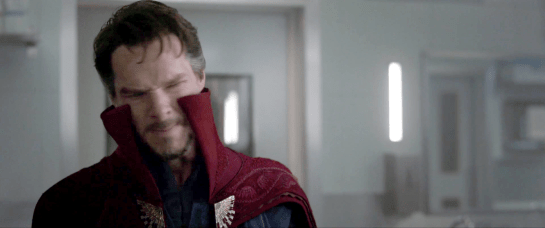
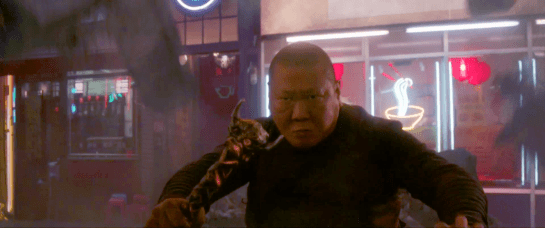
Without a display, the Eye asks Strange to do all the work of exploring the range of values available through it to discover what is of interest. (I am constantly surprised at how many interfaces in the real world repeat this mistake.) We can help by doing a bit of “pre-processing” of the information and provide Strange a key to what he will find, and where, and ways to recover exactly where interesting things happen.
The watch from the film, for reasons that will shortly become clear.
To do this, we’ll add a ring outside the saucer that will stay fixed relative to the saucer’s rotation and contain this display. Since we need to call this ring something, and we’re in the domain of time, let’s crib some vocabulary from clocks. The fixed ring of a clock that contains the numbers and minute graduations is called a chapter ring. So we’ll use that for our ring, too.
What chapter ring content would most help Strange?
Good: A time-focused chapter ring
Both the controlled-extents and the auto-extents shown in the prior post presume a smooth display of time. But the tome and the speculative meteorite simply don’t change much over the course of their existence. I mean, of course they do, with the book being pulled on and off shelves and pages flipped, and the meteorite arcing around the sun in the cold vacuum of space for countless millennia, but the Eye only displays the material changes to an object, not position. So as far as the Eye is concerned, the meteoroid formed, then it stays the same for most of its existence, then it has a lot of activity as it hits Earth’s atmosphere and slams into the planet.
A continuous display of the book shows little of interest for most of its existence, with a few key moments of change interspersed. To illustrate this, lets make up some change events for the tome.
Now let’s place those along an imaginary timeline. Given the Doctor Strange storyline, Page Torn would more likely be right next to Now, but making this change helps us explore a common boredom problem, see below. OK. Placing those events along a timeline…
And then, wrapping that timeline around the saucer. Much more art direction would have to happen to make this look thematically like the rest of the MCU magic geometries, but following is a conceptual diagram of how it might look.
With time flowing smoothly, though at different speeds for the past and the future.
On the outside of the saucer is the chapter ring with the salient moments of change called out with icons (and labels). At a glance Strange would know where the fruitful moments of change occur. He can see he only has to turn his hand about 5° to the left to get to the spot where the page was ripped out.
Already easier on him, right? Some things to note.
The chapter ring must stay fixed relative to the saucer to work as a reference. Imagine how useless a clock would be if its chapter ring spun in concert with any of its hands. The center can still move with his palm as the saucer does.
The graduations to the left and right of “now” are of a different density, helping Strange to understand that past and future are mapped differently to accommodate the limits of his wrist and the differing time frames described.
When several events occur close together in time, they could be stacked.
Having the graduations evenly spaced across the range helps answer roughly when each change happened relative to the whole.
The tome in front of him should automatically flip to spreads where scrubbed changes occur, so Strange doesn’t have to hunt for them. Without this feature, if Strange was trying to figure out what changed, he would have to flip through the whole book with each degree of twist to see if anything unknown had changed.
Better: A changes-focused chapter ring
If, as in this scene, the primary task of using the Eye is to look for changes, a smooth display of time on the chapter ring is less optimal than a smooth display of change. (Strange doesn’t really care when the pages were torn. He just wants to see the state of the tome before that moment.) Distribute the changes evenly around the chapter ring, and you get something like the following.
This display optimizes for easy access to the major states of the book. The now point is problematic since the even distribution puts it at the three o’clock point rather than the noon, but what we buy in exchange is that the exact same precision is required to access any of the changes and compare them. There’s no extra precision needed to scrub between the book made and the first stuff added moments. The act of comparison is made simpler. Additionally, the logarithmic time graduations help him scrub detail near known changes and quickly bypass the great stretches of time when nothing happens. By orienting our display around the changes, the interesting bits are made more easy to explore, and the boring bits are more easy to bypass.
In my comp, more white areas equal more time. Unfortunately, this visual design kind of draws attention to the empty stretches of time rather than the moments of change, so would need more attention; see the note above about needing a visual designer involved.
So…the smooth time and the distributed events display each has its advantages over the other, but for the Tibet scene, in which he’s looking to restore the lost pages of the tome, the events-focused chapter ring gets Strange to the interesting parts more confidently.
Note that all the events Strange might be scrubbing through are in the past, but that’s not all the Eye can do in the Tibet mode. So next up, let’s talk a little about the future.
This is one of those sci-fi interactions that seems simple when you view it, but then on analysis it turns out to be anything but. So set aside some time, this analysis will be one of the longer ones even broken into four parts.
The Eye of Agamotto is a medallion that (spoiler) contains the emerald Time Infinity Stone, held on by a braided leather strap. It is made of brass, about a hand’s breadth across, in the shape of a stylized eye that is covered by the same mystical sigils seen on the rose window of the New York Sanctum, and the portal door from Kamar-Taj to the same.
World builders may rightly ask why this universe-altering artifact bears a sigil belonging to just one of the Sanctums.
We see the Eye used in three different places in the film, and in each place it works a little differently.
The Tibet Mode
The Hong Kong Modes
The Dark Dimension Mode
The Tibet Mode
When the film begins, the Eye is under the protection of the Masters of the Mystic Arts in Kamar-Taj, where there’s even a user manual. Unfortunately it’s in mysticalese (or is it Tibetan? See comments) so we can’t read it to understand what it says. But we do get a couple of full-screen shots. Are there any cryptanalysists in the readership who can decipher the text?
They really should put the warnings before the spells.
The power button
Strange opens the old tome and reads “First, open the eye of Agamotto.” The instructions show him how to finger-tut a diamond shape with both hands and spread them apart. In response the lid of the eye opens, revealing a bright green glow within. At the same time the components of the sigil rotate around the eye until they become an upper and lower lid. The green glow of this “on state” persists as long as Strange is in time manipulation mode.
Once it’s turned on, he puts the heels of his palms together, fingers splayed out, and turns them clockwise to create a mystical green circle in the air before him. At the same time two other, softer green bands spin around his forearm and elbow. Thrusting his right hand toward the circle while withdrawing his left hand behind the other, he transfers control of the circle to just his right hand, where it follows the position of his palm and the rotation of his wrist as if it was a saucer mystically glued there.
Then he can twist his wrist clockwise while letting his fingers close to a fist, and the object on which he focuses ages. When he does this to an apple, we see it with progressively more chomps out of it until it is a core that dries and shrivels. Twisting his wrist counter clockwise, the focused object reverses aging, becoming younger in staggered increments. With his middle finger upright, the object reverts to its “natural” age.
Pausing and playing
At one point he wants to stop practicing with the apple and try it on the tome whose pages were ripped out. He relaxes his right hand and the green saucer disappears, allowing him to manipulate it and a tome without changing their ages. To reinstate the saucer, he extends his fingers out and gives his hand a shake, and it fades back into place.
Tibet Mode Analysis: The best control type
The Eye has a lot of goodness to it. Time has long been mapped to circles in sun dials and clock faces, so the circle controls fit thematically quite well. The gestural components make similar sense. The direction of wrist twist coincides with the movement of clock hands, so it feels familiar. Also we naturally look at and point at objects of focus, so using the extended arm gesture combined with gaze monitoring fits the sense of control. Lastly, those bands and saucers look really cool, both mystical in pattern and vaguely technological with the screen-green glow.
Readers of the blog know that it rarely just ends after compliments. To discuss the more challenging aspects of this interaction with the Eye, it’s useful to think of it as a gestural video scrubber for security footage, with the hand twist working like a jog wheel. Not familiar with that type of control? It’s a specialized dial, often used by video editors to scroll back and forth over video footage, to find particular sequences or frames. Here’s a quick show-and-tell by YouTube user BrainEatingZombie.
Is this the right kind of control?
There are other options to consider for the dial types of the Eye. What we see in the movie is a jog dial with hard stops, like you might use for an analogue volume control. The absolute position of the control maps to a point in a range of values. The wheel stops at the extents of the values: for volume controls, complete silence on one end and max volume at the other.
But another type is a shuttle wheel. This kind of dial has a resting position. You can turn it clockwise or counterclockwise, and when you let go, it will spring back to the resting position. While it is being turned, it enacts a change. The greater the turn, the faster the change. Like a variable fast-forward/reverse control. If we used this for a volume control: a small turn to the left means, “Keep lowering the volume a little bit as long as I hold the dial here.” A larger turn to the left means, “Get quieter faster.” In the case of the Eye, Strange could turn his hand a little to go back in time slowly, and fully to reverse quickly. This solves some mapping problems (discussed below) but raises new issues when the object just doesn’t change that much across time, like the tome. Rewinding the tome, Strange would start slow, see no change, then gradually increase speed (with no feedback from the tome to know how fast he was going) and suddenly he’d fly way past a point of interest. If he was looking for just the state change, then we’ve wasted his time by requiring him to scroll to find it. If he’s looking for details in the moment of change, the shuttle won’t help him zoom in on that detail, either.
There are also free-spin jog wheels, which can specify absolute or relative values, but since Strange’s wrist is not free-spinning, this is a nonstarter to consider. So I’ll make the call and say what we see in the film, the jog dial, is the right kind of control.
So if a jog dial is the right type of dial, and you start thinking of the Eye in terms of it being a video scrubber, it’s tackling a common enough problem: Scouring a variable range of data for things of interest. In fact, you can imagine that something like this is possible with sophisticated object recognition analyzing security footage.
The investigator scrubs the video back in time to when the Mona Lisa, which since has gone missing, reappears on the wall.
INVESTIGATOR
Show me what happened—across all cameras in Paris—to that priceless object…
She points at the painting in the video.
…there.
So, sure, we’re not going to be manipulating time any…uh…time soon, but this pattern can extend beyond magic items a movie.
The scrubber metaphor brings us nearly all the issues we have to consider.
What are the extents of the time frame?
How are they mapped to gestures?
What is the right display?
What about the probabilistic nature of the future?
What are the extents of the time frame?
Think about the mapping issues here. Time goes forever in each direction. But the human wrist can only twist about 270 degrees: 90° pronation (thumb down) and 180° supination (thumb away from the body, or palm up). So how do you map the limited degrees of twist to unlimited time, especially considering that the “upright” hand is anchored to now?
The conceptually simplest mapping would be something like minutes-to-degree, where full pronation of the right hand would go back 90 minutes and full supination 2 hours into the future. (Noting the weirdness that the left hand would be more past-oriented and the right hand more future-oriented.) Let’s call this controlled extents to distinguish it from auto-extents, discussed later.
What if -90/+180 minutes is not enough time to entail the object at hand? Or what if that’s way too much time? The scale of those extents could be modified by a second gesture, such as the distance of the left hand from the right. So when the left hand was very far back, the extents might be -90/+180 years. When the left hand was touching the right, the extents might be -90/+180 milliseconds to find detail in very fast moving events. This kind-of backworlds the gestures seen in the film.
That’s simple and quite powerful, but doesn’t wholly fit the content for a couple of reasons. The first is that the time scales can vary so much between objects. Even -90/+180 years might be insufficient. What if Strange was scrubbing the timeline of a Yareta plant (which can live to be 3,000 years old) or a meteorite? Things exist in greatly differing time scales. To solve that you might just say OK, let’s set the scale to accommodate geologic or astronomic time spans. But now to select meaningfully between the apple and the tome his hand must move mere nanometers and hard for Strange to get right. A logarithmic time scale to that slider control might help, but still only provides precision at the now end of the spectrum.
If you design a thing with arbitrary time mapping you also have to decide what to do when the object no longer exists prior to the time request. If Strange tried to turn the apple back 50 years, what would be shown? How would you help him elegantly focus on the beginning point of the apple and at the same time understand that the apple didn’t exist 50 years ago?
So letting Strange control the extents arbitrarily is either very constrained or quite a bit more complicated than the movie shows.
Could the extents be automatically set per the focus?
Could the extents be set automatically at the beginning and end of the object in question? Those can be fuzzy concepts, but for the apple there are certainly points in time at which we say “definitely a bud and not a fruit” and “definitely inedible decayed biomass.” So those could be its extents.
The extents for the tome are fuzzier. Its beginning might be when its blank vellum pages were bound and its cover decorated. But the future doesn’t have as clean an endpoint. Pages can be torn out. The cover and binding could be removed for a while and the pages scattered, but then mostly brought together with other pages added and rebound. When does it stop being itself? What’s its endpoint? Suddenly the Eye has to have a powerful and philosophically advanced AI just to reconcile Theseus’ paradox for any object it was pointed at, to the satisfaction of the sorcerer using it and in the context in which it was being examined. Not simple and not in evidence.
Auto-extents could also get into very weird mapping. If an object were created last week, each single degree of right-hand-pronation would reverse time by about 2 hours; but if was fated to last a millennium, each single degree of right-hand-supination would advance time by about 5 years. And for the overwhelming bulk of that display, the book wouldn’t change much at all, so the differences in the time mapping between the two would not be apparent to the user and could cause great confusion.
So setting extents automatically is not a simple answer either. But between the two, starting with the extents automatically saves him the work of finding the interesting bits. (Presuming we can solve that tricky end-point problem. Ideas?) Which takes us to the question of the best display, which I’ll cover in the next post.
Given its wealth of capabilities, the main complaint might be its lack of language.
A mute sidekick
It has a working theory of mind, a grasp of abstract concepts, and intention, so why does it not use language as part of a toolkit to fulfill its duties? Let’s first admit that mute sidekicks are kind of a trope at this point. Think R2D2, Silent Bob, BB8, Aladdin’s Magic Carpet (Disney), Teller, Harpo, Bernardo / Paco (admittedly obscure), Mini-me. They’re a thing.
Yes, I know she could talk to other fairies, but not to Peter.
Despite being a trope, its muteness in a combat partner is a significant impediment. Imagine its being able to say, “Hey Steve, he’s immune to the halberd. But throw that ribcage-looking thing on the wall at him, and you’ll be good.” Strange finds himself in life-or-death situations pretty much constantly, so having to disambiguate vague gestures wastes precious time that might make the difference between life and death. For, like, everyone on Earth.
Additionally, its muteness makes it very difficult for Strange to ever understand the reasoning behind any but its most obvious actions. That would be very important if it ever did anything ethically questionable, because intent would be difficult to gauge without the abstract representation of language.
So between the speed and clarity gains of language, I’d want to equip the Cloak with language: spoken, sign, direct-to-brain, or maybe even a mystical weave which, like the Marauder’s Map in Harry Potter, could mystically transform in real-time to convey linguistic information.
Like this but woven.
Using apologetics, though, we can see that the muteness isn’t a bug, it’s an important feature. Read on.
But, the hero…
One of the things writers “buy” with a mute sidekick is it lets the hero be the hero. If the Cloak could speak, suddenly we have a “sidekick” who knows much more and can do a few more things—i.e. fly—than our hero can. This is not good for optics. Note that the Cloak’s last intention seems to be “Keep him looking sorcererly,” which implies a service status, and which it could not do if it upstaged him. So from a narrative perspective, the muteness means they are less like a crime fighting duo, and more of a hero-with-a-sidekick, or dare I note it: a familiar.
Also if you contrast the cape with JARVIS and the Iron HUD, note that this has language, but that conversation is wholly private with Tony. To an outsider, it looks like Tony is just the Iron Man. They may have no clue that it’s probably all the suit. So JARVIS’ use of language doesn’t get in the way of keeping Tony looking hero-ey. I’d even go so far as to say that the muteness is the thing that lets the Cloak be primarily agentive, as language would encourage its use as an assistant.
Other improvements
Language is the big one, but there are a few other improvements I could imagine.
Cloaklet
If this were for a soldier or a police officer or anyone else who could expect combat as part of their job, the Cloak might make them look cartoonish, like a cosplayer rather than a person with authority. But, hey, if it let them fly, and can supernatural protection, maybe that impression wouldn’t last long. Maybe they could take advantage of being underestimated. But I’d still want to look at how little fabric we could get away with and still maintain its benefits.
Remote control / telecommunication
Another constraint seems to be that it has some proximity limits. To imprint on Tony, it makes some social sense that it would want to be within “handshake distance.” But when Strange is astrally overseeing the emergency operation of his own body (a later post), the Cloak sits back at the Sanctum and doesn’t rush to help when things get fighty. Extending its connectivity would help it fulfill its duties. At the very least tape a cell phone to a pocket and let Strange shout orders at it.
Whew. So that’s my take on the Cloak of Levitation. It’s a marvelous piece of speculative “tech” that fits Tony, his future-role as Sorcerer Supreme, and is nicely unique in the MCU.
It’s a great sophisticated example of agentive tech the constraints of which make complete narrative sense. I hope we get to learn much more of this marvelous, agentive familiar in the sequel.
So I mentioned in the intro to this review that I was drawn to review Doctor Strange (with my buddy and co-reviewer Scout Addis) because the Cloak displays some interesting qualities in relation to the book I just published. Buy it, read it, review it on amazon.com, it’s awesome.
That sales pitch done, I can quickly cover the key concepts here.
A tool, like a hammer, is a familiar but comparatively-dumb category of thing that only responds to a user’s input. A hammer is an example. Tool has been the model of the thing we’re designing in interaction design for, oh, 60 years, but it is being mostly obviated by narrow artificial intelligence, which can be understood as automatic, assistive, or agentive.
Assistant technology helps its user with the task she is focused on: Drawing her attention, providing information, making suggestions, maybe helping augment her precision or force. If we think of a hammer again, an assistive might draw her attention to the best angle to strike the nail, or use an internal gyroscope to gently correct her off-angle strike.
Agentive technology does the task for its user. Again with the hammer, she could tell hammerbot (a physical agent, but there are virtual ones, too) what she wants hammered and how. Her instructions might be something like: Hammer a hapenny nail every decimeter along the length of this plinth. As it begins to pound away, she can then turn her attention to mixing paint or whatever.
When I first introduce people to these distinctions, I step one rung up on Wittgenstein’s Ladder and talk about products that are purely agentive or purely assistive, as if agency was a quality of the technology. (Thabks to TU prof P.J. Stappers for distinguishing these as ontological and epistemological approaches.) The Roomba, for example, is almost wholly agentive as a vacuum. It has no handle for you to grab, because it does the steering and pushing and vacuuming.
Once you get these basic ideas in your head, we can take another step up the Ladder together and clarify that agency is not necessarily a quality of the thing in the world. It’s subtler than that. It’s a mode of relationship between user and agent, one which can change over time. Sophisticated products should be able to shift their agency mode (between tool, assistant, agent, and automation) according to the intentions and wishes of their user. Hammerbot is useful, but still kind of dumb compared to its human. If there’s a particularly tricky or delicate nail to be driven, our carpenter might ask hammerbot’s assistance, but really, she’ll want to handle that delicate hammering herself.
Which brings us back to the Cloak.
I wish I knew how to quit you.
Watch the movie carefully and you’ll see that the only time it acts purely on command is when Strange uses it to fly to the Dark Dimension. So it has all of one tool-like function. It initiates the rest of its actions on its own.
So it is assistive or agentive? Well, again, that’s tricky, because it depends on which function we’re talking about. Here is my backworlded list of those functions, in order of importance.
Obey commands (subject to some mystical and unmentioned 4 Laws of Relics?)
Prevent harm to Strange
Halt the thing threatening him
If that’s not possible, get Strange out of harm’s way (pull him to safety)
Catch him, if he’s falling
Critical case: if Strange is disabled and threatened, take care of the threat (the head-wrap scene)
Guide him toward the best tactic for his current situation
Keep him looking sorcererly
Don yourself when appropriate
Try and do your work while being worn (don’t jump off Strange’s shoulders to do something, if you can avoid it)
Groom him if he becomes untidy
Let’s look at each of these.
1. Obeying commands could be any category. Strange can gesturally command it to fly, as he does, treating it as a tool. He can command it to assist him in some task, or assign it a task to do on its own. So that one is all over the board.
2. Preventing harm is mostly agentive. After all, if it’s preventing harm from happening, it should just do it, and not ask, right? The question would just be noise because the answer would almost always be, “of course.” Like a mystical Spider-Sense, this helps Strange avoid a threat he didn’t even know was there. This allows Strange to focus on the most critical thing in the situation, because the Cloak has his back for the minor stuff. (Which, admittedly, isn’t quite how Spider-Man’s Spider-Sense works.)
There’s a bit of conceptual hairsplitting to do here. When Strange is in combat, you might wonder, isn’t his attention on the combat, so it’s assisting him with it? Sure, but that’s the category of thing he’s trying to do, more appropriate to our description of it rather than what he’s thinking. His attention is not on the category of thing he’s doing but on the thing itself. Not combat, but bringing down Kaecelius.
So I’d argue what we see is agentive. Note that it’s easy to imagine an assistive prevention of harm, too. If Strange knows there is a big rock heading his way, he’s going to dodge. The Cloak can predict how well his dodge will work, and add a little oomph if it’s not going to be enough. But I don’t think we see that in the movie.
3. Guiding him toward the best situational tactic is an interesting case. It’s agentive, but in the one case we really see it in action, it looks assistive. Strange is reaching for the halberd on the wall, and the Cloak, knowing that would be ineffective at best, is dragging him toward the thing that will work, which are the Crimson Bands of Cyttorak. Is it assisting him to grab the right thing?
Yes, but again, it’s a question of attention. Strange’s attention is on getting the halberd. The Cloak has run through the scenarios, and knows that probabilistically, the halberd is the wrong choice. So it is having to intervene and draw Strange’s attention to the Bands. In monitoring and correcting Strange’s tactics, it is operating outside his attention and acting agentively.
4. When the Cloak works to keep Strange looking sorcererly it is similarly monitoring his appearance and making adjustments as needed. Strange’s attention does not need to go there, so it’s agentive.
Hang on, you cry, what about that time Strange tells it to stop wiping his face? That’s a command. His attention is on it. Yes, but Strange isn’t commanding it to begin some new task that he wanted it to accomplish. The Cloak found a trigger (blood on face) and initiated a behavior to correct the problem. Strange is correcting the Cloak that he finds this level of grooming to be too much. In the second part of the book I refer to this as tuning a behavior, and it’s one of the interactions that distinguish agentive tech from automation, which does not afford this kind of personalization.
So, in short, the Cloak demonstrates lots and lots of agentive properties, and provides a rich example that helps illuminate differences in the core concepts. If you want to know more about these thoughts as they apply to real world tech as opposed to sci-fi interfaces, there’s that book I mentioned.
Next up, we’ll get to some critiques of the Cloak and suggestions for how it might be improved if it were a real world thing.
As this site nears its 5-year anniversary, it’s time to take a measure of who the hell you are out there, and what you dig/don’t dig/want on the site. It’s 18 questions, and at most 15 minutes of your time, and by gosh, I would appreciate it.
How could this work as technology instead of magic?
In the prior post I looked at the Cloak as a bit of wearable technology. Today let’s ask ourselves how possible this is in the real world.
The abilities of the Cloak listed in the first post imply a great deal of functionality: Situational awareness, lightning fast thinking, precision actuators throughout its fabric, gravity controls for itself and its wearer, goal awareness, knowledge of the world. Some of these aren’t going to happen, but some are conceivable over time.
Parts of it are conceivable over time
Some of those abilities make sense with what we know of the arc of technology.
Actuators
Technology keeps shrinking, so a fabric made of strong actuators might be conceivable. I’m not sure muscle wire will ever be this strong, but let’s presume generative design can discover a way to use its relatively weak strength for greater-than-human feats of strength, and that wires can be coordinated when woven into a fabric.
Sensors
The Cloak has complete situational awareness, but where are its sensors? It demonstrates field awareness. We don’t see sensors, but it has to be building this awareness from something. One possibility is that if it was able to connect to sensors around it, much like The Machine and Samaritan Super AIs from Person of Interest or Batman’s cellular panopticon. Alternately, the cape could be dotted with sensors that detect in the x-ray or infrared spectrums, so they can be hidden under the fabric. Let’s say this is pretty futuristic, but possible.
The Cloak’s AI
Yes we have crazy fast processors that seem to keep getting faster, so perhaps the processors could become embeddable in the cloth or perhaps the fibulae. And the amount of cloth in the Cloak is much more than most wearables, so sure, let’s say the computational power can be made this small and sartorial.
Writing this blog takes my vocabulary to some obscure places.
There is the problem of the AI. Some of the Cloak’s abilities imply general, rather than narrow, artificial intelligence. It has complete situation awareness, a clear theory of mind, and seems to learn. We’re not at general AI yet and at least according to Nick Bostrom’s poll, computer scientists are estimating it will be about another decade until we get there, if we can get there at all. Opinions are split as to whether it’s possible, but let’s go optimistic with this one and put it in the conceivable category, with the caveat that it may be wishful thinking.
But some parts break the laws of physics
But then there are a few things that just break the laws of physics, the first of which is flying.
There’s no evidence from other things in the scenes that it is employing a propellant of some kind to do this lifting. It just moves where it wants to. Cloak don’t give a shit. Add the fact that it can hang in place (see the vitrine gif, above) as if it can just ignore the Earth’s gravity, and we’ve got something that earns the Isaac Newton seal of WTF.
It also seems able to pull in any arbitrary direction in space with a great deal of force, as it does when it drags around one of the beefier zealots in a defend-the-master move that would make a Molossus war dog lower its head in respect. Flatworms are the closest thing to a muscled bit of fabric that evolution has come up with, and I don’t think physics would allow it to do this kind of maneuver, either.
Then, when Strange flies wearing it, it doesn’t seem to use its powers to carry him. That would look more like a hammock, or a flying carpet. Instead it somehow grants the power of arbitrary space positioning to him, and then it just gets to relax and ride along and concentrate on looking majestic.
So it can pull in any direction with no anchor, propellant, or regard for gravity; and grant this ability to someone on contact. Sorry, but I think we have to admit that these aspects of the Cloak are just wish fulfillment.
Even if flight could be overlooked, then there comes the question of where’s the power coming from? I don’t see much battery technology trending towards infinite especially when it has to be small enough to be wearable.
So while an engaging vision, we have to be quite careful about drawing design lessons from the Cloak. Enabling technology would be far in the future. And even though personal flight technology (ofsorts) exists, but we should take in mind their designs have to deal with the very real issues of thrust and power.
That’s enough for today. In the next post we’ll look at the intelligence and agency evident in the Cloak.
When Dr. Strange visits the New York Sanctum for the first time, he passes by a vitrine in which a lush red cape hovers in midair. It’s the Cloak of Levitation, and in this moment it chooses Strange. We see many of its functions throughout the movie.
Functions
When the glass of the vitrine is broken and Kaecilius stabs at Strange with a Soul Sword, the Cloak reaches out with a corner and stays Kaecilius’ hand to save Strange.
When Kaecilius knocks Strange down a stairwell, the Cloak chases him, catches him, and floats him back up to the fight. (See above.)
Attached by two fibulae to his surcoat, it can pull him, physically, and does so several times for different reasons:
to get him out of the first fight with Kaecilius
to help him dodge the soul sword
to keep him from grabbing ineffective weapons, pointing him instead to the more effective Crimson Bands of Cyttorak
Unbidden, the Cloak wraps itself around the head of one of Kaecilius’ zealots, drags him around, and slams his head into the walls and floor until the zealot is dead. (Even though, for the entire end of the fight, Strange is across town getting medical attention.) After the combat, the Cloak hovers next to the dead zealot, perhaps keeping watch.
After Strange tells Christine goodbye in the surgical prep room, the Cloak gently floats itself into place and uses the corner of its popped collar to remove blood from Strange’s face, to his annoyance. He tells it to, “Stop!” and it relaxes.
It pulls him out of the path of some flying debris while time is reversed before the Hong Kong Sanctum, and defends him from a punch later in the same sequence.
He uses it to fly through the portal into the Dark Dimension to face Dormammu.
It dons itself in the Kamar-Taj, brusquely enough to cause Strange to catch his balance.
The Cloak is like a guardian angel. Or maybe a super-familiar, in the wizard sense. It keeps an eye out for Strange. It is able to predict, protect, crudely inform, and, not least, fly. It acts as both an assistant and an agent. (More on this later)
Wearable Analysis
Let’s first look at it as a wearable. Turns out it fares well according to the wearable principles I laid out in the The Combadge & ideal Wearables post. Those principles are discussed individually below.
Sartorial? Yes.
The Cloak is literally a piece of clothing and quite inline with fashion trends of the sorcerous and superhero worlds. A dash of panache for the workday and a night flying above the town. I’m saying it looks quite in place for being a piece of tech.
Social? Yes, kind of.
The cape does not signal its cape-abilities (how many terrible puns will I allow myself, here? Time will tell…) and so might score low on its social aspect. But it is a unique mystical item. Those in the know, know. Its reputation conveys its abilities. To those who don’t know, its cape-ness grants an initial element of surprise, as we saw when it blocked Kaecilius’ stab the first and second time. The villain was as surprised as we. The Cloak is cloaked, but this is a feature.
Tough to accidentally activate? Yes.
To fly to the Dark Dimension, he places his hands in a “Devil sign,” with 1st and 4th fingers extended and the others bent down to the thumb. He points his hands towards his feet, and flies off in the opposite direction. This isn’t him casting a spell. It’s him telling the Cloak what he wants it to do. That’s hard to do by accident.
Apposite I/O? Yes.
For the most part, the Cloak acts of its own accord. Looking at the list above, the only times it acts under instruction is when Strange tells it to stop wiping his cheek and when he uses it to fly to the Dark Dimension. He uses speech for the former and finger-tutting for the latter.
The rest of its functionality (that is, most of it) is it acting on its own, which doesn’t befit an i/o mapping evaluation.
Easy to access and use? Yes, exceptionally.
Being a key part of Strange’s uniform, and able to both get out of the way and onto shoulders when it needs to, the Cloak is not just easy to use, but it makes itself easy to access and use, so it scores high here.
This staff appears to be made of wood and is approximately a meter long when in its normal form. When activated by Mordo it has several powers. With a strong pull on both ends, the staff expands into a jointed energy nunchaku. It can also extend to an even greater length like a bullwhip. When it impacts a solid object such as a floor, it seems to release a crack of loud energy. Too bad we only ever see it in demo mode.
How might this work as technology?
The staff is composed of concentric rings within rings of material similar to a collapsing travel cup. This allows the device to expand and contract in length. The handle would likely contain the artificial intelligence and a power source that activates when Mordo gives it a gestural command, or if we’re thinking far future, a mental one. There might also be an additional control for energy discharge.
In the movie, sadly, Mordo does not use the Staff to its best effect, especially when Kaecilius returns to the New York sanctum. Mordo could easily disrupt the spell being cast by the disciples using the staff like a whip, but instead he leaps off the balcony to physically attack them. Dude, you’re the franchise’s next Big Bad? But let’s put down the character’s missteps to look at the interface.
Mode switching and inline meta-signals
Any time you design a thing with modes, you have to design the state changes between those modes. Let’s look at how Mordo moves between staff, nunchaku, and whip in this short demonstration scene.
To go from staff to nunchaku, Mordo pulls it apart. It’s now in a dangerous state, so is there any authentication or safety switch here? It could be there, but all passive via contact sensors, which would be the best so it could be activated in a hurry. The film doesn’t give us any clue, really, so that’s an open question.
How does it know to go from nunchaku to whip? It sure would be crappy to bet on a disabling thwack against your opponent only to find it lazily draping over a shoulder instead. (Pere Perez might have advanced ideas, given his ideas on light saber tactics.) Again, this state change could be passive, detecting in real time the subtle gestural differences in a distal snap, which a bullwhip would need, and lateral force, which sets the nunchaku spinning, and adjust between the two accordingly. Gestural and predictive technologies are not particularly cinegenic, so let’s give it the benefit of the doubt and say that’s what’s happening.
A last mode is After Mordo cracks it against the ground, it retracts back to Staff form. This is the hardest one to buy. Certainly it’s a most dramatic ending for Mordo’s demonstration. But does it snap back automatically after it strikes a surface? Automation is not always the answer. Deliberate control would mean Mordo doesn’t have to waste time undoing unwanted automatic actions.
Critical systems must be extremely confident in their interpretations before automation is the right choice.
It might be that this particular gesture is a retraction signal, but how the Staff distinguishes this from a mid-combat strike is tricky. It would have to have sophisticated situational awareness to know the difference, and it doesn’t display this. Better backworlding would point at some subtle gestural signal from Mordo. A double-tightening of his grip, maybe. Or even a double-slight-release of his grip, since that’s something he’s quite unlikely to do in combat.
This is a broad pattern for designers to remember. Inline control signals should be simple-to-provide, but unlikely to occur in literal use. Imagine if the Winter Soldier’s Trigger Phrase wasn’t “Longing, rusted, 17, daybreak, furnace, 9, benign, homecoming, 1, freight car” but instead was the word “the.” He’d be berserking every few seconds. Unworkable. So, if you were designing the Staff’s retraction command gesture, you’d have to pick something he could remember and perform easily, and that would be difficult to accidentally provide.
If Mordo has the staff in the next film, I hope the control modes are clearer and of course well-designed.
“Any sufficiently advanced technology is indistinguishable from magic.”
You’ve no doubt opened up this review of Doctor Strange thinking “What sci-fi interfaces are in this movie? I don’t recall any.” And you’re right. There aren’t any. (Maybe the car, the hospital, but they’re not very sci-fi.) We’re going to take Clarke’s quote above and apply the same types of rigorous assessment to the magical interfaces and devices in the movie that we would for any sci-fi blockbuster.
Dr. Strange opens up a new chapter in the Marvel Cinematic Universe by introducing the concept of magic on Earth, that is both discoverable and learnable by humans. And here we thought it was just a something wielded by Loki and other Asgardians.
In Doctor Strange, Mordo informs Strange that magical relics exist and can be used by sorcerers. He explains that these relics have more power than people could possibly manage, and that many relics “choose their owner.” This is reminiscent of the wands in the Harry Potter books. Magical coincidence?
Subsequently in the movie we are introduced to a few named relics, such as…
The Eye of Agamoto
The Staff of the Living Tribunal
The Vaulting Boots of Valtor
The Cloak of Levitation
The Crimson Bands of Cyttorak
…(this last one, while not named specifically in the movie, is named in supporting materials). There are definitely other relics that the sorcerers arm themselves with. For example, in the Hong Kong scene Wong wields the Wand of Watoomb but it is not mentioned by name and he never uses it. Since we don’t see these relics in use we won’t review them.
Choosing an Owner
The implications of what Mordo tells Strange is profound because it means magical relics possess some kind of intelligence. That’s a weighty word, so In order to back this up, we need a common definition in place. Let’s ask Merriam-Webster.
Intelligence
a (1) : the ability to learn or understand or to deal with new or trying situations : reason; also : the skilled use of reason (2) : the ability to apply knowledge to manipulate one’s environment or to think abstractly as measured by objective criteria (as tests)
That gives us the foundation that we need. In order to choose their owner, these relics require a theory of mind, an ability to detect and perceive the individuals they meet, and they must possess a reasoning mechanism to decide that an individual is worthy or useful to them. That seems to satisfy both senses of that definition. For our purposes we’re going to think of this in terms of an artificial intelligence and review these relics as if they were a form of advanced technology. Thanks, Mr. Clarke.
We should take care, though. There are some narrative trappings for magic that can trip us up. Magic, for instance, doesn’t typically run out in these relics, but if they were technological, we would have to deal with issues of power, batteries or recharging. So for all their instructive power, we would have to deal with even greater complexity if they were real technology.
The AIs/Intelligences appear to vary in capabilities from narrow to general and are focused on their own specific purposes and “hardware.” In use, they primarily respond to the intentions and actions of the user. None of the objects seem to be able to speak directly, although the Cloak provides rudimentary directional guidance and responds to speech and emotions, so the connection varies from communication via touch to some form of remote telepathy.
Distance constraints
The initial awareness and selection by an relic for a sorcerer seems limited in range to a few meters. It’s almost like they need to meet their humans socially to determine if they are a match. But once an relic chooses a sorcerer, their interactions can occur more remotely. The Cloak, as we’ll see in that write-up, flies to save Strange from a fall and it fights for him in the Sanctum while he seeks medical attention across town at the hospital.
What’s the platform?
One question the diligent backworlder might seek to answer is how all of these unique relics—created as they were across different millennia, and realities and by different sources/sorcerers/beings—wound up with similar intelligence and imprinting features. The movie itself doesn’t provide an answer, so we’ll leave it to speculation, but it does imply some sort of shared provenance/source material/code base/relic-maker convention.
—
Ok. So we’re set with some understanding of how these things work and what they have in common. Next let’s dig into the big billowy one that should have gotten supporting actor credit in the film.
I saw Doctor Strange fairly close to opening weekend and was intrigued by much of what I saw there, especially the artifacts and the Cloak of Levitation. (It has some powerful agentive aspects, and given that that is the topic of my new book, I thought it would be fruitful to examine.)
But, awwww, that’s too bad. Doctor Strange deals in magic, not techn—Whatever.
Technology is just a black box in all but the hardest of sci-fi. Magic in this film performs much of the same role as technology in sci-fi, i.e., it’s the thing that allows characters to do cool stuff. Most importantly, the magic obeys rules, and has (mostly, as we’ll see) consistent inputs and outputs. And when you’re reviewing the interfaces, the actual technological/mystical underpinning doesn’t really matter anyway. As long as it’s consistent and rule-based, we can review it. So. Let’s review it.
Release Date: 04 November 2016 (USA)
Plot
As usual, beware all the spoilers.
Doctor Steven Strange is at the peak of his career as the world’s finest and most arrogant surgeon when an automobile accident destroys his hands. Medical science is unable to help, so he follows leads of a mystical cure to a place called Kamar-taj, in the mountains of Nepal near Kathmandu. There he is accepted as a student to the Masters of the Mystic Arts, studying under a powerful sorcerer known as the Ancient One. His eidetic memory makes him a fast study of their mystical awareness, combat training, astral projection, gesture-based spells, teleportation Sling Rings, unique powerful magical artifacts, and library of ancient tomes.
Strange’s hunger for mastery leads him to use a powerful forbidden artifact, the Eye of Agamoto, to repair a forbidden tome, the Book of Cagliostro, and study its lost pages. He learns of Dormammu, a great evil bent on drawing the Earth into his Dark Dimension, and of Kaecilius, a former student who is using the stolen pages to supplicate Dormammu, draw upon his dark power, wage war on the Masters of the Mystic Arts, sacrifice the Earth, and gain revenge on the Ancient One.
Flush with Dark Dimension power, Kaecilius and his zealots blast the London Sanctum Sanctorum, one of three such anchors of a mystical defense shield protecting the Earth. In the chaos of the attack, Strange stumbles through a portal to find himself in the New York Sanctum just as Kaecilius attacks it. In the Sanctum, an artifact called the Cloak of Levitation chooses Strange as its new master. It helps Strange survive the attack, but only just barely. The Cloak holds one of the zealots at bay while Strange teleports to his old hospital, where he astrally manages his own resuscitation.
Returning to the Sanctum, Strange regroups with the Ancient One, accusing her of drawing power from the Dark Dimension, but before that can be resolved, the next wave of attack begins. To save the Sanctum, Strange traps everyone in a trippy mirror dimension, where they fight, and the Ancient One takes a mortal wound. Strange escapes the mirror dimension to take her to his hospital, but is unable to save her.
Strange travels to the Hong Kong Sanctum, only to find that it is too late. The Sanctum is destroyed and a portal to the Dark Dimension has opened in the sky above it. Strange uses the Eye of Agamoto to set time in reverse, but Kaecilius and his zealots break from the reversing time stream to enjoin the sorcerers in more combat. Overwhelmed, Strange flies into the Dark Dimension to confront Dormammu directly. Using the Eye, Strange imprisons Dormammu in a time loop, agreeing to stop the loop only if he ends his assault on the Earth, never to return. Dormammu, maddened by the entrapment, agrees, taking his zealots with him, and the Earth is saved.
Strange returns home to restore the Eye of Agamotto to its holding place and ready defenses for an attack which—now that the Earth has no Sorcerer Supreme—must surely be coming.