Rocky Horror Triple Contact Electro Magnet [sic]

Refresher: Brad, Frank-N-Furter, and Riff Raff are in the laboratory when the monitor reveals Dr. Scott entering the castle. To skip a chase scene, Frank activates the Triple Contact Electro Magnet, drawing Dr. Scott’s wheelchair on a comically twisty route through the castle to the magnet. (Look close and you’ll see both the wire pulling Jonathan Adams and the carpet separate when he gets near the top.)

It’s hard not to linger on the litany of ways this defies physics and…you know…reason, but let’s stick to interface and interaction. The main control is a lever that slides along a channel that runs a third of the way horizontally, then downward diagonally for the middle third, and horizontally again for the last third.

Screenshot from the movie showing a close-up of Frank’s hand manipulating the lever. Dripping-blood overlay highlights the guided channel.

When Frank pulls the lever to the right, the first contact (the v-shaped electromagnet) extends away from the wall. When he pulls it along the slope, the second contact extends. The last slide right extends the third. Across all three, a humming sound in the background increases in intensity.

After sliding it all the way to the right, Frank raises a heel to the corner of the panel, and we see the magnet take hold of Dr. Scott’s wheelchair. This may be more than posturing, see below.

A subtle character clue

In the vivification scene, Frank-N-Furter shouts orders for minions to carry out. Here he grabs and manipulates the machine himself. As I noted in my old Presidents Day post, it is a mark of authority to be the one issuing orders but not carrying them out.
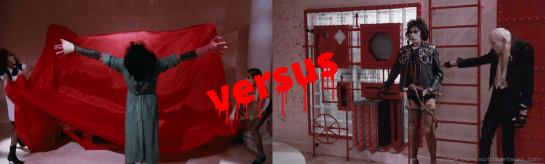
Two screenshots from the movie side-by-side contrasting Frank in command with Frank desperately grabbing the controls for himself.

Frank’s use of machinery here signals both his increasing paranoia and decreasing regality. Riff Raff’s betrayal cannot be too far off.

Oh, wait. I said I’d focus on interfaces.

Right is more is right

Unlike what we see in the monitor and vivification interfaces, here the mapping makes much more sense. This is an English-speaking movie, and for this audience, right equals more is the natural mapping. So props where it’s due for that. As Frank moves the lever to the right, more contacts engage, we hear more humming, and more targeted cartoon magnetism is caused.

{Umpromtped image: Imagine a Tex Avery-style illustration of Frank-N-Furter from The Rocky Horror Picture Show holding three gigantic U-shaped magnets in his laboratory. Leather jacket with studs and chains, fishnets. --ar 16:9}

Selection is missing

Surely there are other metal objects in the castle that would become bullet-like projectiles the moment this was activated: the studs on Frank-N-Furter’s jacket, the anklet he wears (which, ok, might be silver), Dr. Scott’s glasses, the record player in the room where Columbia and Magenta sit, etc. etc.

If the magnet is strong enough to pull a wheelchair through a masonry wall across two floors and at least four rooms, you would expect it to attract other things as well, but…[FX: cricket sounds].

If we presume that the magnet can somehow target objects and leave others alone, there should be some interface for allowing the user to name or specify the object to target. That’s fairly easy to do in a 2026 world of foundation models, speech-to-text, and computer vision, but would have been a major challenge using 1975 technology. I’ll discuss some speculative solutions for this in the upcoming post about the Medusa interface, but in the meantime I leave it as an exercise for the reader.

The guided channel

A plate with a channel cut in it, through which a lever slides, is called a guided channel. The channel guides the motion of the lever.

A blood-dripped comp of a manual gearbox H-pattern. First is up left. Second is directly down from first. Third is up to the right of first. Fourth is directly down from third.
Fifth is up to the right. R for reverse is farthest right at the bottom.

The control for the Triple Contact Electro Magnet has a guided channel, and it borrows from lineages of the automotive gear shift. A manual gearbox’s H-pattern (variation pictured above) is mechanically determined: the channel is a map of the shift rails underneath it. The automatic transmission’s staggered gate is the opposite, that is, a later addition that was retrofitted for error prevention.

Either way, a bend in the channel buys some things.

  1. It allows confident mode selection by turning each distinct position into a pause point that you reach by pushing until the lever stops, so you don’t need to know your current state before you shift, and you don’t have to commit attention and fine motor control to arrest the motion yourself. In this case, every switch sits at an obtuse corner, and that corner interrupts a directional push. This effect would be even more pronounced with 90° or acute angles. Note Frank does not look at the control as he uses it, because he doesn’t need to. He can feel it.
  2. Additionally, the bend puts a safety barrier between states that are dangerous when adjacent. In a car that helps avoid accidental shifts from, say, fifth gear to second, where you might seriously redline the engine. Or worse, if you slipped past neutral into reverse while traveling at speed, your transmission might end up in parts on the road beneath you. That’s the reason regulators require neutral to sit between drive and reverse.

And, sadly, none of these things matter in this context.

  • Since the magnetic effect can be targeted to individual objects (no other way to explain the basic events on screen), there’s no apparent cost to setting it too high. So, mode selection isn’t precious.
  • As a status indicator, it’s redundant. The extended contact is a second cue and the sound of the system a third, and there’s no evident penalty for overshooting to full power. Generally speaking, a bent channel earns its place when use is fast, habitual, and eyes-free. I cannot imagine what regular use of the Triple Contact Electro Magnet might fit these requirements.
  • This is less like a gear shifting through different modes and more like a volume control with four steps (off being one). There are no modes that are dangerously adjacent, so the functional pause isn’t warranted.
Screenshot from the film showing Frank in his dinner party blouse looking judgy.

So the interface is doing something it absolutely doesn’t need to for any functional reason. Sorry, Frank.

No, not the Triple Contact Electro Magnet!

But what it does do very well is drama. Like, you can imagine alternate interfaces:

  • A four-step dial with stops at either extent.
  • Three toggle switches, one above each contact.
  • Illuminated buttons above each, similar to the proposal for the The Reactor Power Input.
  • Even manual pull bars on the contacts, like you see on an airline serving cart, would do the trick.

But none of them give Frank and the other Transsexuals as much opportunity to be over-the-top dramatic as they crank the magnetism up, up, up. That’s impressive for victims (and conventioneers, if they were around), and perfect for Frank’s theatricality.

So even though this control isn’t really warranted, from a functional standpoint, it totally is from the users POV.

Screenshot from the film showing Frank wearing a conical birthday hat looking smug.

Bonus: What if Frank’s not just posturing?

Hear me out on this bit. It’s curious to me that the magnets don’t seem to have any effect on Dr. Scott until all three are extended, and, when they do, they function all at once. Sure, it’s editing convenience, but what if it’s something more? What if Frank’s heel pose is not posturing—well, ok, it’s posturing, but what if it’s also authentication? Imagine a passive RFID key located in Frank’s high heels, and the detector mounted in the plating. (Or maybe the detector is the plating.)

Screenshot from the film showing a close up of Frank’s legs against the panel with three Electro Magnet Contacts extended. Dripping-blood overlays include a wifi signal around the heel.

This would help Frank feel more certain that it can only be operated by him, or at least someone in possession of the shoes. Since the key is disguised, it adds to the security of the interaction. And its activation requires a heel up, which as we’ve seen is a standard Frank move. It would also explain why despite having activated the Triple Contact Electro Magnet to full power, it only takes effect all at once when Frank’s heel activates it.

And if you weren’t aware, interaction design of women’s footwear is kind of a thing.

So now this activation mechanism is my headcanon.

There’s one more set of interfaces that go together, and they’re next. Transducer, Medusa, and de-Medusa (currently scheduled for 29 Sep 2026)

Vibranium sand tables

There are a number of vibranium sand tables seen in Black Panther.

  1. The horseshoe-shaped shelf in which Okoye sits as she pilots the Royal Talon. (We never see it activated.)
  2. The small sand table in the center of the Royal Talon.
  3. The big sand tables in Shuri’s lab.

You can see the Royal Talon one in the post about piloting that craft. The other two are described below.

All of these build on the given that vibranium is a very powerful substance and that Wakanda’s scientists have managed to gain a very, very sophisticated control over it.

In the Talon

This table is about a meter square, and raised off the floor around knee-height. As Okoye and T’Challa approach the traffickers in the Sambisa Forest, T’Challa approaches the table and it springs to life, showing him real-time model of the traffickers’ vehicle train. T’Challa picks up the model of the small transport truck and with a finger, wipes off its roof, revealing that there are over a dozen people huddled within. One of the figures glows amber. (It’s Nakia.) He places the truck back into the display, and the display collapses back to inert sand.

A quick critique of this interaction. The sand highlights Nakia for T’Challa, but why did it wait for him to find her truck and wipe off the top of it to look inside? It knew his goals (find Nakia), can clearly conduct a scan into the vehicle, and understood the context (she’s in one of those trucks), it should not wait for him to pick up each car and scrape off its roof to check and see which one she was in. The interface should have drawn his attention to the truck it knew she was in. This is a “stoic guru” mistake that I’ve critiqued before. You know, the computer knows all, but only tells you when you ask it. It is much more sensible for the transport truck to be glowing from the moment the table goes live, as in the comp below.

Designers: Don’t wait for users to ask just the the right thing at the right time.

Otherwise, this is a good high-tech use of the sand table for the more common meaning of “sand table,” which is a 3-dimensional surface for understanding a theatre of conflict. It doesn’t really help him run through scenarios, testing various tactics, but T’Challa is a warrior king, he can do all that in his head.

The interaction also nicely blurs the line between display and gestural interactive tool, in the same way that the Prometheus astrometrics display did. Like that other example, it would be useful for the display to distinguish when it is representing reality, and when the display is being interrupted or modified. Also, T’Challa is nice enough to put the truck back where it “belongs,” but a design would also need to handle how to respond when T’Challa put the truck back in the wrong place, or, say, crushed the truck model with his hand in fury.

In Prometheus it was an Earth, not a truck, but still focused on Africa.

Shuri’s lab

The largest table we see in the movie is in Shuri’s lab. After Black Panther challenges Killmonger and engages in battle outside the capital city, Shuri, Nakia, and Agent Ross rush down to the lab. As they approach an edge-lit hexagonal table, the vibranium sand lowers to reveal 3D-printed armor and weaponry for Shuri and Nakia to join the fight. (Though it’s not like modern 3D printing, these are powered weapons and kimoyo beads, items with very sophisticated functionality.)

Shuri outfits Ross with kimoyo beads from the print and takes off to join the fight. In the lab, the table creates a seat for Ross to remote-pilot the Royal Talon. Up on the flight deck, Shuri throws a control bead onto the Talon, and an AI in the lab named Griot announces to Agent Ross, “Remote piloting system activated.” (Hey, Trevor Noah, we hear you there!)

Around the seat, a volumetric projection of the Talon appears around him, including a 360° display just beyond the windshield that gives him a very immersive remote flying experience. We hear Shuri’s voice explain to Ross “I made it American Style for you. Get in!”

Ross sits down, grabs joystick controls, and begins remote-chasing down the cargo ships that are carrying munitions to Killmonger’s War Dogs around the world. (The piloting controls and HUD for Ross are a separate issue, and will be handled in their own post.)

The moment that Ross pilots the Talon through the last cargo ship, the volumetric projection disappears and the piloting seat returns to sand, ungraciously plopping Ross down the floor level of the lab.

It is in this shot that we realize that the dark tiles of the lab’s floor are all recessed vibranium sand tables. I can count seven in the shot. So the lab is full of them.

Display material

Let’s talk for a bit about the display choices. Vibranium can change to display any color and a shape down to a fine level of detail. See the screen cap below for an example of perfectly lifelike (if scaled) representation.

This is a vibranium-powered volumetric display.
It raises the gaze matching issues we’ve seen before.

So why would it be designed so that in most cases, the display is sparkly and black like black tourmaline? Wouldn’t the truck that T’Challa picks up be most useful if it was photographically rendered? Wouldn’t the remote piloting chair be more comfortable if it had pleather- and silicone-like surfaces?

Extradiegetically, I understand the reason is because art direction. We want Wakandan tech to be visibly different than other tech in the MCU, and having it look like vibranium dust ties it back to that key plot element.

But, per the stance of this blog, I try to look for a diegetic reason. It might be a deliberate reminder of the resource on which their technological fortunes are built. And as the Okoye VP above shows, they aren’t purists about it. When detail is needed, it’s included. So perhaps this is it. That implies a great deal of sophistication on the part of the displays to know when photorealism is needed and when it is not, but the presence of Griot there tells us that they have something approaching general AI.

Missing interactions

So, just like I had to do for the Royal Talon, I have to throw my hands up about reviewing the interactions with the sand tables, because we don’t see the interactions that would give these results.

How were the mission goals communicated to the Royal Talon table? Is it programmed to activate when someone approaches it, or did T’Challa issue a mental command? How did Shuri specify those weapons and that armor? What did she do to make the ship “American style” for Ross? Is that a template? Was it Griot’s interpretation of her intention? Why did the remote piloting seat vanish the moment the mission was complete? Was this something Shuri set up in advance, or Griot’s way of telling Agent Ross to GTFO for his own safety? How does someone in the lab instruct a floor tile to leap up and become a table and do stuff? It’s almost certainly via mental commands through the kimoyo beads, but that’s conjecture. The film really provides little evidence.

On the one hand, this is appropriate for us mere non-Wakandans observing the most technologically advanced society on earth. Much of it would feel like inexplicable magic to us.

On the other, sci-fi routinely introduces us to advanced technologies, and doesn’t always eschew the explanatory interactions, so the absence is notable here. It’s magic.


Black Lives Matter

Each post in the Black Panther review is followed by actions that you can take to support black lives.

In the last post we grieved Chadwick Boseman’s passing. This week we’re grieving the loss of Ruth Bader Ginsburg. May her memory be a blessing. With her loss, the GOP is ratcheting up its outrageous hypocrisy by reversing a precedent that they themselves established when Obama was president. The “Moscow Mitch Rule” (oh, oops, sorry) “McConnell Rule” was that new Justices should not be appointed within a year of a general election, so the people’s voice can be taken into account. Of course, the bastards are just ignoring that now and trying to ram through one of their own before election day. This Justice will certainly be a conservative, and we know with this administration that means reactionary, loyal to tiny-hand Twittler, and racist as a Jim Crow law.

There are a few arrows in citizen’s quivers to stop this. One is to convince at least 4 Republican Senators to reject this outright hypocrisy, put country over party, and adhere to the McConnell rule.

Brilliant image by Jesse Duquette

To help put pressure where it might work, you can leave voicemails with Republican Senators who may be mulling whether to put country over party. Those 6 Senators’ names and numbers are below. Here’s a script for your message:

Hello, my name is ______. In 2016, Mitch McConnell created the principle of not confirming a Supreme Court Justice in an election year until after the next inauguration. For the legitimacy of the Court in the eyes of the people, I’m asking Senator ________ to uphold that principle by refusing to confirm a new Justice until after a new President is installed. Thank you.

—You, hopefully
  • Lisa Murkowski, Alaska; (202) 224-6665
  • Mitt Romney, Utah: (202) 224-5251
  • Susan Collins, Maine: (202) 224-2523
  • Martha McSally, Arizona: (202) 224-2235
  • Cory Gardner, Colorado: (202) 224-5941
  • Chuck Grassley, Iowa: (202) 224-3744

I’ve made my calls and left my messages. Can you do the same to stop the hypocritical Trumpian power grab that would tip the Supreme Court for generations?

UPDATE: Nevermind. Romney caved.