The Door

fifthelement-doorpanel

The door to unit 281-53 has security and control features that make it Not Like Our Doors.

Sweetie’s Door

Korben’s white cat is named Sweetie. After a long night of carousing the 5000 block, she wants to be let back in, so she meows at the door as soon as she hears Korben’s alarm go off. He presses the lowest on the 5-button panel and a little cat-sized door opens up to let her in. After she passes through, it immediately closes behind her.

The kitty door could be improved by lessening the work it requires of Korben to zero, by automatically opening and closing for Sweetie. Even if Korben wanted her outside for certain hours of the night, we’ve seen that the apartment knows about schedules, so could accomodate another few bytes of scheduling information. To provide automatic access, though, would require some kind of identification. Low-level tokens like an RFID on her collar could work (such systems are sold today) but Korben lives in a crime-ridden area and any criminal could swipe the collar and use it to open the kitty door to “case the joint” or use some trickery to open the big door. An implanted RFID chip would be worse since it would put Sweetie’s life at risk as a “key.” More passive systems like kitty-biometrics would be much more expensive, and all the other evidence in the film tells us that this is not a wealthy man’s apartment. Ultimately, though there are other solutions for the problem, none fit the circumstances as well.

fifthelement-052

Four out of five of the panel’s icons are clearer than those seen on the apartment’s other panels.

  • A moon (the mysterious one. Night mode?)
  • A high star (for shining a light from above the door, downward?)
  • An ajar door, for opening or closing it
  • A low star (for shining a light below on Sweetie
  • A a cat face (and cat butt?) for opening Sweetie’s door

In addition to being readable, they’re also well-mapped. The button for the human is in the middle. The cat door is lower on the panel. Let’s presume the lights are similarly well mapped.

The only difficulty this system might have is accidental activation of the wrong thing since the buttons are so similar and close together. It might not be so bad to accidentally turn on a light when you meant to open the door, but if you’d intended to turn on the light to check who’s outside and then accidentally opened the door, it could mean a home invasion. This is a Fitts’ Law problem for a doorknob. Better would be for the “knob” to be a hand’s width distant from any of the other buttons. This would also save him from having to look to target it precisely to do something as common as shutting the door.

Video peephole

Unlike adorable kittens, humans on the other side of the door may pose a threat. Korben can see who has come calling via a video monitor, located above the panel. The feed is always on. The video camera sits above the lintel and aims straight down, so Korben can see all the way to where Sweetie would be. Three buttons below the monitor are not seen in use. For most cases, the monitor would work well. Korben can glance at it from anywhere in the room and have a good idea who is there. And, since it’s a one-way system, he has time to get quick things done before answering without seeming too rude.

FifthE-doormonitor001

That said, the camera is not foolproof. Early in the film Korben checks it and though it looks as if the hallway was empty, upon opening it finds a would-be robber who has donned a “hat” with a picture of the empty hallway from the perspective of the camera. Though he’s ultimately unsuccessful in robbing Korben his ruse to appear invisible to the door monitor worked perfectly. Multiple cameras might make it harder for this trick to be effective, but some other sensors, like a weight sensor under the floor outside or heat sensor would be harder to fool.

fifthelement-061

As if that weren’t bad enough, the fact that the camera has a very limited field of view allows anyone to hide just off to the side. Cornelius uses this tactic when he uses Leeloo as a sort of video bait to get him to open the door.

FifthE-doormonitor002

FifthE-doormonitor005

This latter problem could be solved with a fisheye lens on the camera (y’know, like real peepholes), which would show him more of the hallway and reduce the places where an assailant could easily hide.

Gravity controls

Barbarella-002

In what may be the only mid-title interface use seen in sci-fi to date, after Barbarella completely strip-teases her space suit off, she restores artificial gravity to her space rocket. To do this, she floats to a panel and depresses one of a set of four transparent, underlit buttons. The row of buttons dim as she depresses one of them, and she drops to the fur-lined floor.

This moment quickly sets the tone for the design of the film, which is more whimsy than utility.

Wouldn’t push buttons be easy to accidentally bump while floating around in zero-g?

Why are they a hard material shaped kind of like bullets? Wouldn’t a softer material and gentler shape reduce the risk of injury?

Why are there four buttons? Are there four levels of artificial gravity that she can induce? Wouldn’t that work better as a dial? Or four different speeds of transitioning gravity? Shouldn’t the controls look a bit different to indicate their different functions?

Why does the gravity shift so suddenly? That could prove dangerous if she was precariously positioned in the air, especially with the bullet shapes protruding from the floor. Best would be a more gradual transition from zero- to one-g.

In zero-g, pushing the button would simultaneously push her away from the wall, increasing the height of her fall. Shouldn’t she have a handle to grip and keep herself anchored?

Then again, why does she need a physical control at all? Once she has her helmet off, why not just speak to Alphy (the conversational computer that we’ll meet in a later post) and have him turn it on slowly?

Barbarella-007

Despite these questions, there are three things I really like about the design of this control.

  1. The floor is covered in fake fur, which cushions her fall a bit. Hopefully there is padding beneath the fur lining as well, though this is less necessary if the transition is made more gradual.
  2. The control is placed on the floor, which means—since she has to be near it to activate it—her fall is minimized. Of course this raises questions about accidental deactivation later by a foot or a sexy space pillow fight, but let’s presume that’s a different control entirely for safety reasons. Then a design improvement might be to have the buttons recess into the floor after activation.
  3. The buttons are dim when the gravity is turned on. Ordinarily buttons should be illuminated when a system is on, but humans are best adapted to working with gravity, so the on switch should draw attention.

Pilot seat

Prometheus_PilotSeat-0006

The reawakened alien places his hand in the green display and holds it there for a few seconds. This summons a massive pilot seat. If the small green sphere is meant to be a map to the large cyan astrometric sphere, the mapping is questionable. Better perhaps would be to touch where the seat would appear and lift upwards through the sphere.

He climbs into the seat and presses some of the “egg buttons” arrayed on the armrests and on an oval panel above his head. The buttons illuminate in response, blinking individually from within. The blink pattern for each is regular, so it’s difficult to understand what information this visual noise conveys. A few more egg presses re-illuminate the cyan astrometric display.

Prometheus_PilotSeat-0010

A few more presses on the overhead panel revs up the spaceship’s engines and seals him in an organic spacesuit. The overhead panel slowly advances towards his face. The purpose for this seems inexplicable. If it was meant to hold the alien in place, why would it do so with controls? Even if they’re just navigation controls that no longer matter since he is on autopilot, he wouldn’t be able to take back sudden navigation control in a crisis. If the armrest panels also let him navigate, why are the controls split between the two parts?

Prometheus_PilotSeat-0012

Prometheus_PilotSeat-0014

On automatic at this point, the VP traces a thin green arc from the chair to the VP earth and adds highlight graphics around it. Then the ceiling opens and the spaceships lifts up into the air.

Alien head stem line

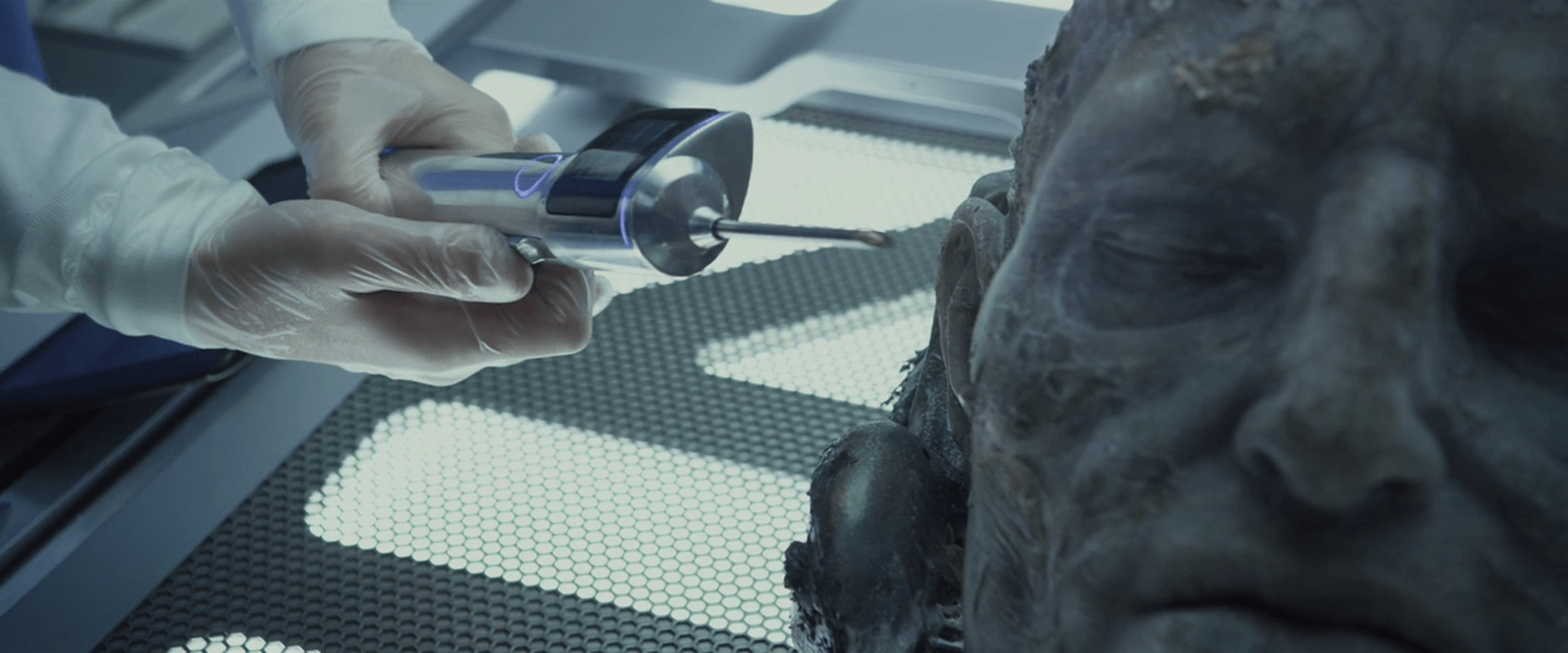
Using a tool that looks suspiciously identical to the Injection Carbon Reader, the stem line provides electrical current to nerve endings. It is inserted directly into the alien head and then controlled wirelessly via unseen controls on a nearby touch-sensitive slate pad.

Prometheus-168

The output on the stem line device animates with changes, but it seems the numbers appear near the middle and then slide to fixed positions on the top and bottom. If the point of the display was output, and it is meant to be seen from a distance, wouldn’t a simpler large-number display make more sense? If motion is meant to convey the meaning, like a digital gauge on a multimeter, then the text should be fixed on the graduated background and slide with it.

stemline

By stimulating the locus coeruleus of the alien, the Prometheus scientists seek to “trick it into thinking it’s still alive,” even though they have not confirmed the physiology of this 2000 year old alien specimen, or even that (in a quick Googling, the author learned that) this is the panic area of the nervous system. Were the results really that surprising?