

Where we are: To talk about how sci-fi AI attributes correlate, we first have to understand how their attributes are distributed. In the first distribution post, I presented the foundational distributions for sex and gender presentation across sci-fi AI. Today we’ll discuss embodiment.
As always, you can read the Gendered AI posts in order or check out the source data for more information.
Embodiment


Another simple measurement is how the AIs are embodied. That is, how to they manifest in the world of the story (or diegesis): Are they walking around, appearing as a screen on a wall, or as pulsing stars in the cosmos?
The categories that emerged from the survey were as follows:
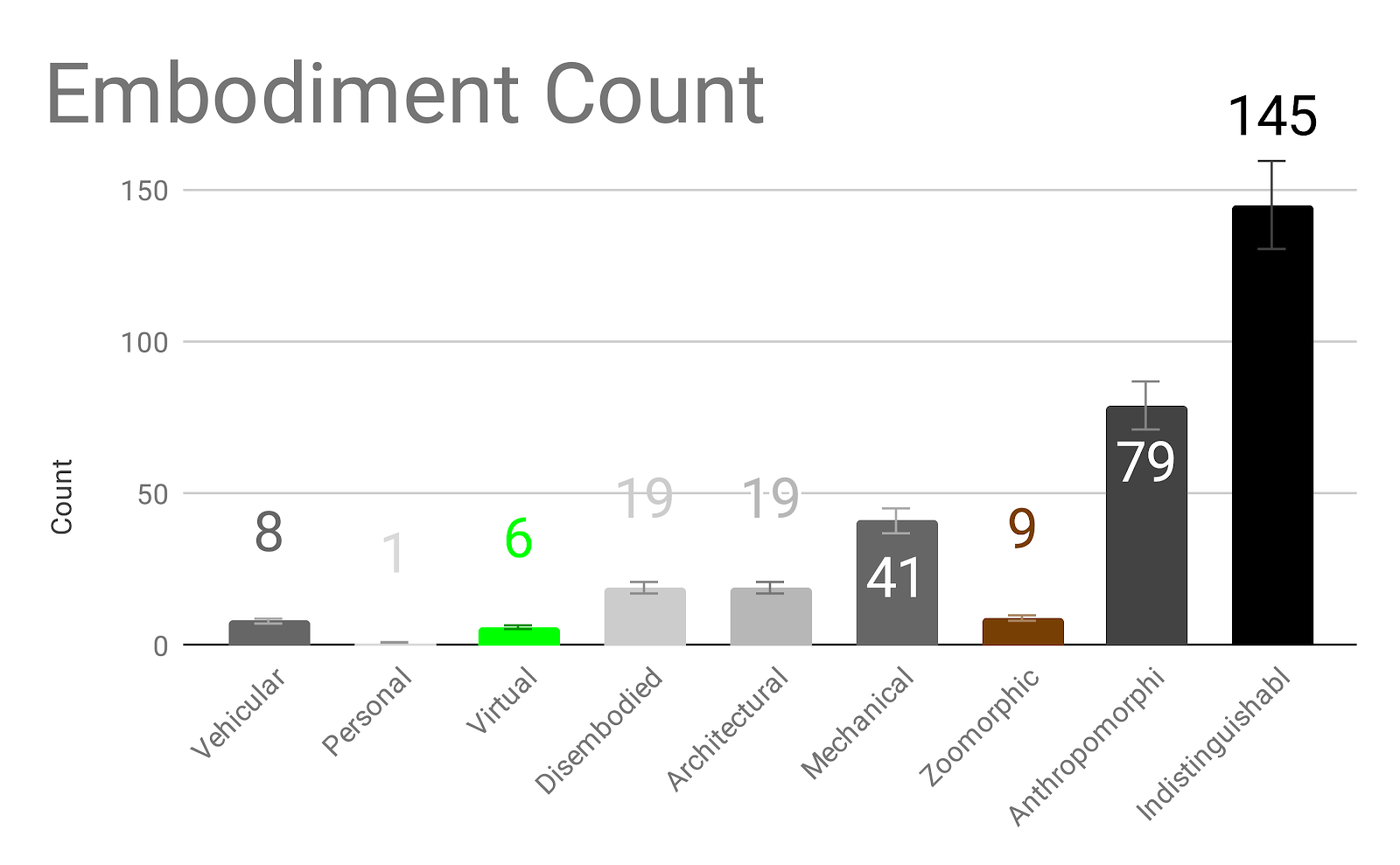
- Virtual, where a character only had, for example, a body or face that was generated for presentation to other characters on a screen or via volumetric projection. Joi from Blade Runner 2049 is virtual.
- Disembodied, if the AI doesn’t have a particular, or an ad-hoc embodiment. The Machine from Person of Interest is disembodied.
- Edgar from Electric Dreams is a Personal computer. In this regard, Edgar is a sui generis, or a category containing only one example.
- Architectural: Some AIs are stuck to the walls of a building. HAL 9000 from 2001: A Space Odyssey is architectural.
- Vehicular, where a character is embodied in a vehicle of some sort. K.I.T.T. from Knight Rider is vehicular.
- Zoomorphic robot, where the robot is built to look something like an animal. Often these characters do not have voice. Muffit from the original Battlestar Galactica television series is an example.
- Mechanical robot, where the robot is mechanical (and more mechanical looking than humanoid looking). WALL·E is mechanical.
- Anthropomorphic robot, where the robot is proportioned like a human, and has most all the surface features of a human, but is readily identifiable as a robot. The Iron Giant is anthropomorphic.
- Indistinguishable from human, where the robot can “pass” as a human. Only detailed or violent inspection will reveal it to be non-human. Aida from Agents of S.H.I.E.L.D. is indistinguishable from humans.
Here’s what that looks like in a bar chart.

Sometimes the details are tricksy
Sci-fi can make these things tricky. For example, the virtual crewmembers of the U.S.S. Callister might be considered indistinguishable from humans—as long as they are wearing clothes. Their unfortunate captain (and captor) had them created in virtual space such that they had no genitals. They are listed as bodily male and bodily female (rather than biologically) even though they are also indistinguishable from human.
Similarly, David from Prometheus has a fingerprint with a subtle Weyland-Yutani logo maker’s mark built into it (see the image below), but since this would only be apparent to someone who knew exactly where to look and for what, David is also listed as indistinguishable from human.


Why so human?
My conjecture to explain the high number of AIs that indistinguishable from human is threefold.
First, it is a matter of production convenience—that is, it is much easier and cheaper to insert a line of dialogue that establishes a character as a human-looking robot, rather than any of the other ways of signaling robotic-ness:
- Create a costume like Robbie the Robot
- Make a puppet like Teddy from A.I. Artificial Intelligence
- Do prosthetic makeup like The Terminator
- Create a set piece that syncs with audio like Alphy from Barbarella
- Produce special effects, like Ava from Ex Machina
There’s also a fit-to-media argument which notes that people are much better and more comfortable at reading the emotional states of people than they are of machines. If catharsis, or the emotional journey, is part of what the art is about, humans work as a medium. (This lack of emotional information in interfaces was played to great effect in 2001: A Space Odyssey, unnerving us with the psychopathy of HAL’s unblinking eye.) Actors, too (I highly suspect) enjoy using their bodies, voices, and faces to do their jobs without the additional layers of prosthetics or puppetry. So we would expect an overweighting of indistinguishable from humans because they are often the best tools for the narrative job, from both the audience’s and the actor’s perspective.

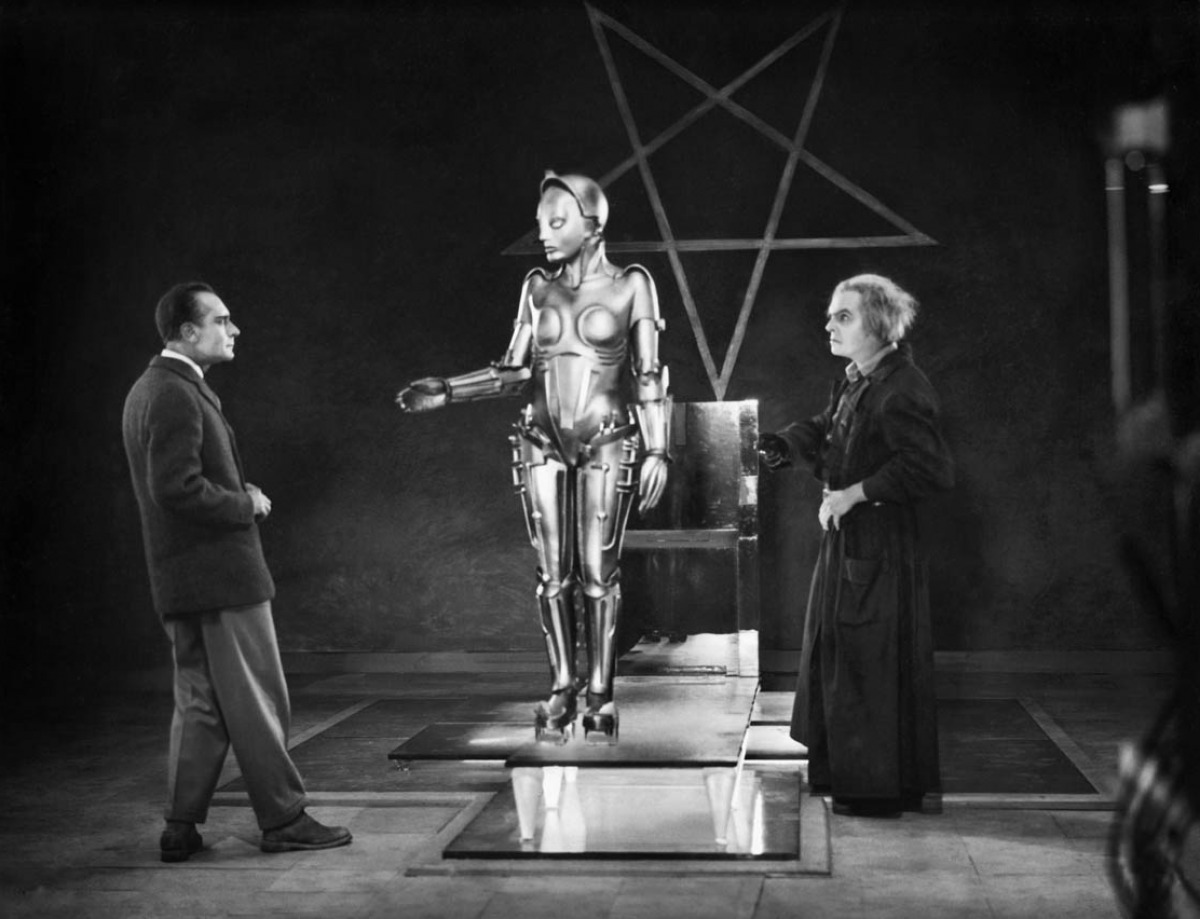
There’s another argument—a genre-and-narrative argument—that people are mostly interested in stories about people, and most sci-fi is a speculation about social effects rather than actual technology, and so indistinguishable robots are the best embodiment of what we’re interested in, anyway. Humans, just with different rules.
To riff on Daniel Mallory Ortberg’s “what if phones but too much”…
- What if humans, but smarter and faster and helpful?
- What if humans, but relentless indestructible assassins?
- What if humans, but their enslavement was “ok”?
- What if humans, but too much?