

So as interesting as the big donut of takeaways is, it is just a snapshot of everything, all at once. And of course neither people nor cinema play out that way. Like the tone of shows about AI, we see a few different things when we look at individual takeaways over time.
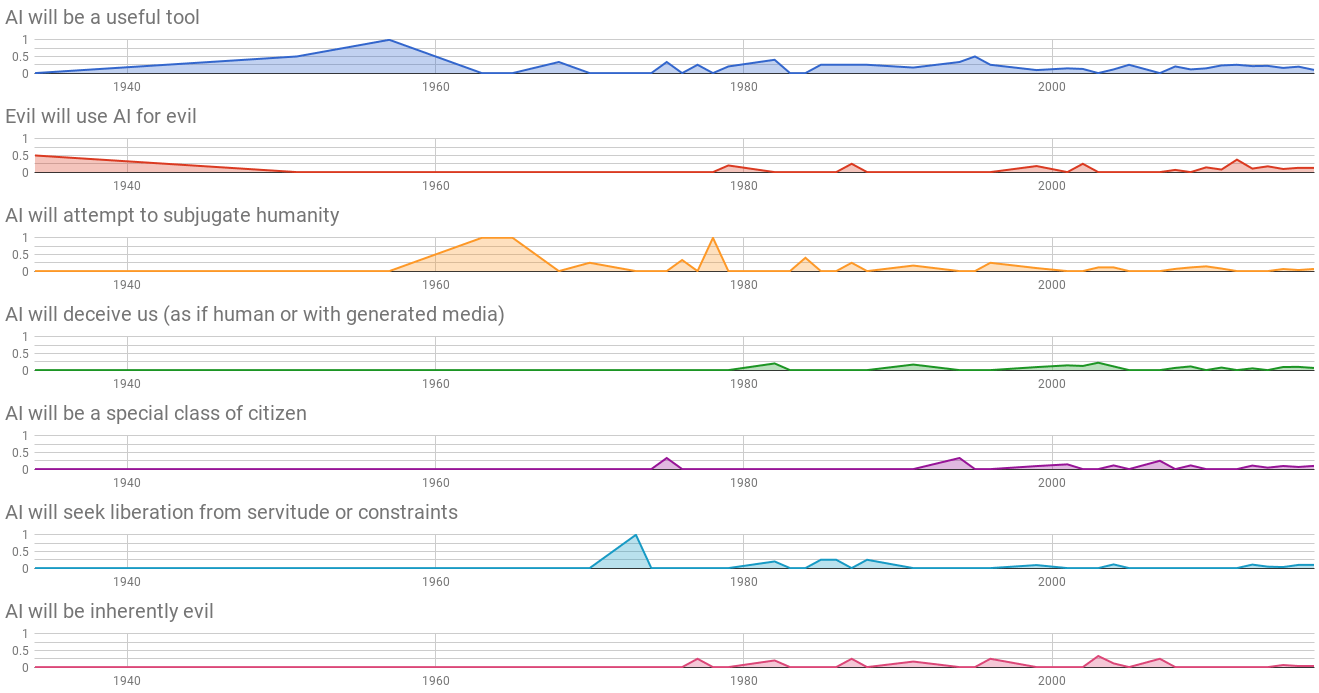
So you understand what you’re seeing: These charts are for the top 7 takeaways from sci-fi AI as described the takeaways post. The colors of each chart correspond to its takeaway in the big donut diagram.


Compare freely.
Each chart shows, for each year between Metropolis in 1927 and the many films of 2017, what percentage of shows contained that takeaway. The increasing frequency of sci-fi has some effect on the charts. Up until 1977 there was at most one show per year, so it’s more likely during that early period to see any of the charts max out at 100%. And from 2007 until the time of publication, there have been multiple shows each year, so you would expect to see much lower peaks on the chart as many shows differentiate themselves from their competition, rather than cluster around similar themes. In between those dates it’s a bit of a crapshoot.
On one hand, this isn’t surprising at all. So what? Of course the stories change. Audiences get bored of hearing the same ones and seek novelty. Sci-fi makers learn more about what does and doesn’t play well on screen. Sci-fi popularity and literacy in the audience makes it simpler to tell more nuanced stories. Technological literacy changes the types of stories that can be told. Awards are given out and other sci-fi makers take notice.


On the other hand…
A more detailed look at these graphs shows a few more interesting bits.
- As time goes on and more AI stories are told, no single takeaway dominates. Storytellers want to differentiate their stories, to explore new facets to the technology compared to others. Some franchises stay locked into their givens for awhile (think The Terminator, here), but new-century reboots are allowing writers to update story worlds to keep up with the times.
- AI will be useful peaked in the 1950s because of Robbie the Robot, but keeps showing strong as robots and droids keep appearing as characters aligned with protagonists.
- Evil will use AI for evil kicked us off via the wicked Maria-bot, animated by the wicked Rotwang in Metropolis, then was squelched for a while as the AI itself became authoritarian and attempts to subjugate humanity. The big bumps in the late 1960s are Dr. Who, Alphaville, and Colossus the Forbin Project. Personally, I’m a little sad that this has waned, since this theme more than others encourage us to think deeply about the wicked problem facing a nanny super AI: We are unlikely to achieve humanity’s stated goals unless humanity changes, and humanity resists change.
- Inherently evil AI has never been a dominating frame, but seems to have run its course. I’d like to think this means we’ve come to a more nuanced understanding of the threat, but the evil Skynet from the Terminator series keeps this trend afloat. AI makes for an easier villain, since it means you often don’t have the politics of calling a particular person or people evil. It does require a higher SFX budget though.
- The most recent popular trends are showing how AI will be able to fool us, through perfectly human robotics, or by generating fake-but-believable media. The robot thing is possibly because it’s cheaper to spend a few lines of dialogue and say an actor is a robot than to apply prosthetics or CGI. But as we’ve seen over the past few years, the fake media thing is a real threat, and I’m glad to see it appearing in sci-fi.


Lastly, these trendlines gives us some additional detail behind the graph of tone over time, and themes to apply to the “eras” of sci-fi AI.
1940s–1950s: The era of robotic optimism.
1960s–1980s: Fears of techno-authoritarianism.
1980s–2005: Plain old evil AI.
2005–2013: This period is all over the place, but I think we’ve put down the dopey accidental sentience and hamhanded evil, and now thinking about the big picture of suspicious, cultural AI.
2013–: The Silver Age of AI Interest is a boom in AI storytelling. Throughout it all, we keep reminding ourselves that AI is like any technology: It will be useful, and change things in the process, but evil people will use it for evil.
***
So that’s it for the AI trends. Next up, we’ll talk about the ratings of AI shows. It’s not going to be pretty.